
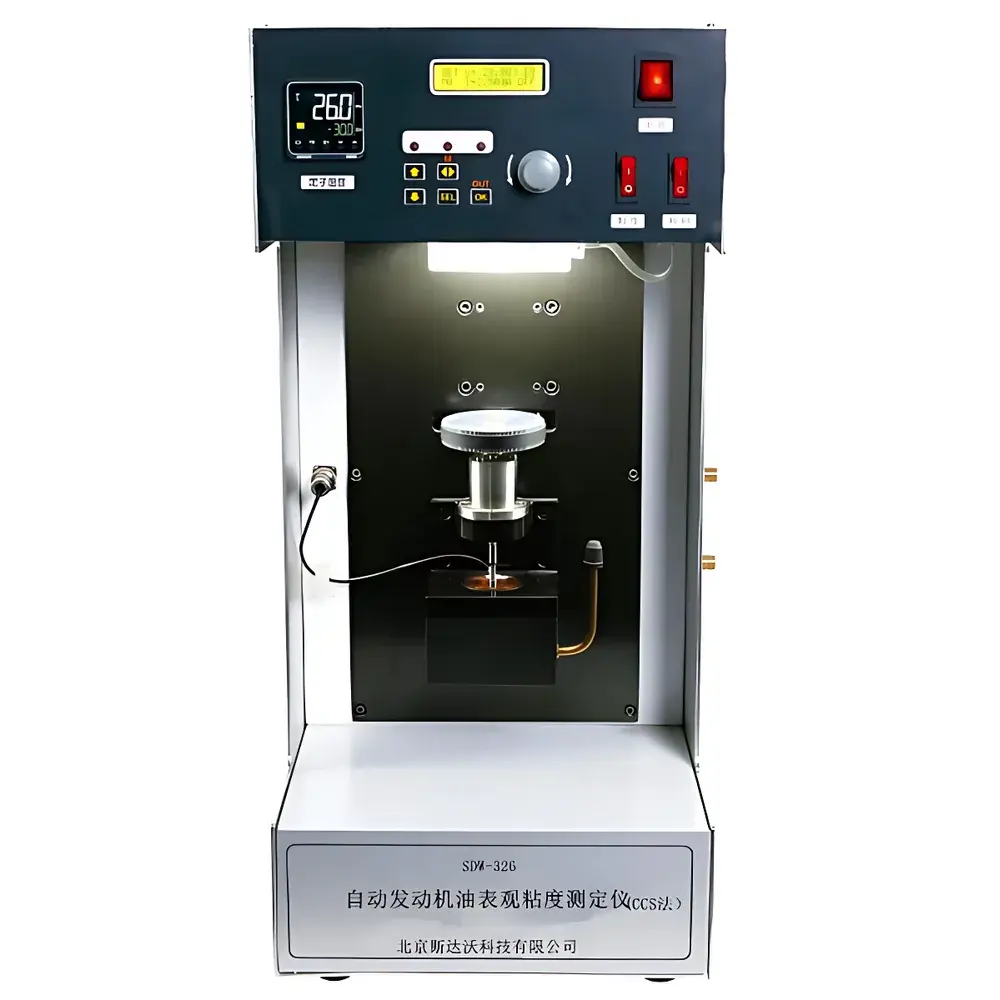
Starwood SDW-326 Engine Oil Apparent Viscosity Tester
| Brand | Starwood |
|---|---|
| Origin | Beijing, China |
| Manufacturer Type | Direct Manufacturer |
| Region of Origin | Domestic (China) |
| Model | SDW-326 |
| Pricing | Available Upon Request |
Overview
The Starwood SDW-326 Engine Oil Apparent Viscosity Tester is a precision-engineered rotational viscometer specifically designed for low-temperature apparent viscosity measurement of engine oils under high-shear conditions. It operates on the principle of controlled-shear-rate rotational rheometry in a cold-bath environment, conforming rigorously to ASTM D5293 (Standard Test Method for Low-Temperature Viscosity of Engine Oils Measured by Cold-Cranking Simulator) and GB/T 6538 (Chinese national standard equivalent). The instrument measures apparent viscosity in the range of 1200–27,000 mPa·s at shear rates between 10⁴ s⁻¹ and 10⁵ s⁻¹ and temperatures from –5 °C to –35 °C—conditions simulating cold-cranking resistance during engine startup. Its architecture integrates a thermally stabilized cooling bath, a motor-driven rotor-stator measurement system, real-time tachometric speed monitoring, and embedded multi-threaded control logic to ensure synchronized operation across thermal regulation, mechanical actuation, data acquisition, and computational analysis.
Key Features
- Automated multi-threaded control architecture enabling concurrent temperature regulation, rotational speed control, torque sensing, and viscosity computation without operator intervention.
- Fuzzy logic-based temperature control system delivering ±0.05 °C thermal stability over the operational range (–50 °C to +100 °C), with rapid response dynamics critical for maintaining ISO/ASTM-defined thermal ramp profiles.
- Dual-mode thermal management: integrated compressor-based refrigeration (–50 °C to ambient) and resistive heating (≤800 W), supporting precise cold-soak conditioning per ASTM D5293 Annex A1.
- PC-hosted control interface with native Windows-compatible software for method setup, real-time parameter visualization, curve-fitting algorithms (e.g., Casson or Walther-type extrapolation), and automated viscosity reporting.
- Onboard thermal printer compliant with GLP documentation requirements, providing timestamped, audit-ready hardcopy output of test parameters, raw torque/speed data, and final apparent viscosity values.
- Rugged mechanical design optimized for laboratory environments in petroleum refineries, OEM lubricant R&D centers, military fuel testing labs, and third-party certification bodies.
Sample Compatibility & Compliance
The SDW-326 is validated for use with SAE 0W–20 through 25W–40 multigrade engine oils, including formulations containing VI improvers, dispersants, and friction modifiers. It supports sample volumes of 35–40 mL in standardized cold-cranking simulator (CCS) cups. Instrument calibration and performance verification follow traceable procedures aligned with ISO/IEC 17025:2017 general requirements for competence of testing and calibration laboratories. All firmware and software modules comply with basic data integrity principles required under FDA 21 CFR Part 11 for electronic records and signatures, including user authentication, audit trail logging, and non-editable result export formats (CSV, PDF).
Software & Data Management
The proprietary SDW-326 Control Suite provides a deterministic, deterministic real-time operating environment for method definition, sequence scheduling, and post-acquisition analysis. Key capabilities include automatic detection of yield point onset via torque inflection analysis, dynamic adjustment of rotational acceleration profiles to maintain target shear rate, and polynomial curve fitting for viscosity–temperature interpolation. Data files are stored with embedded metadata (operator ID, instrument serial number, calibration date, environmental conditions) and support batch export for LIMS integration. Software update logs and configuration change history are retained for internal QA review and external audit readiness.
Applications
- Low-temperature pumpability and cranking simulation for API SP, CK-4, and FA-4 specification engine oils.
- Formulation development and QC screening of synthetic and semi-synthetic base stocks (PAO, ester blends) and additive packages.
- Compliance testing for OEM specifications (e.g., GM dexos1™ Gen 3, Ford WSS-M2C962-A, MB 229.71).
- Research into shear-thinning behavior and structural breakdown kinetics under transient cold-start conditions.
- Third-party certification for customs clearance and import regulatory submissions (e.g., CNCA, AQSIQ, EU REACH pre-registration).
FAQ
What standards does the SDW-326 fully support?
ASTM D5293 and GB/T 6538, including all procedural requirements for bath temperature equilibration time, rotor immersion depth, and shear rate validation.
Is drive current calibration required after initial installation?
Yes—drive current must be measured upon commissioning and monthly thereafter until variation remains below ±20 mA for three consecutive months, as specified in the maintenance protocol.
Can the instrument operate continuously at –40 °C ambient?
No—the recommended ambient operating range is –40 °C to +30 °C; however, the bath itself achieves –50 °C internally using its dedicated refrigeration subsystem.
Does the software support 21 CFR Part 11 compliance features?
It provides foundational elements including user-level access control, immutable result logs, and electronic signature capture—though full Part 11 validation requires site-specific IQ/OQ protocols conducted by the end user.
What is the maximum power draw during simultaneous cooling and heating cycles?
Total system consumption remains ≤2 kW, with refrigeration and heating subsystems operating in priority-controlled mode to prevent overload.






