
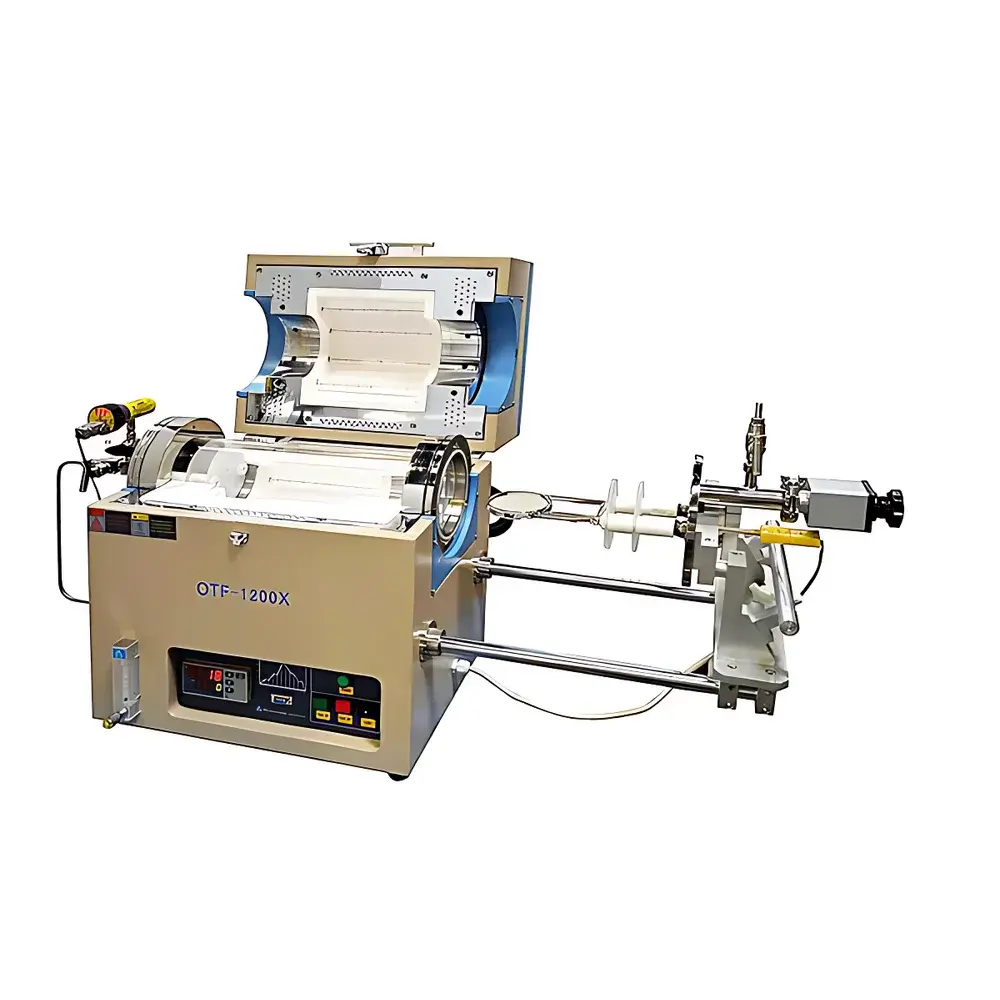
KJ Scientific OTF-1200X-4-RTP Rapid Thermal Processing Tube Furnace
| Brand | KJ Scientific |
|---|---|
| Origin | Anhui, China |
| Model | OTF-1200X-4-RTP |
| Maximum Temperature | 1200°C |
| Temperature Control Accuracy | ±1°C |
| Heating Rate | 50°C/s (RT to 800°C), 10°C/s (800–1000°C) |
| Cooling Rate | 60°C/min (at 200 mtorr), 117°C/min (at atmospheric pressure) |
| Heating Zone | 12" length with 4" × 12" uniformity zone (±5°C) |
| Chamber Dimensions | 4.33" O.D. × 4.05" I.D. × 15" L |
| Power Supply | 208–240 V AC, 50/60 Hz, single-phase, 12 kW |
| Weight | 45 kg |
| Certifications | CE, UL/MET/CSA compliant (>24 V components), TUV/CAS optional |
Overview
The KJ Scientific OTF-1200X-4-RTP is a compact, high-performance rapid thermal processing (RTP) tube furnace engineered for precise, repeatable annealing of semiconductor wafers, photovoltaic substrates, and thin-film devices up to 3 inches in diameter. Unlike conventional resistance-heated furnaces, this system employs eight high-intensity infrared (IR) lamps (Ø10 mm × 300 mm) to deliver localized, non-contact heating—enabling ultra-fast thermal transients essential for dopant activation, oxide growth, silicide formation, and defect passivation without bulk thermal stress. The furnace operates on the principle of radiative heat transfer within a sealed quartz reaction chamber, where temperature uniformity is maintained via an aluminum nitride (AlN) sample holder (3″ diameter) mounted on a sliding KF-25 vacuum flange. AlN’s exceptional thermal conductivity (~170 W/m·K) ensures lateral temperature homogeneity of ±5°C across the wafer surface during ramp-and-soak cycles. The dual-layer mullite-insulated steel housing—coated internally with US-sourced high-emissivity alumina—enhances thermal efficiency while minimizing external surface temperatures and extending structural service life.
Key Features
- 30-segment programmable PID temperature controller with auto-tuning, over-temperature cutoff, and thermocouple break protection
- K-type thermocouple embedded directly beneath the AlN substrate for real-time, contact-critical measurement at the sample plane
- Integrated digital vacuum gauge (10 mtorr–800 torr range, N₂/air calibrated); optional corrosion-resistant variant (3.8×10⁻⁵–1125 torr) eliminates gas-specific correction factors
- KF-25 stainless-steel vacuum flange with dual high-temperature Viton® O-rings; sliding configuration enables rapid, contamination-free sample loading/unloading
- RS485 communication interface compatible with third-party SCADA systems and KJ-supplied PC-based control software for full-cycle logging, curve replay, and remote monitoring
- Configurable cooling options: forced convection or recirculating chiller (≥3 L/min flow, 25 PSI pressure) to achieve controlled quench rates below 10°C/s
- Modular design supports retrofitting into rapid thermal evaporation (RTE) mode using SiC-coated graphite crucibles (sold separately)
Sample Compatibility & Compliance
The OTF-1200X-4-RTP accommodates standard 3-inch wafers, glass substrates, ceramic coupons, and metal foils. Its quartz tube (4.05″ I.D., 15″ length) is rated for continuous operation ≤1100°C; extended exposure above 1000°C under vacuum is prohibited to prevent O-ring degradation (maximum dwell time: 600 s at 1000–1100°C). Gas flow is restricted to ≤200 SCCM to avoid thermal shock to the quartz envelope. All electrical subsystems comply with CE directives and UL/MET/CSA safety standards for industrial equipment (>24 V). Optional TÜV Rheinland or CSA certification is available upon customer request and fee coverage. The system supports GLP/GMP-aligned workflows through audit-trail-capable software logging (time-stamped setpoints, actual readings, alarms), though native 21 CFR Part 11 compliance requires supplemental validation protocols.
Software & Data Management
Control is executed via a Windows-compatible application that provides real-time graphing of multiple thermocouple inputs, programmable ramp/soak profiles, and exportable CSV data files. The RS485 interface supports Modbus RTU protocol for integration into centralized lab automation networks. Firmware updates are delivered via USB; no cloud dependency or proprietary dongles are required. All temperature logs include metadata (date/time, operator ID if entered, program name, ambient conditions), satisfying basic traceability requirements for QC laboratories. Raw data retention is limited only by host storage capacity; no proprietary file formats are used.
Applications
This RTP furnace is routinely deployed in academic microfabrication labs and R&D centers for process development in silicon photonics, perovskite solar cell fabrication, MEMS release annealing, and atomic layer deposition (ALD) precursor activation. It meets ASTM F1953 (Standard Practice for Rapid Thermal Annealing of Silicon Wafers) and ISO 14644-1 cleanroom compatibility guidelines when operated inside laminar flow hoods. Typical use cases include: low-thermal-budget dopant drive-in for shallow junctions; post-deposition annealing of TiO₂, ZnO, or NiOₓ layers; crystallization of amorphous Si films; and thermal desorption spectroscopy (TDS) sample preparation under controlled partial pressures.
FAQ
What is the maximum recommended operating temperature for continuous use?
Continuous operation is rated to 1000°C; short-duration excursions to 1200°C are permitted only for calibration or qualification runs, not routine processing.
Can this furnace be used under high vacuum (e.g., 10⁻⁴ torr)?
Yes—when paired with a turbomolecular pump, the KF-25 flange achieves base pressures down to 10⁻⁴ torr; however, IR lamp emissivity and thermal coupling degrade below 10⁻² torr, requiring empirical recalibration.
Is the quartz tube included with the system?
Yes—the furnace ships with one 4.33″ O.D. × 4.05″ I.D. × 15″ fused silica tube and a matching 3″ AlN sample holder.
Does the system support inert gas purging during heating?
Yes—integrated mass flow controllers (16–160 mL/min range) enable precise N₂, Ar, or forming gas introduction; all gas lines must be fitted with certified pressure regulators (0.01–0.1 MPa range recommended).
What maintenance intervals are recommended for consumables?
IR lamps: inspect every 200 h, replace after 1000 h or visible filament deformation; O-rings: replace annually or after any vacuum breach exceeding 0.02 MPa; quartz tube: inspect for devitrification before each run above 900°C.



