
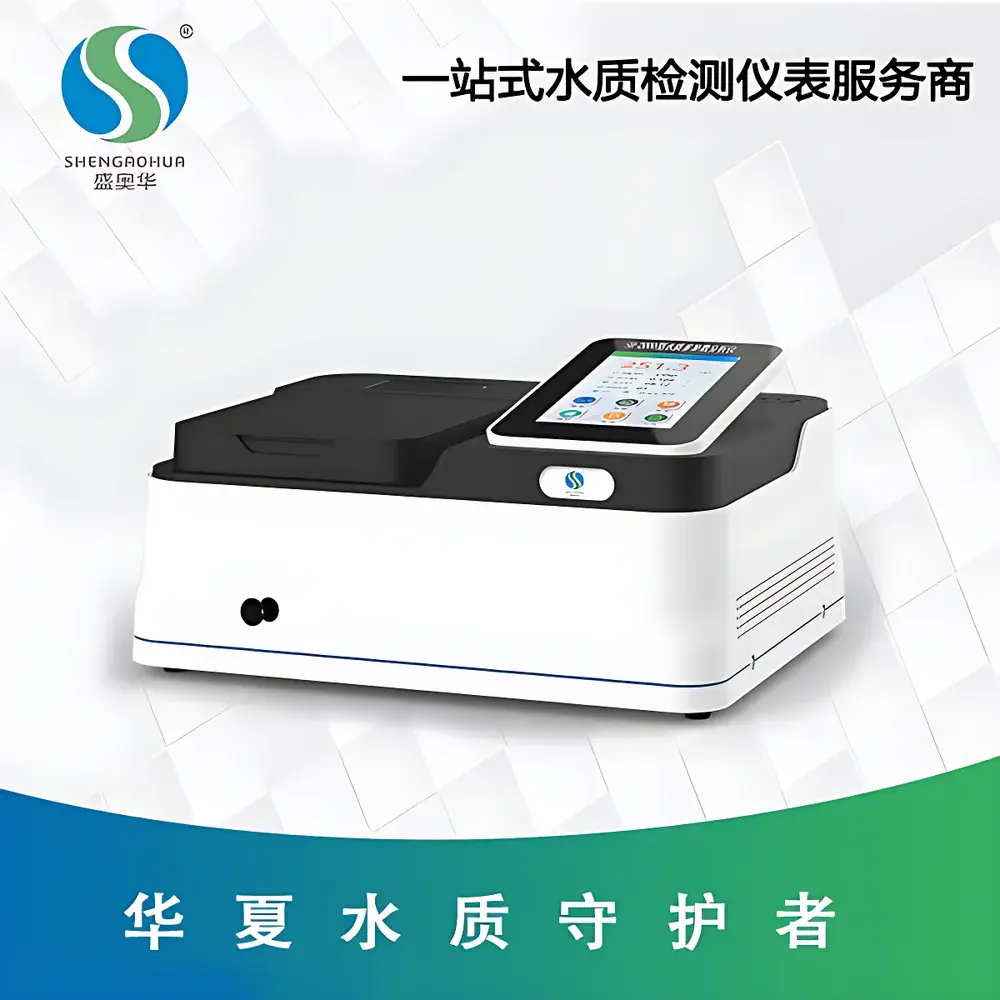
Shengaohua SH-2000 Multi-Parameter Water Quality Analyzer
| Brand | Shengaohua |
|---|---|
| Origin | Jiangsu, China |
| Manufacturer Type | Manufacturer |
| Product Category | Domestic |
| Model | SH-2000 |
| Instrument Type | Laboratory Water Quality Analyzer |
| Measurable Parameters | COD, Ammonia Nitrogen, Total Phosphorus, Total Nitrogen, Turbidity, Heavy Metals (e.g., Cu, Fe, Zn, Ni, Ag, Mn, Cr, Cr⁶⁺), Color, Suspended Solids, Sulfide, Silicate, Residual Chlorine, Total Chlorine, Formaldehyde, Cyanide, Phosphate, Benzidine, Phenol, Permanganate Index, Nitrate-N (UV & Vis), Nitrite-N, Sulfate, Fluoride, Ozone, Chlorine Dioxide, Hardness, etc. |
| Wavelength Range | 190–1100 nm ±1 nm |
| Wavelength Accuracy | ±1 nm (auto-calibrated) |
| Spectral Bandwidth | 2 nm |
| Measurement Error | ≤±5% |
| Repeatability | ±5% |
| Photometric Stability | ≤±0.005 A/20 min |
| Digestion Temperatures | 165 °C / 123 °C ±0.5 °C |
| Digestion Times | 10 min / 30 min |
| Sample Capacity | 30 samples/batch |
| Chloride Interference Tolerance | Cl⁻ < 1200 mg/L (standard) |
| Power Supply | AC 220 V ±10%, 50 Hz |
| Dimensions | 360 × 280 × 100 mm |
| Net Weight | 3 kg |
| Interface | USB |
| Data Storage | Built-in high-capacity TF card (≥10 years’ logging capacity) |
| Display | 7-inch capacitive color touchscreen |
| Light Sources | Independently controlled tungsten and deuterium lamps |
| Preloaded Calibration Curves | 680 standard curves + user-definable curve library |
| Output | Integrated thermal printer |
| Software Compatibility | LIMS integration via documented communication protocol (ASCII/Modbus RTU over USB) |
| Regulatory Alignment | Designed for compliance with ISO 7027 (turbidity), ISO 6060 (COD), ISO 7150-1 (ammonia nitrogen), ISO 11908 (total phosphorus), USP <643>, EPA Methods 410.4, 365.4, 353.2, and GLP/GMP data integrity requirements (audit trail, user access control, electronic signature readiness) |
Overview
The Shengaohua SH-2000 Multi-Parameter Water Quality Analyzer is a laboratory-grade spectrophotometric platform engineered for precise, standardized quantification of over 35 water quality parameters—including chemical oxygen demand (COD), ammonia nitrogen (NH₃-N), total phosphorus (TP), total nitrogen (TN), turbidity, heavy metals, and organic contaminants—using validated colorimetric, photometric, and UV-Vis absorption methodologies. It operates on the principle of Beer-Lambert law-based absorbance measurement across a broad spectral range (190–1100 nm), supported by dual light sources (tungsten lamp for visible region; deuterium lamp for UV region) and automated wavelength selection. The system integrates sample digestion, optical detection, data processing, and reporting into a single compact unit, enabling full method compliance with international standards such as ISO 6060 (COD dichromate method), ISO 7150-1 (indophenol blue for NH₃-N), ISO 11908 (ascorbic acid molybdenum blue for TP), and EPA-approved protocols for metal speciation and disinfection byproduct analysis.
Key Features
- 7-inch capacitive color touchscreen with intuitive Chinese/English bilingual interface, supporting both gesture navigation and physical key input for glove-compatible operation in lab environments.
- Dual-zone digestion block (165 °C and 123 °C, ±0.5 °C accuracy) allows simultaneous processing of two distinct reaction protocols—e.g., high-temperature COD digestion and low-temperature ammonia nitrogen determination—reducing batch turnaround time by up to 40%.
- Automated wavelength calibration at startup ensures long-term photometric fidelity; spectral bandwidth fixed at 2 nm for optimal resolution between overlapping absorption peaks (e.g., nitrate vs. nitrite in UV region).
- Independent on/off control of tungsten and deuterium lamps extends deuterium lamp service life beyond 1,000 hours while maintaining stable baseline performance (photometric drift ≤ ±0.005 A over 20 min).
- Built-in thermal printer supports immediate hardcopy output of results with timestamp, operator ID, method ID, and QC flagging—fully traceable per GLP documentation requirements.
- Preloaded library of 680 certified calibration curves aligned with national and international standard methods; users may store, name, version-control, and recall custom curves with one-touch access.
- Internal TF card provides encrypted, tamper-evident storage for ≥10 years of raw absorbance values, calculated concentrations, digestion logs, calibration history, and user audit trails.
Sample Compatibility & Compliance
The SH-2000 accommodates standard 10-mm and 20-mm square cuvettes (including quartz for UV applications) and accepts pre-filled disposable reaction tubes compatible with Shengaohua’s solid-phase reagent kits—minimizing pipetting errors and exposure to hazardous reagents (e.g., concentrated H₂SO₄, K₂Cr₂O₇). Its chloride tolerance (up to 4000 mg/L Cl⁻ with matrix-matched correction) enables direct analysis of saline wastewater, estuarine samples, and industrial effluents without dilution. All optical measurements adhere to ISO/IEC 17025 validation principles; instrument verification includes wavelength accuracy (NIST-traceable holmium oxide filter), photometric linearity (neutral density filters), and repeatability assessment per ISO 8466-1. The system supports 21 CFR Part 11–ready configurations when deployed with optional LIMS middleware, including role-based access control, electronic signatures, and immutable audit logs.
Software & Data Management
Data acquisition, processing, and export are managed through an embedded Linux-based firmware with real-time visualization of absorbance spectra, kinetic reaction profiles, and calibration diagnostics. Results are stored in CSV and XML formats with embedded metadata (sample ID, operator, date/time, method version, instrument serial number). USB host interface enables direct transfer to Windows/Linux PCs; open ASCII/Modbus RTU communication protocol facilitates seamless integration with enterprise LIMS platforms (e.g., LabVantage, Thermo Fisher SampleManager, or custom SQL-based systems). Firmware updates are performed via USB drive with SHA-256 checksum validation. All data entries include automatic timestamping and user authentication—supporting full ALCOA+ (Attributable, Legible, Contemporaneous, Original, Accurate, Complete, Consistent, Enduring, Available) compliance for regulated laboratories.
Applications
The SH-2000 serves environmental monitoring labs, municipal water treatment facilities, industrial QA/QC departments, academic research groups, and third-party testing organizations. Typical use cases include: routine compliance monitoring of discharge permits (NPDES, EU WFD); source water characterization for drinking water treatment optimization; nutrient loading assessment in eutrophication studies; heavy metal screening in electroplating and mining effluents; and method validation for ISO/IEC 17025 accreditation. Its modular design supports rapid reconfiguration between regulatory methods—e.g., switching from EPA Method 365.4 (total phosphorus) to ISO 11908 within minutes—and maintains metrological continuity across multi-year longitudinal datasets.
FAQ
Does the SH-2000 support remote data retrieval or cloud synchronization?
No native cloud connectivity is provided; however, exported CSV/XML files can be ingested into cloud-based LIMS or ELN platforms via scheduled USB transfers or network-mounted drives.
Can third-party reagents be used with the SH-2000?
Yes—provided they conform to the same reaction chemistry, cuvette geometry, and absorbance range specified in the corresponding standard method. Performance validation against Shengaohua-certified reagents is strongly recommended.
Is the digestion block compliant with ISO 8692 for reproducible heating profiles?
The dual-zone block meets ISO 8692 temperature uniformity criteria (±0.5 °C across all positions) under steady-state conditions; thermal mapping reports are available upon request.
How is data integrity ensured during power interruption?
All measurements are written to non-volatile memory before display; the system performs automatic recovery upon reboot, preserving incomplete batches and audit trail continuity.
What maintenance intervals are recommended for optical alignment and lamp replacement?
Deuterium lamp replacement is advised every 1,000 operating hours; tungsten lamp every 5,000 hours. Optical path cleaning and wavelength verification should occur quarterly or after 200 digestion cycles—documented in the built-in maintenance log.
Related Products







