
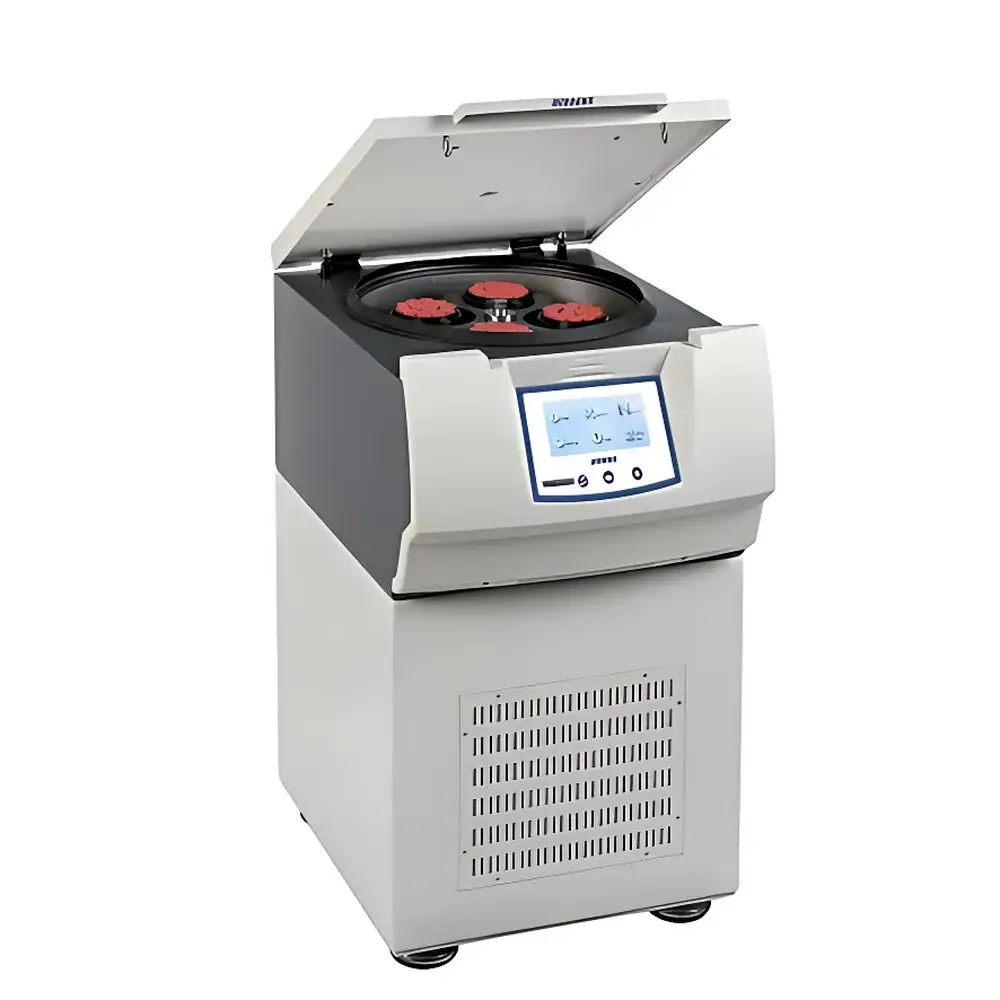
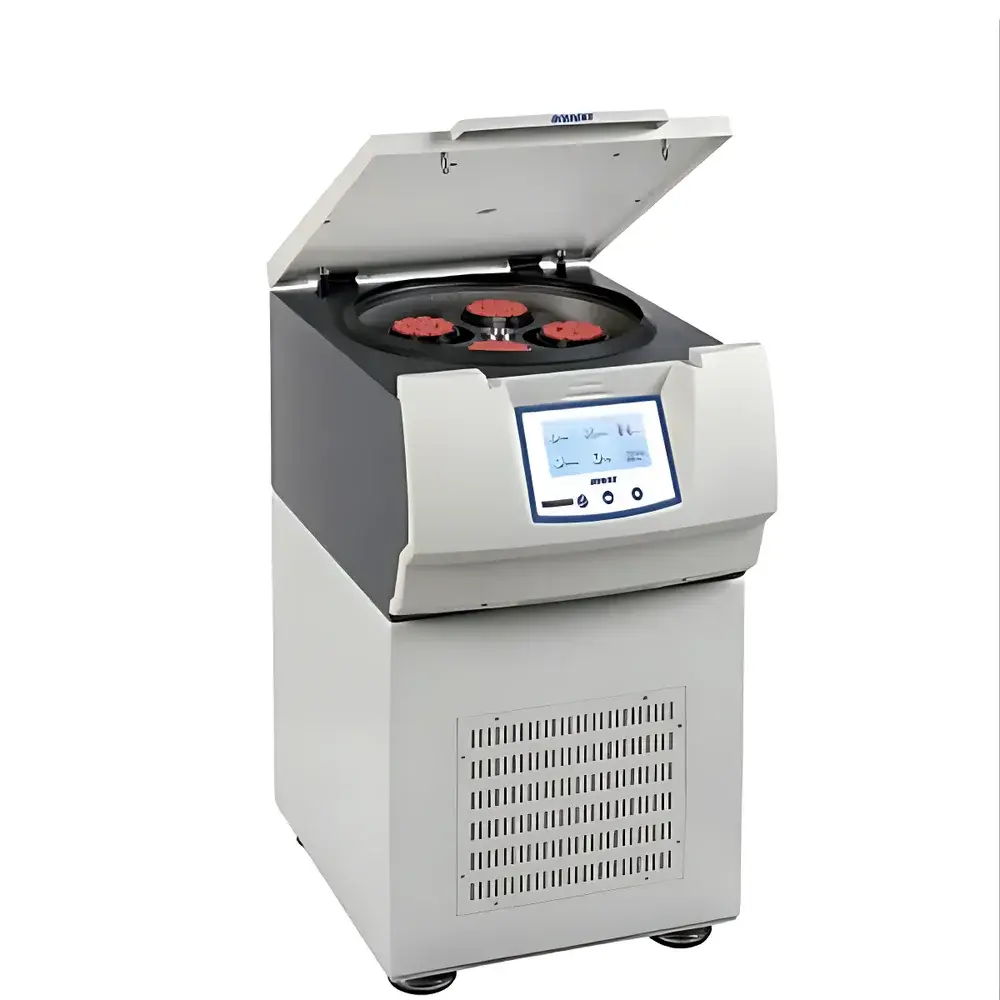
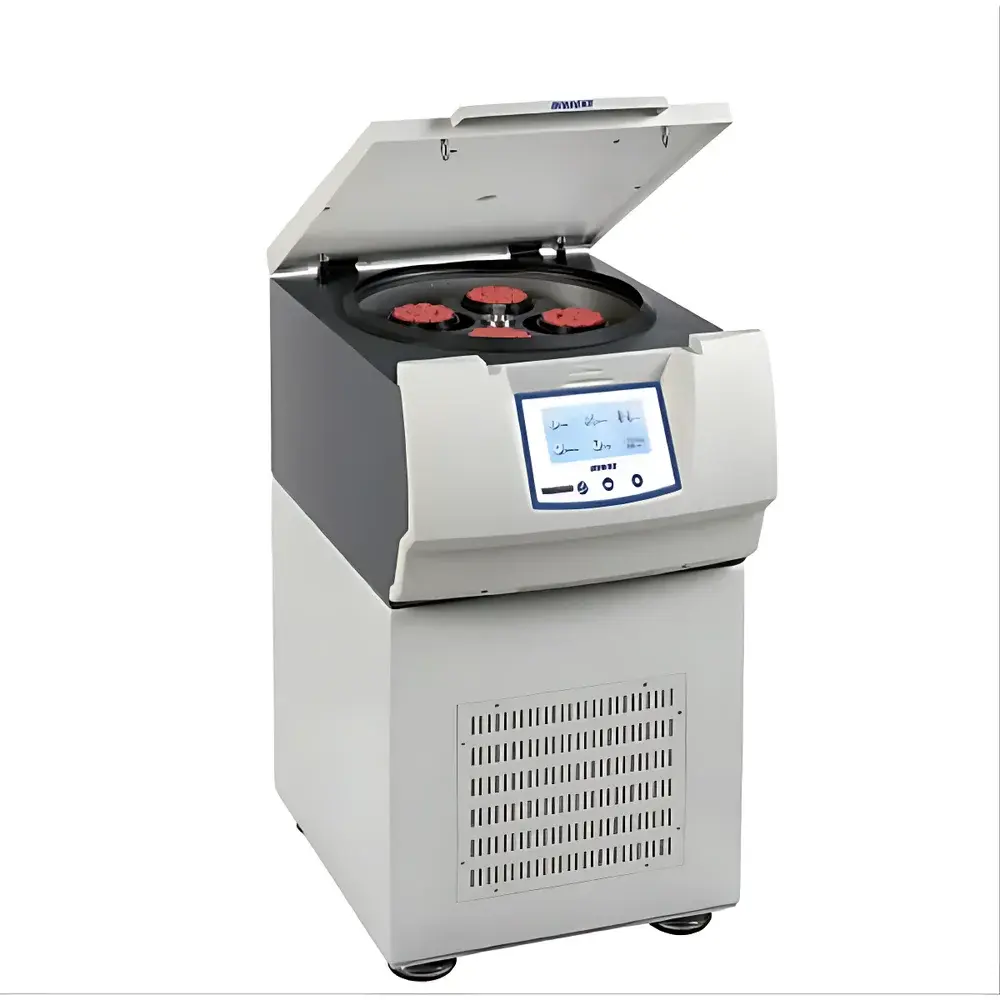
WIGGENS MAGNUS 22 Floor-standing High-Capacity Centrifuge
| Brand | WIGGENS |
|---|---|
| Origin | Germany |
| Model | MAGNUS 22 |
| Instrument Type | Floor-standing Centrifuge |
| Maximum Capacity | 4 × 750 mL |
| Maximum Speed | 14,300 rpm |
| Maximum RCF | 21,948 × g |
| Rotor Type | Horizontal (Swinging-Bucket) |
| Acceleration/Deceleration Control | Programmable PCBS with 175 selectable ramp profiles |
| Unbalance Detection | ULS (Unbalance Location System) with positional identification |
| Display | TFT color touchscreen (≥3 m visibility) |
| Timer Range | 1 s to 99 h, programmable in 1 s increments |
| Noise Level | <60 dB(A) |
| Motor | Brushless, maintenance-free |
| Compliance | EN 61010-1, EN 61010-2-020, EN 61326-1, EN 61326-2-6 |
| EU Directives | 2011/65/EU (RoHS), 2012/19/EU (WEEE), 2014/30/EU (EMC), 2014/35/EU (LVD), 98/79/EC (IVDR) |
Overview
The WIGGENS MAGNUS 22 is a high-performance floor-standing centrifuge engineered for demanding routine and research applications requiring large-volume processing with precision, safety, and operational traceability. Utilizing horizontal (swinging-bucket) rotor architecture, it operates on the principle of sedimentation under controlled gravitational force (RCF), enabling efficient separation of heterogeneous mixtures—including cell suspensions, serum, plasma, bacterial cultures, and particulate-laden solutions—based on density, size, and shape differentials. With a maximum capacity of 4 × 750 mL and an RCF ceiling of 21,948 × g at 14,300 rpm, the MAGNUS 22 bridges the functional gap between benchtop and industrial-scale centrifugation while maintaining laboratory-grade reproducibility and regulatory readiness. Its robust steel chassis, stainless-steel centrifuge chamber, and thermally managed airflow system ensure long-term mechanical stability and minimal sample temperature drift during extended runs—critical for heat-sensitive biological specimens.
Key Features
- Intuitive 7-inch TFT color touchscreen with ≥3 m viewing distance, displaying real-time rpm, RCF, elapsed time, acceleration/deceleration status, and system alerts
- ULS (Unbalance Location System): Automatically identifies and displays the exact angular position (e.g., “Bucket #3”) of imbalance during rotor spin-up, eliminating trial-and-error rebalancing
- PCBS (Programmable Controlled Braking & Acceleration System): Offers 175 user-selectable acceleration and deceleration ramp profiles to prevent resuspension of pelleted material and preserve gradient integrity
- Real-time RCF calculation dynamically adjusted for actual rotor and adapter configuration—no manual conversion required
- 40 programmable protocols with password protection; supports multi-step programs including hold, pause, and automatic lid opening post-run
- Dual mechanical + electromagnetic lid lock with emergency manual release, anti-drop hinge, and transparent observation window for real-time process verification
- Automatic rotor recognition and overspeed protection compliant with EN 61010-2-020 safety requirements
- Brushless DC motor with zero maintenance intervals and integrated thermal monitoring for sustained duty-cycle reliability
- Stainless-steel chamber and autoclavable rotors/adapters (121°C, 20 min) supporting GLP/GMP-compliant cleaning validation
Sample Compatibility & Compliance
The MAGNUS 22 accommodates a broad range of primary containers: standard conical tubes (15–50 mL), microtiter plates (96-well, 384-well), cell culture flasks (T75, T175), and custom 750 mL bottles—all secured via certified swinging-bucket rotors with interchangeable adapters. All rotor assemblies are CE-marked and validated per ISO 13485 design controls where applicable. The instrument meets essential safety and electromagnetic compatibility requirements outlined in EN 61010-1 (electrical safety), EN 61010-2-020 (particular safety for centrifuges), EN 61326-1/-2-6 (EMC for laboratory equipment), and relevant EU directives including RoHS, WEEE, LVD, EMC, and IVDR. It supports audit-ready operation under FDA 21 CFR Part 11 when integrated with validated LIMS or ELN platforms via RS232/USB data export.
Software & Data Management
While the MAGNUS 22 operates as a standalone instrument, its embedded firmware enables full parameter logging—including start/stop timestamps, final RCF, total run time, rotor ID, and unbalance events—with non-volatile memory retention. All 40 stored protocols retain metadata (user ID, date/time of creation/modification) and support export via USB to CSV format for external analysis or QA documentation. The system records up to 1,000 recent run logs with timestamped event sequences (e.g., “Lid opened at 14:22:08”, “RCF reached target at 14:23:15”), fulfilling traceability requirements aligned with ISO/IEC 17025 and GLP Annex 3. Optional WIGGENS CentriLink software (sold separately) provides remote monitoring, centralized protocol deployment, and PDF report generation with digital signature capability.
Applications
- Biopharmaceutical QC: Clarification of monoclonal antibody harvests, buffer exchange of protein formulations, and residual host-cell DNA removal
- Clinical diagnostics: Serum/plasma separation from whole blood prior to immunoassay or molecular testing
- Cell biology: Harvesting adherent and suspension mammalian cells, isolation of extracellular vesicles (EVs), and organelle fractionation
- Environmental microbiology: Concentration of waterborne pathogens (e.g., Legionella, Cryptosporidium) from large-volume samples
- Food & beverage testing: Fat separation in milk homogenates, yeast pellet recovery in fermentation monitoring, and allergen extraction validation
- Academic research: Scalable preparative centrifugation for cryopreservation workflows, nanoparticle purification, and polymer solution characterization
FAQ
What rotor configurations are certified for use with the MAGNUS 22?
The MAGNUS 22 is validated exclusively with WIGGENS-certified horizontal rotors—including the 4 × 750 mL bucket rotor (Cat. No. WIG-ROTOR-HB750), 12 × 50 mL rotor (WIG-ROTOR-HB50), and 32 × 15 mL rotor (WIG-ROTOR-HB15)—all supplied with individual calibration certificates and autoclave validation reports.
Does the MAGNUS 22 support 21 CFR Part 11 compliance?
Yes—when operated with WIGGENS CentriLink software (v3.2+), the system implements electronic signatures, audit trails, and role-based access control meeting FDA 21 CFR Part 11 Subpart B requirements for closed systems.
Can I run temperature-sensitive samples without active refrigeration?
The MAGNUS 22 lacks a compressor-based cooling system but incorporates forced-air thermal management that limits internal temperature rise to ≤3°C above ambient over a 30-minute 14,300 rpm run—suitable for short-duration protocols with pre-chilled samples and rotors.
Is rotor balancing mandatory before every run?
No—the ULS system continuously monitors mass distribution during acceleration and will halt operation if imbalance exceeds EN 61010-2-020 thresholds (≤5 g difference between opposing buckets); however, gross imbalance detection does not replace proper manual balancing for optimal bearing life and noise performance.
How is firmware updated, and is version history documented?
Firmware updates are delivered via encrypted USB stick with SHA-256 checksum verification; each release includes a formal change log referencing IEC 62304 software lifecycle compliance and traceable to WIGGENS’ internal revision control system (Revision ID, date, test summary).



