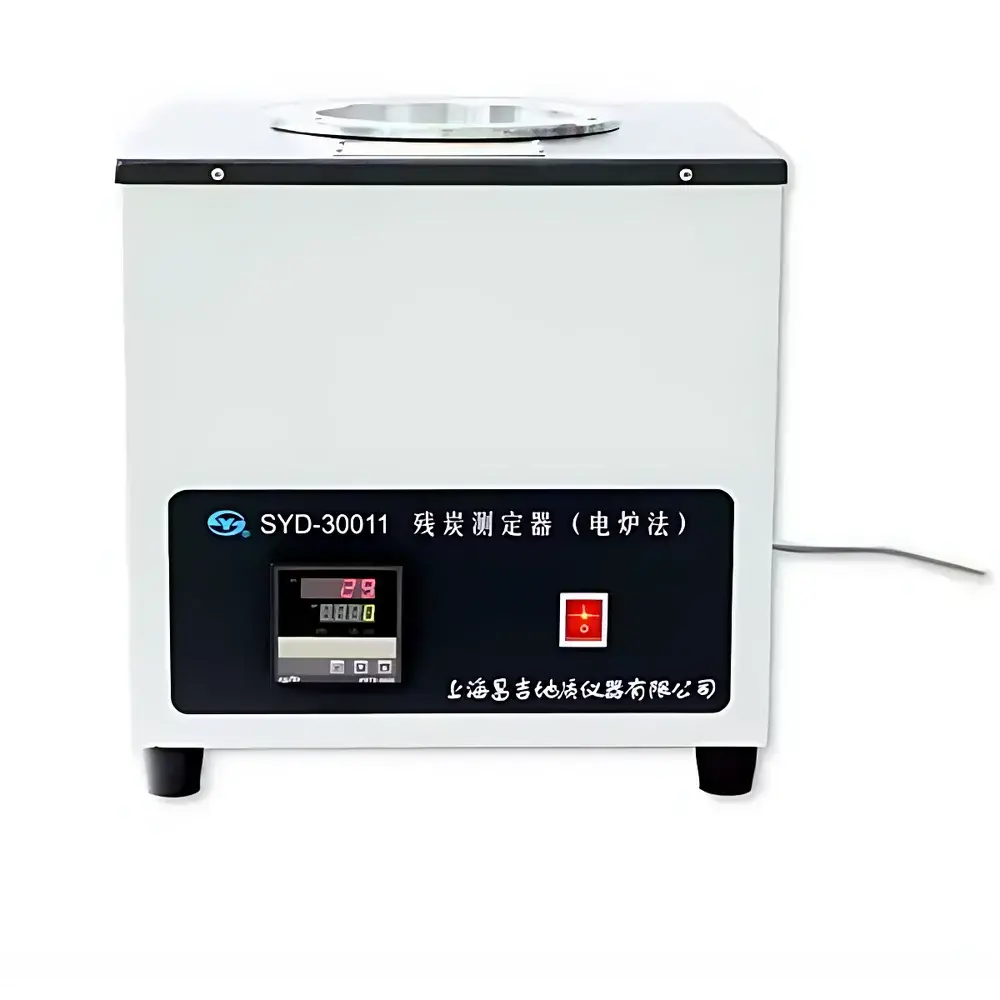
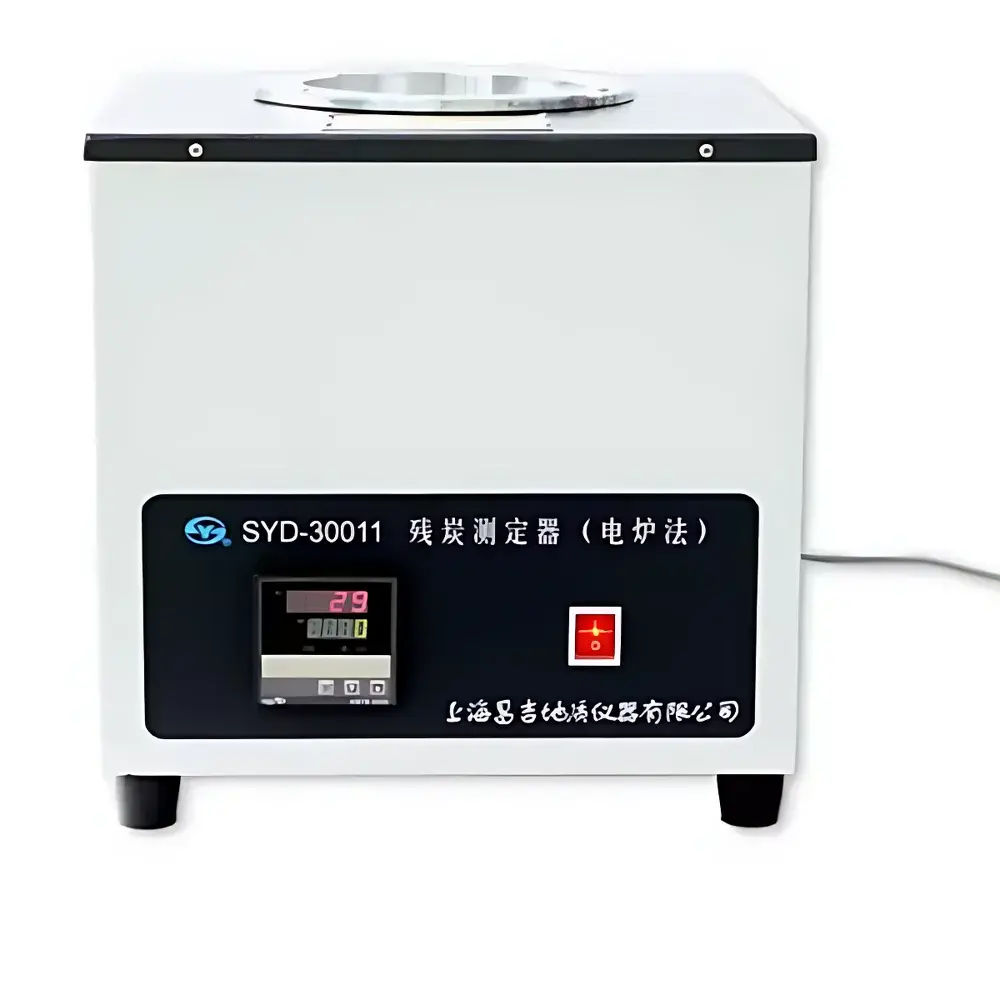
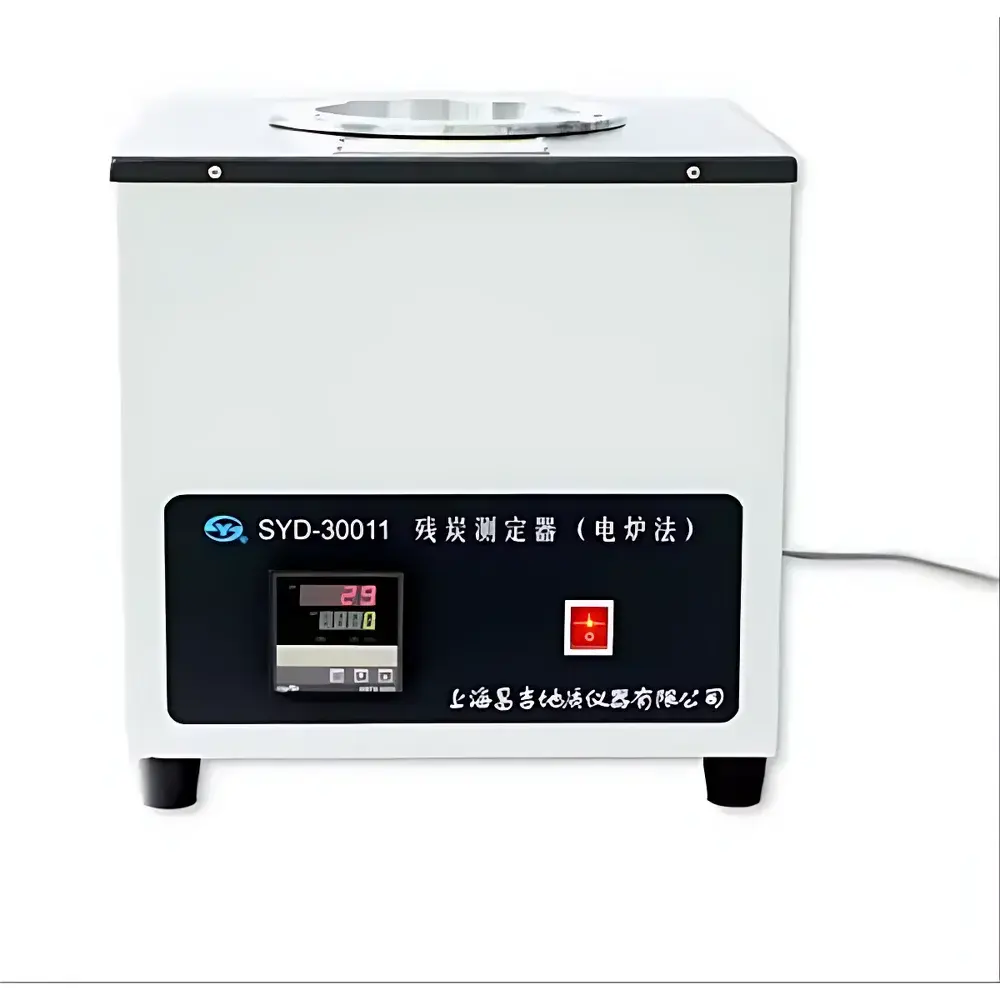
Changji Instruments SYD-30011 Conradson Carbon Residue Tester (Electric Furnace Method)
| Brand | Changji Instruments |
|---|---|
| Origin | Shanghai, China |
| Model | SYD-30011 |
| Power Supply | AC 220 V ±10%, 50 Hz |
| Temperature Range | 0–520 °C |
| Temperature Control Accuracy | ±5 °C |
| Sample Capacity | 4 positions |
| Dimensions (L×W×H) | 600 mm × 260 mm × 550 mm |
| Net Weight | 21 kg |
| Compliance | SH/T 0170 |
Overview
The Changji Instruments SYD-30011 Conradson Carbon Residue Tester (Electric Furnace Method) is a precision laboratory instrument engineered for the quantitative determination of carbon residue in petroleum products—specifically lubricating oils, heavy liquid fuels, and related hydrocarbon-based materials. It operates in strict accordance with the Chinese industry standard SH/T 0170, which defines the electric furnace method for Conradson carbon residue (CCR) testing. This method relies on controlled thermal decomposition under inert atmospheric conditions (typically ambient air, as specified in SH/T 0170), where a weighed sample is heated to 500–520 °C in a standardized crucible within a calibrated electric furnace. Volatile components are driven off, and the non-volatile carbonaceous residue is quantified gravimetrically as a mass percentage of the original sample. The SYD-30011 implements this protocol with an integrated benchtop architecture that consolidates furnace heating elements, temperature sensing, and digital PID control into a single compact unit—eliminating external controllers and reducing thermal lag or calibration drift between subsystems.
Key Features
- Integrated benchtop design: Combines furnace chamber, thermocouple-based temperature sensing, and digital temperature controller into one mechanically stable and space-efficient unit.
- Precise thermal regulation: Digital temperature controller maintains setpoints across the full 0–520 °C range with accuracy of ±5 °C—meeting SH/T 0170’s requirement for furnace temperature stability during the 30-minute heating cycle.
- Quadruple sample capacity: Four independent crucible positions enable parallel processing of up to four samples per test run, improving throughput without compromising inter-sample reproducibility.
- Robust thermal insulation: Ceramic fiber-lined furnace chamber ensures uniform radial and axial temperature distribution, minimizing hot-spot formation and supporting consistent charring kinetics across all sample locations.
- Electrical safety compliance: Built-in over-temperature cutoff, ground-fault protection, and thermal fusing align with IEC 61010-1 requirements for laboratory electrical equipment.
Sample Compatibility & Compliance
The SYD-30011 is validated for use with petroleum-derived samples conforming to SH/T 0170 scope—including base oils, residual fuel oils (e.g., No. 6 fuel oil), cracked stocks, and asphaltic blends. It is not intended for volatile solvents, low-boiling fractions (<150 °C initial boiling point), or non-petroleum organic matrices (e.g., biofuels with high oxygen content) unless method validation has been performed per ASTM D4530 or ISO 10370 guidelines. Instrument operation satisfies the procedural and apparatus requirements outlined in SH/T 0170, including crucible geometry (standardized porcelain crucibles, 15–18 mL capacity), heating ramp profile (gradual rise to final temperature over ~15 minutes), and dwell time (30 ± 2 minutes at target temperature). While SH/T 0170 does not mandate GLP documentation, the instrument’s stable thermal performance supports audit-ready traceability when paired with calibrated thermocouples (Type K, NIST-traceable) and analytical balances meeting USP repeatability criteria.
Software & Data Management
The SYD-30011 operates via embedded digital temperature controller with LED display and manual setpoint input—no PC interface or proprietary software is included. All operational parameters (set temperature, elapsed time, real-time furnace temperature) are displayed locally. For laboratories requiring electronic recordkeeping, integration with external data loggers (e.g., Omega OM-DAQPRO-5300 series) is supported via analog 4–20 mA or 0–5 V output signals (optional configuration). When used in regulated environments (e.g., refinery QC labs operating under ISO/IEC 17025), users may implement manual entry into LIMS or ELN systems, with operator signatures, date/time stamps, and raw gravimetric data (pre- and post-test crucible masses) retained per 21 CFR Part 11 principles where applicable.
Applications
- Refinery process monitoring: Tracking carbon residue trends in vacuum residuum and coker feedstocks to optimize cracking severity and coke drum cycle times.
- Lubricant formulation QA: Verifying batch-to-batch consistency of base oil refining and additive package stability under thermal stress.
- Fuel specification compliance: Confirming conformance of marine residual fuels (ISO 8217 Annex A) and industrial heating oils to maximum CCR limits (e.g., ≤0.6% m/m for RMG 380).
- Research correlation studies: Supporting comparative analysis against ASTM D189 (Conradson, older method) and ASTM D524 (Ramsbottom), particularly for high-asphaltene crudes.
- Educational laboratories: Teaching fundamental concepts of thermal stability, coke formation mechanisms, and gravimetric analysis in petroleum chemistry curricula.
FAQ
Does the SYD-30011 comply with international standards such as ASTM D189 or ISO 6615?
No—the SYD-30011 is specifically designed and verified for SH/T 0170 only. ASTM D189 requires a different furnace geometry and condensation trap; ISO 6615 specifies a distinct crucible size and heating rate profile.
Can the instrument be used for micro-method carbon residue (ASTM D4530 or GB/T 17144)?
No—SYD-30011 lacks the micro-crucible holder, precise low-mass sample weighing interface, and rapid-cool quenching capability required for micro-method protocols.
What maintenance is required to ensure long-term temperature accuracy?
Annual verification using a NIST-traceable reference thermometer (e.g., Fluke 1523) at three points (100 °C, 300 °C, 500 °C) is recommended; ceramic insulation should be inspected for cracking or compression after 500+ cycles.
Is external ventilation or fume hood integration necessary?
Yes—thermal decomposition generates combustible vapors and particulate smoke; operation must occur in a certified chemical fume hood with ≥100 fpm face velocity.
How is calibration documented for quality audits?
Users must maintain a calibration log recording date, technician name, reference standard ID, deviation values, and pass/fail status against SH/T 0170 tolerance (±5 °C at 500 °C).