
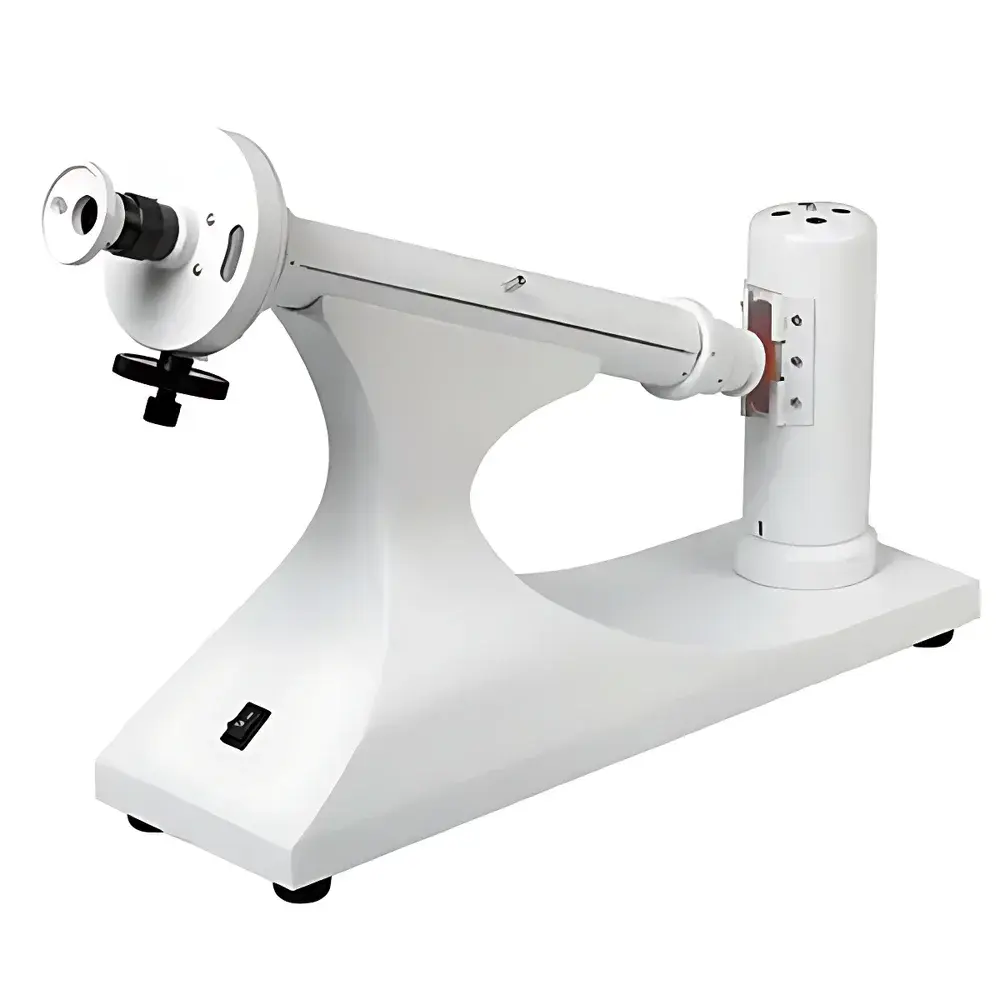
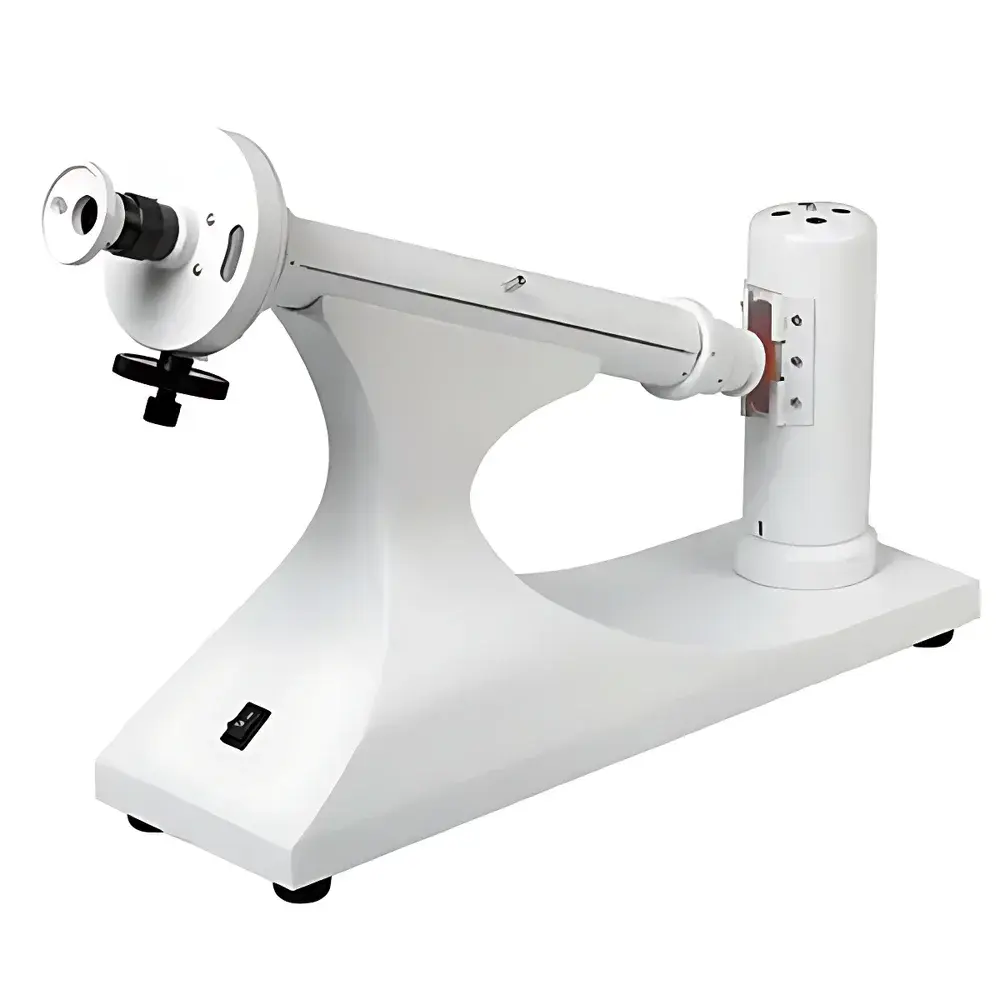
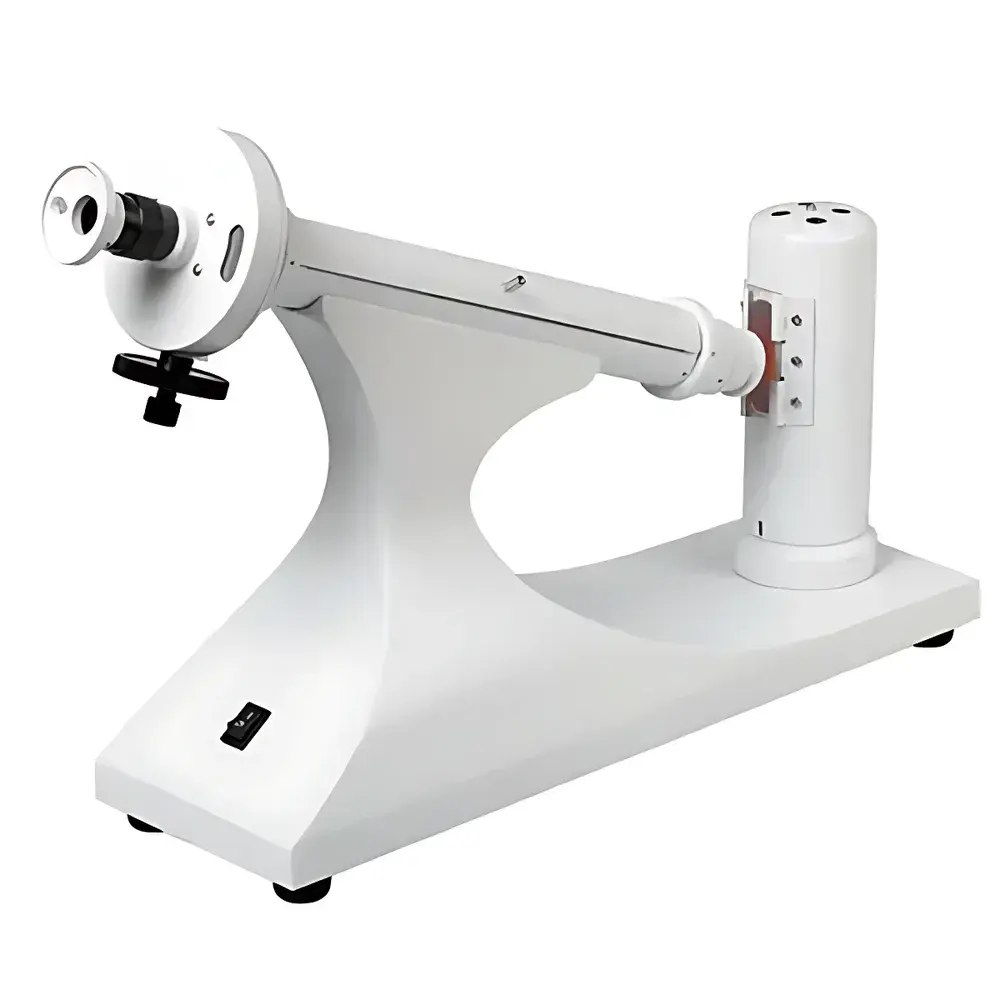
BM WXG-4 Manual Circular Polarimeter
| Brand | BM |
|---|---|
| Origin | Shanghai, China |
| Model | WXG-4 |
| Product Type | Manual Circular Polarimeter |
| Light Source | Sodium Lamp (589.44 nm) |
| Measurement Range | ±180° |
| Scale Division | 1° |
| Vernier Reading Resolution | 0.05° |
| Sample Tube Lengths | 100 mm and 200 mm |
| Power Supply | 220 V ± 10 %, 50 Hz ± 1 Hz |
| Dimensions (L×W×H) | 540 × 220 × 380 mm |
| Weight | 5 kg |
| Temperature Control | Not Available |
| Digital Display | Not Available |
Overview
The BM WXG-4 Manual Circular Polarimeter is a precision optical instrument engineered for the quantitative measurement of optical rotation — the angular deviation of plane-polarized light as it passes through an optically active substance. Based on the fundamental principle of polarimetry, the WXG-4 employs a fixed-wavelength sodium lamp (λ = 589.44 nm) in conjunction with a high-contrast half-shadow field optical system and a calibrated circular scale to enable direct visual reading of rotation angles. Its design adheres to classical polarimetric methodology, where sample-induced rotation is determined via manual alignment of the analyzer until uniform brightness is achieved across the viewing field. This analog, operator-dependent measurement approach delivers traceable results suitable for routine quality control and educational applications where regulatory-grade automation is not required.
Key Features
- Classical half-shadow field optical system optimized for high-contrast visual null detection, minimizing parallax error during manual alignment.
- Dual-length sample tube compatibility: standardized 100 mm and 200 mm pathlength cells included, supporting concentration-dependent sensitivity adjustment per Beer–Lambert considerations.
- Mechanically robust brass-and-aluminum optical housing with precision-ground glass scales and vernier caliper-style readout, delivering consistent mechanical repeatability over extended use.
- Fixed-wavelength sodium light source (589.44 nm), aligned with the D-line standard used in pharmacopoeial methods (e.g., USP , EP 2.2.7) for chiral compound assay.
- 4× magnifying eyepiece integrated into the viewing system to enhance resolution of the 1° scale divisions and support accurate interpolation to 0.05°.
- No electronic components or software dependencies — fully operational without firmware updates, network connectivity, or calibration certificates tied to digital infrastructure.
Sample Compatibility & Compliance
The WXG-4 accommodates standard cylindrical glass sample tubes sealed with ground-glass stoppers, compatible with aqueous solutions, organic solvents (e.g., ethanol, chloroform), and viscous liquids within viscosity limits typical for gravity-filled polarimetric cells. It supports measurements of pure enantiomers, racemic mixtures, and partially resolved compounds — particularly relevant in sugar analysis (e.g., sucrose, glucose, fructose), amino acid characterization, and pharmaceutical intermediate verification. While not compliant with FDA 21 CFR Part 11 or ISO/IEC 17025 for automated data integrity, its mechanical design conforms to long-standing national metrological standards for manual polarimeters (JJG 536–2015, China). Documentation of measurement procedure, operator identity, ambient temperature (recorded separately), and raw scale readings satisfies basic GLP documentation requirements for internal QC labs.
Software & Data Management
The BM WXG-4 operates entirely without embedded electronics, firmware, or digital interfaces. All measurements are recorded manually in laboratory notebooks or LIMS-compatible spreadsheets. Users must document: observed rotation angle (±0.05°), tube length, sample temperature (measured externally), concentration (if applicable), and calculation of specific rotation [α] using the standard formula: [α] = (100 × α) / (l × c), where α is observed rotation in degrees, l is pathlength in dm, and c is concentration in g/100 mL. No audit trail, electronic signature, or data export functionality is provided — consistent with instruments deployed in teaching laboratories and non-GMP manufacturing environments where handwritten records remain acceptable.
Applications
- Pharmaceutical QC: Verification of enantiomeric purity in chiral APIs (e.g., levodopa, ibuprofen, chloramphenicol) per pharmacopoeial monographs.
- Sugar industry: Routine determination of sucrose content in cane juice, syrups, and refined products using established polarimetric conversion tables.
- Food & flavor analysis: Quantification of natural sweeteners, identification of adulteration in honey and maple syrup via optical rotation deviation.
- Academic instruction: Hands-on training in wave optics, symmetry-breaking phenomena, and structure–activity relationships of chiral molecules.
- Chemical synthesis monitoring: Tracking enantioselectivity in asymmetric catalysis without real-time instrumentation.
FAQ
What is the wavelength of the light source, and why is it standardized?
The WXG-4 uses a sodium lamp emitting at 589.44 nm (the D-line doublet average), which is the internationally accepted reference wavelength for polarimetric assays in pharmacopoeias and industrial standards.
Can this instrument measure samples at controlled temperature?
No — the WXG-4 lacks integrated temperature regulation. For temperature-sensitive measurements, users must employ external thermostatted jackets or water baths and record ambient or bath temperature independently.
Is digital output or data logging possible?
No — the instrument provides only analog visual readout. All data capture and processing must be performed manually by the operator.
What level of accuracy can be expected under optimal conditions?
When operated by trained personnel under stable lighting and thermal conditions, reproducibility of ±0.1° is achievable; the vernier scale permits estimation to 0.05°, consistent with Class B manual polarimeters per JJG 536.
Are replacement sodium lamps and sample tubes available?
Yes — standard 100 mm and 200 mm polarimetric tubes with ground-glass joints, as well as certified sodium vapor lamps (type SG-11 or equivalent), are commercially available through authorized BM distributors.




