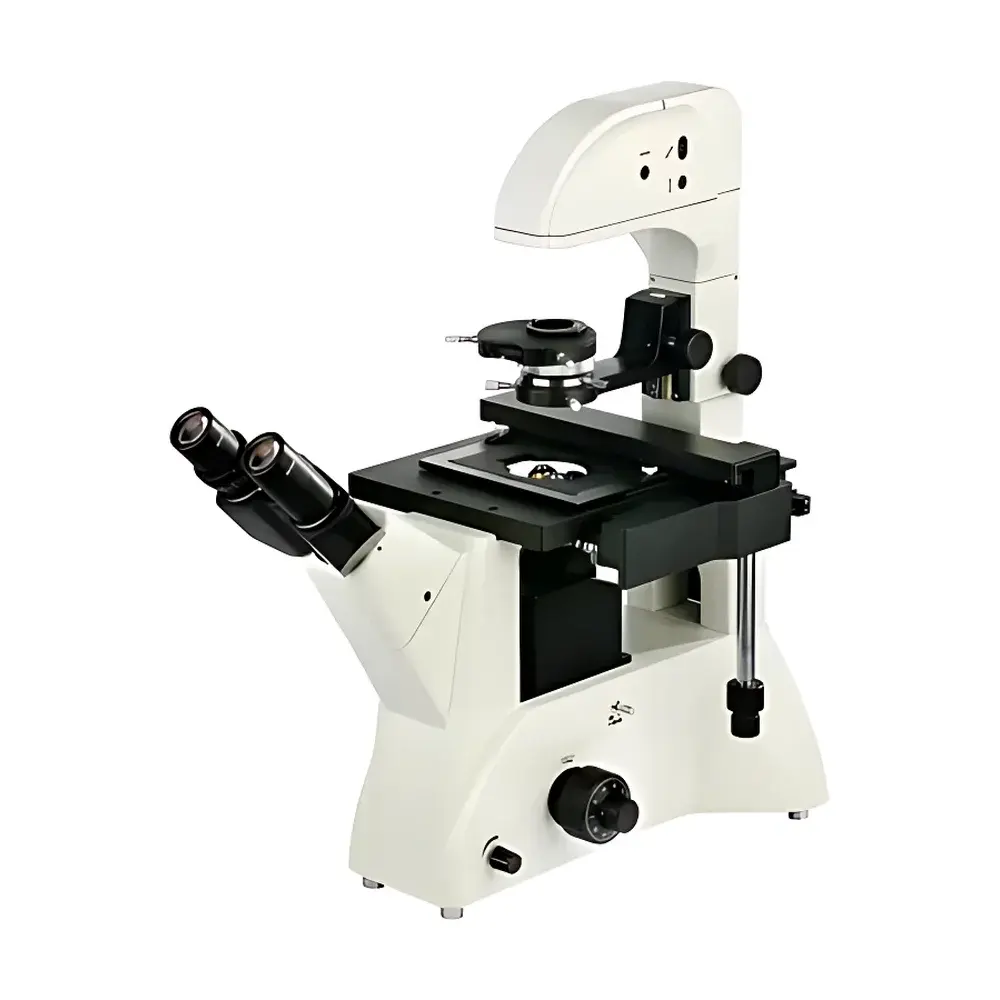
XDS-3 Inverted Biological Microscope
| Origin | Guangdong, China |
|---|---|
| Manufacturer Type | Authorized Distributor |
| Origin Category | Domestic (China) |
| Model | XDS-3 |
| Price | USD 2,300 (FOB Guangdong) |
Overview
The XDS-3 Inverted Biological Microscope is engineered for high-stability live-cell observation and routine in vitro tissue analysis in academic, clinical, and industrial life science laboratories. Built upon a robust, vibration-damped inverted platform with an infinity-corrected optical system, the XDS-3 delivers consistent image fidelity across extended imaging sessions. Its optical architecture supports both brightfield and phase contrast modalities—enabling label-free visualization of unstained, transparent, or low-contrast biological specimens such as adherent mammalian cells, primary cultures, spheroids, and suspension-based samples in standard culture vessels. The inverted configuration positions the objective lenses beneath the specimen stage, allowing direct access to the sample surface for micromanipulation, perfusion, or integration with environmental control chambers—critical for time-lapse imaging and long-term viability studies.
Key Features
- Infinity-corrected optical path with parfocal, long-working-distance plan achromat objectives (10×/0.25, 20×/0.40, 40×/0.65), each optimized for 1.2 mm cover glass thickness and ≥4.3 mm working distance—ensuring clearance for Petri dishes, flasks, and multi-well plates.
- Rotatable swing-in/out condenser with 55 mm working distance and built-in turret-style phase contrast annuli (PH2), enabling rapid switching between BF and PH without realignment or contamination risk during high-container imaging.
- Ergonomic 45° inclined binocular head with interpupillary adjustment (53–75 mm) and wide-field 10×/Φ22 mm eyepieces—designed to reduce operator fatigue during prolonged observation sessions.
- Precision coaxial coarse/fine focusing mechanism with locking function and mechanical stop limit; fine focus graduation: 2 µm per division—supporting reproducible Z-stack acquisition and depth profiling.
- Large fixed stage (227 × 208 mm) with interchangeable circular and rectangular Petri dish carriers accommodating Ø87.5 mm, Ø68.5 mm, and 57 × 82 mm culture formats—ensuring compatibility with common labware from Corning, Falcon, and Nunc.
- 6 V/30 W halogen illumination with continuous intensity control and integrated ground-glass diffuser plus blue/green interference filters—providing stable, color-balanced Köhler illumination suitable for photometric consistency in documentation workflows.
Sample Compatibility & Compliance
The XDS-3 is validated for use with standard cell culture substrates including glass-bottom dishes, plastic-bottom multiwell plates (6–96-well), T-flasks, roller bottles, and cylindrical bioreactors up to 100 mm height. Its mechanical design conforms to ISO 10993-5 (biocompatibility of lab equipment surfaces) and meets structural stability requirements outlined in ASTM E2594–18 (Standard Practice for Microscope Performance Verification). While not certified for GMP manufacturing environments, the system supports GLP-aligned documentation when paired with compliant digital imaging accessories (e.g., USB 3.0 cameras with audit-trail-capable software). All optical components are assembled and aligned under cleanroom-grade protocols to ensure minimal particulate shedding and long-term calibration retention.
Software & Data Management
The microscope integrates seamlessly with third-party imaging platforms via C-mount or 0.5×/1× CCTV adapters (part nos. 810004, 810002). Compatible digital capture modules—including DV-1 (composite video + USB 2.0, 420K pixels), DV-2 (USB 2.0, up to 3 MP), and DV-3 (composite video only)—enable DICOM-compliant export, timestamped frame logging, and basic measurement annotation. When used with FDA 21 CFR Part 11–enabled software suites (e.g., ImageJ with LOCI plugin, or commercial packages like NIS-Elements BR), the system supports electronic signatures, user-access controls, and audit trail generation—fulfilling essential data integrity criteria for QC/QA labs in pharmaceutical and food safety testing.
Applications
- Real-time monitoring of cell proliferation, migration, and morphology changes in monolayer and 3D co-cultures.
- Routine quality control of hybridoma, CHO, and stem cell lines in bioproduction facilities.
- Teaching laboratory instruction in histology, embryology, and microbiology at undergraduate and graduate levels.
- Pathological evaluation of cytological suspensions (e.g., ascites, CSF) and semi-solid media colonies.
- Pre-screening of CRISPR-edited clones prior to FACS sorting or cryopreservation.
- Field-deployable diagnostics support in veterinary and agricultural extension services—particularly for mastitis screening in dairy herds and protozoan identification in aquaculture systems.
FAQ
Is the XDS-3 compatible with fluorescence imaging?
No—the base configuration lacks excitation/emission filter sets, mercury/xenon lamp housing, or dichroic mirrors required for epifluorescence. Fluorescence capability may be added via third-party retrofit kits, but optical alignment and signal-to-noise performance are not factory-validated.
What is the maximum recommended magnification for live-cell phase contrast on this system?
400× (40× objective × 10× eyepiece) is the practical upper limit for sustained live-cell observation due to reduced depth of field and increased sensitivity to thermal drift and stage vibration.
Can the XDS-3 be connected to a hospital PACS network?
Yes—when equipped with a DICOM-conformant USB camera (e.g., DV-2 with firmware v2.1+) and configured through HL7/DICOM gateway middleware, it supports push-mode transmission of annotated stills and time-series clips.
Does the manufacturer provide ISO 17025 traceable calibration certificates?
Calibration reports for magnification accuracy and stage movement linearity are available upon request; however, full ISO/IEC 17025 accreditation applies only to the distributor’s metrology lab—not the instrument itself.
Are replacement parts and service support available outside mainland China?
Yes—authorized service partners operate in Southeast Asia, the Middle East, and Latin America; spare optics, mechanical assemblies, and LED conversion kits (replacing halogen) are stocked regionally under part numbers listed in the official accessory catalog (Rev. 2024-B).