
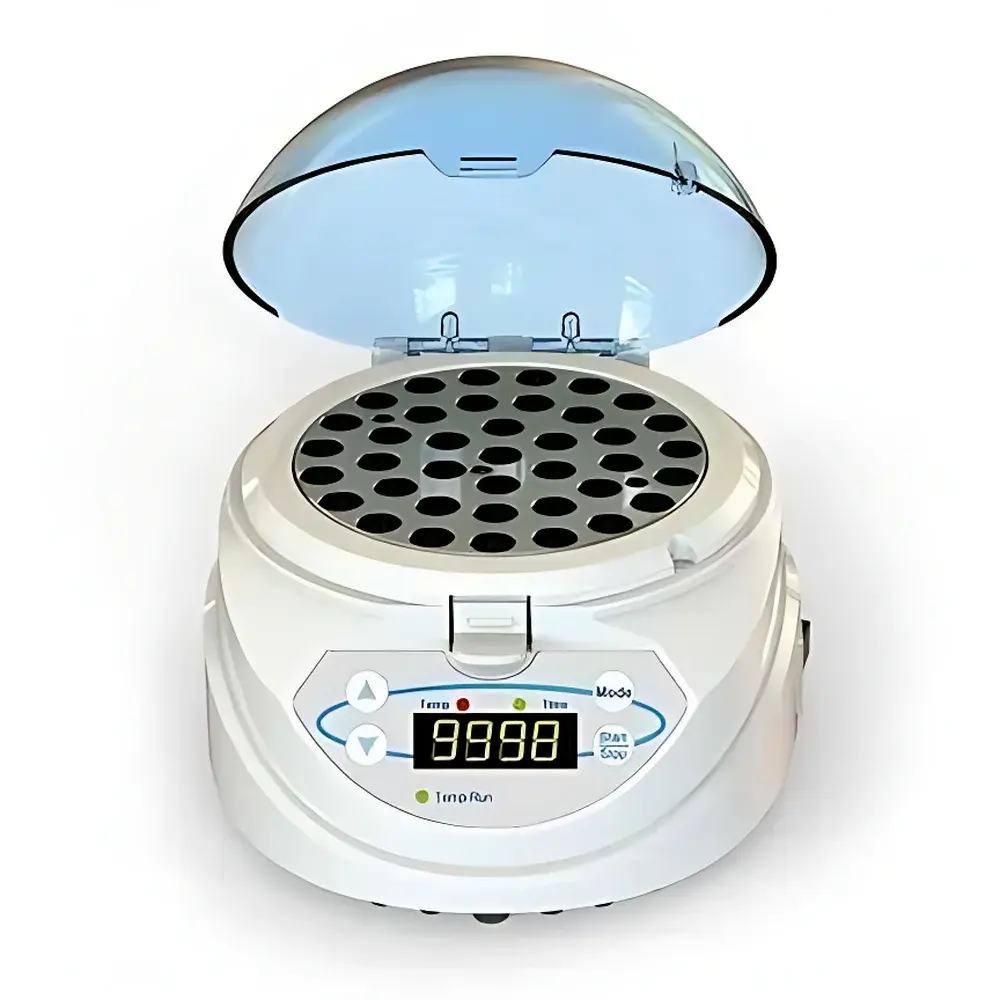
Jiayuan K30 Precision Dry Block Heater (Metal Bath)
| Brand | Jiayuan |
|---|---|
| Model | K30 |
| Temperature Range | Ambient +5°C to 100°C |
| Heating Time | ≤15 min (20°C → 100°C) |
| Temperature Accuracy | ±0.5°C |
| Display Resolution | 0.1°C |
| Block Uniformity | ±0.5°C |
| Max Power | 150 W |
| Max Set Temperature | 105°C |
| Timer Range | 1–9999 min |
| Dimensions (W×D×H) | 176 × 156 × 121 mm |
| Net Weight | 1.5 kg |
| Origin | Beijing, China |
| Module Type | Interchangeable Round-Well Aluminum Blocks |
Overview
The Jiayuan K30 Precision Dry Block Heater (Metal Bath) is an engineered thermal platform designed for reliable, uniform, and repeatable sample heating in laboratory environments where liquid baths are impractical or contamination-sensitive. Unlike water or oil baths, this dry block system utilizes solid-state aluminum heating blocks with precisely machined wells to transfer thermal energy directly to tubes and vials via conduction—eliminating evaporation, spillage, and cross-contamination risks. Its core operating principle relies on PID-controlled resistive heating elements embedded beneath a thermally optimized aluminum block, enabling rapid thermal response and high spatial temperature homogeneity across the well array. The K30 is widely deployed in clinical diagnostics (e.g., serum coagulation assays), molecular biology (enzyme activation, DNA denaturation), pharmaceutical QC (stability testing), food safety (pathogen enrichment), and environmental analysis (sample pre-treatment). It complies with fundamental thermal safety and electrical safety requirements per IEC 61010-1:2010 for laboratory equipment.
Key Features
- PID-based digital temperature control ensures stable setpoint maintenance within ±0.5°C accuracy and 0.1°C display resolution—critical for assay reproducibility in regulated workflows.
- Aluminum heating block achieves uniform temperature distribution (≤±0.5°C across all wells) due to high thermal conductivity and symmetrical well geometry.
- Rapid thermal ramping: heats from 20°C to 100°C in ≤15 minutes, minimizing turnaround time in high-throughput sample preparation.
- Integrated overtemperature protection circuit automatically cuts power if internal sensor detects exceedance of 105°C—preventing damage to samples and instrument integrity.
- Self-calibrating temperature offset function allows user-initiated correction of minor drift, supporting traceable calibration practices aligned with ISO/IEC 17025 quality systems.
- Transparent polycarbonate lid minimizes ambient heat loss while permitting real-time visual monitoring without opening—reducing thermal disturbance and improving repeatability.
- Compact footprint (176 × 156 × 121 mm) and low mass (1.5 kg) enable flexible benchtop integration, including use inside biosafety cabinets or cold rooms.
Sample Compatibility & Compliance
The K30 accommodates standard round-bottom microcentrifuge tubes (0.2 mL, 0.5 mL, 1.5 mL, 2.0 mL), PCR strips, and small-volume vials via interchangeable aluminum modules—each CNC-machined to exact dimensional tolerances for optimal thermal contact. Modules are autoclavable (121°C, 20 min) and chemically resistant to common solvents and disinfectants, supporting GLP-compliant cleaning validation. While not certified to FDA 21 CFR Part 11 out-of-the-box, the device supports audit-ready documentation when paired with external loggers and controlled procedural records. It meets CE marking requirements for electromagnetic compatibility (EMC Directive 2014/30/EU) and low-voltage safety (LVD Directive 2014/35/EU).
Software & Data Management
The K30 operates as a standalone analog-digital hybrid instrument with no embedded firmware or network interface. All parameters—including temperature setpoint, timer duration, and status alerts—are configured via front-panel push-button controls and a dual-digit LED display. For laboratories requiring electronic data capture, optional external USB data loggers (e.g., HOBO UX100-003) may be used to record block temperature profiles over time. Timestamped logs can be exported to CSV for inclusion in electronic lab notebooks (ELN) or LIMS, satisfying basic ALCOA+ data integrity principles when accompanied by documented SOPs.
Applications
- Clinical coagulation studies: precise 37°C incubation of citrated plasma for PT/INR and APTT assays.
- Molecular workflows: denaturation of DNA templates (95°C), restriction enzyme activation (37°C), and reverse transcription (42–50°C).
- Pharmaceutical stability testing: accelerated degradation studies at controlled elevated temperatures per ICH Q1A(R2).
- Food microbiology: pre-enrichment of Salmonella or Listeria in buffered peptone water at 35–42°C.
- Environmental sample processing: digestion of soil extracts or filtration concentrates prior to instrumental analysis.
FAQ
What tube sizes are supported by the K30?
Standard configurations include modules for 0.2 mL, 0.5 mL, 1.5 mL, and 2.0 mL microcentrifuge tubes; custom well diameters are available upon request.
Can the K30 be used for long-duration incubations?
Yes—the programmable timer supports up to 9999 minutes (~166 hours), and continuous operation is validated under rated load conditions.
Is the unit suitable for use in a laminar flow hood?
Yes—its compact dimensions, low power draw (150 W), and absence of volatile fluids make it compatible with Class II biosafety cabinets and cleanroom environments.
Does the K30 support external temperature probes?
No—it relies solely on the built-in RTD sensor embedded in the aluminum block; however, third-party calibrated probe loggers can be inserted into adjacent wells for independent verification.
How often should temperature calibration be performed?
Per ISO/IEC 17025 recommendations, calibration verification using NIST-traceable reference thermometers is advised before critical experiments or at least daily in routine QC settings.
Related Products



