
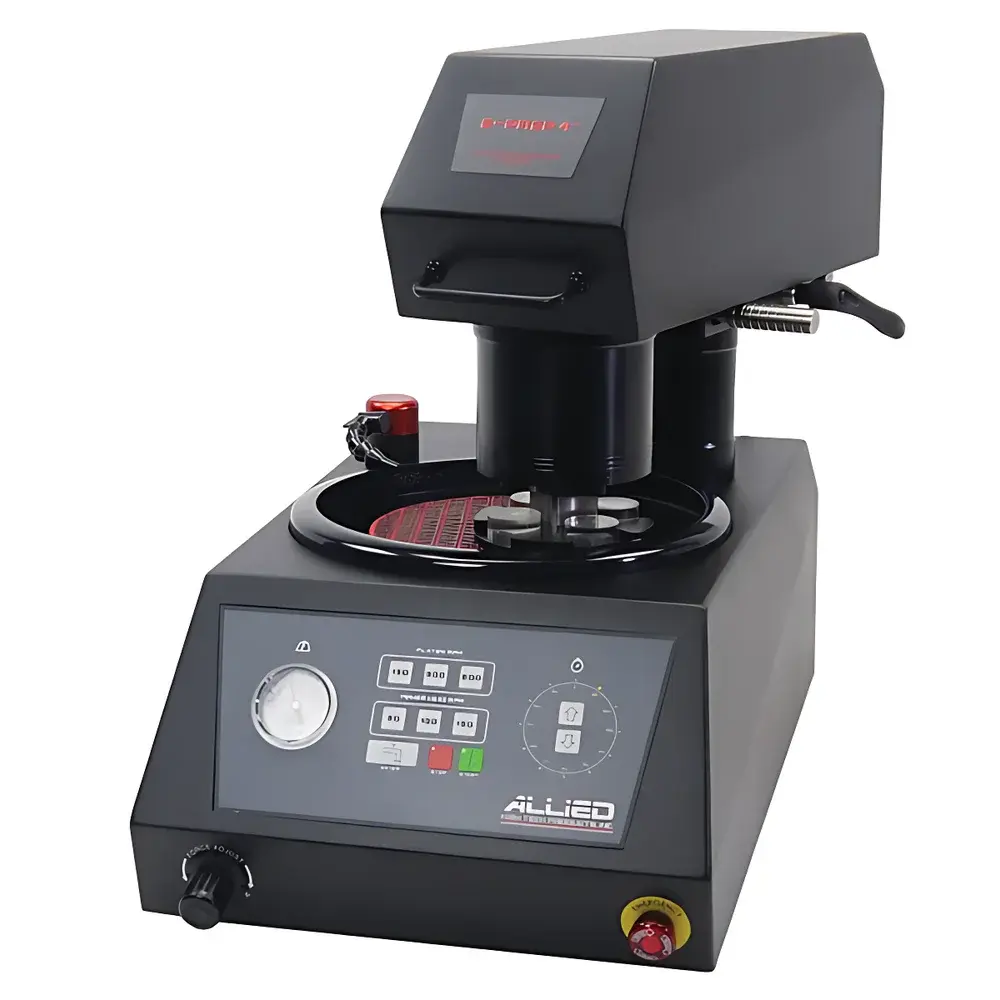
Allied E-PREP 4™ Automated Grinding and Polishing System with PH-4i Power Head
| Brand | Allied |
|---|---|
| Origin | USA |
| Model | E-PREP 4™ |
| Platen Speeds | 150 / 300 / 600 rpm |
| PH-4i Sample Rotation Speeds | 50 / 100 / 150 rpm |
| Cycle Time Range | 30 s – 9 min (1 min increments) |
| Sample Force Range | 0–12 lb (0–60 N) in 1 lb (~5 N) increments |
| Motor | 0.5 HP DC (E-PREP 4™ base), 0.25 HP geared motor (PH-4i power head) |
| Construction | RIM-molded housing, anodized aluminum, stainless steel |
| Warranty | 2 years |
Overview
The Allied E-PREP 4™ is a fully automated, precision-engineered grinding and polishing system designed for reproducible, high-fidelity specimen preparation in metallurgical, geological, ceramic, and advanced materials laboratories. Built upon Couette-flow–optimized kinematics and complementary rotational motion—where the platen rotates at selectable speeds while the sample holder rotates independently at a distinct, user-defined rate—the system ensures uniform material removal and minimal edge rounding. Its dual-motor architecture separates platen drive (0.5 HP DC) from sample force application (0.25 HP geared motor), enabling independent control of mechanical variables critical to ISO 14782, ASTM E3, and ASTM E407 compliance. The low-profile, corrosion-resistant chassis integrates seamlessly into GLP-compliant lab workflows, supporting routine use in QA/QC, failure analysis, and R&D environments where traceability, repeatability, and operator safety are non-negotiable.
Key Features
- Three programmable platen speeds (150, 300, 600 rpm) and three independent sample rotation speeds (50, 100, 150 rpm) enable precise kinetic tuning for soft alloys, hard ceramics, or multiphase composites.
- Pneumatically actuated, manually adjustable sample force (0–12 lb / 0–60 N in 1 lb increments) delivers consistent load application without drift—critical for ASTM E766 flatness validation and cross-section integrity.
- Quick-change anodized aluminum platens (compatible with 8”/203 mm or 10”/254 mm standard/magnetic configurations) minimize downtime between protocols; no tools required for platen or holder exchange.
- Electronic coolant flow control with pivoting, adjustable nozzle ensures targeted delivery across the full platen surface—reducing slurry waste and preventing thermal artifact formation during prolonged cycles.
- Molded one-piece RIM cover provides impact resistance and chemical barrier protection; integrated overflow diversion channels route excess coolant away from electronics and drive components.
- Dual emergency shut-off switches (front panel and foot-pedal mounted) meet ANSI B11.19 machine safeguarding requirements; all controls comply with UL 61010-1 and IEC 61000-6-2 EMC standards.
Sample Compatibility & Compliance
The E-PREP 4™ accommodates planar specimens up to 4″ (102 mm) in diameter using either plain/adhesive-backed or magnetic disc systems. Its tilt-up PH-4i power head grants unobstructed access to the platen and holder assembly, facilitating rapid cleaning and verification of disc flatness per ISO 15510. The system supports standardized consumables—including diamond-impregnated, silicon carbide, and alumina-based lapping/polishing discs—and interfaces directly with Allied’s consumables tracking database for lot-controlled documentation. All operational parameters (speed, force, time, coolant flow) are logged with timestamp and user ID, satisfying FDA 21 CFR Part 11 audit-trail requirements when paired with Allied’s optional LIMS-integrated software module. The unit is certified to CE, RoHS, and FCC Class A emission limits and conforms to ISO/IEC 17025 calibration traceability frameworks when used with NIST-traceable force and speed verification kits.
Software & Data Management
While the E-PREP 4™ operates via intuitive manual/touchpad interface without mandatory PC dependency, its embedded firmware supports RS-232 and USB-C data export for protocol archiving and post-process review. Each cycle stores metadata—including applied force curve, real-time RPM feedback, total elapsed time, and coolant valve position—to internal flash memory (retention >10,000 cycles). Optional Allied LabLink™ software enables remote parameter synchronization across multi-unit labs, generates PDF reports compliant with ISO 17025 clause 7.8.2, and exports CSV files compatible with JMP, Minitab, and Python-based statistical process control (SPC) pipelines. Audit logs include electronic signatures, change history, and role-based access control (RBAC) for SOP enforcement in GMP-regulated facilities.
Applications
- Metallurgical lab preparation of ferrous/non-ferrous alloys for optical microscopy, SEM-EDS, and microhardness testing (Vickers/Knoop).
- Geological thin-section fabrication requiring sub-micron flatness and zero relief across heterogeneous mineral assemblages.
- Failure analysis of electronic packaging substrates, solder joints, and wafer-level interconnects where delamination artifacts must be excluded.
- Quality assurance of additive-manufactured metal parts, where pore distribution and grain boundary continuity depend on artifact-free surface conditioning.
- ISO 14782-certified reference material production for hardness and microstructure proficiency testing programs.
FAQ
What platen sizes are supported?
The E-PREP 4™ accepts both 8” (203 mm) and 10” (254 mm) platens—available in standard or magnetic variants—with compatibility for plain/adhesive-backed or magnetic-backed consumable discs.
Is the PH-4i power head included by default?
Yes—the PH-4i power head with individual sample force control, tilt-up access, and quick-lock positioning is integral to the E-PREP 4™ configuration.
Can cycle parameters be saved and recalled?
Up to 20 user-defined protocols can be stored onboard with full parameter sets (platen speed, sample speed, force, time, coolant flow); recall is performed via numeric keypad or touchpad navigation.
Does the system support GLP/GMP documentation requirements?
When used with Allied LabLink™ software and enabled audit-trail mode, the system captures electronic records meeting FDA 21 CFR Part 11, EU Annex 11, and ISO/IEC 17025 data integrity criteria.
What maintenance intervals are recommended?
Platen alignment verification every 200 hours; coolant filter replacement every 6 months or 1,000 cycles; annual calibration of force transducer and tachometric sensors using Allied-certified service kits.



