
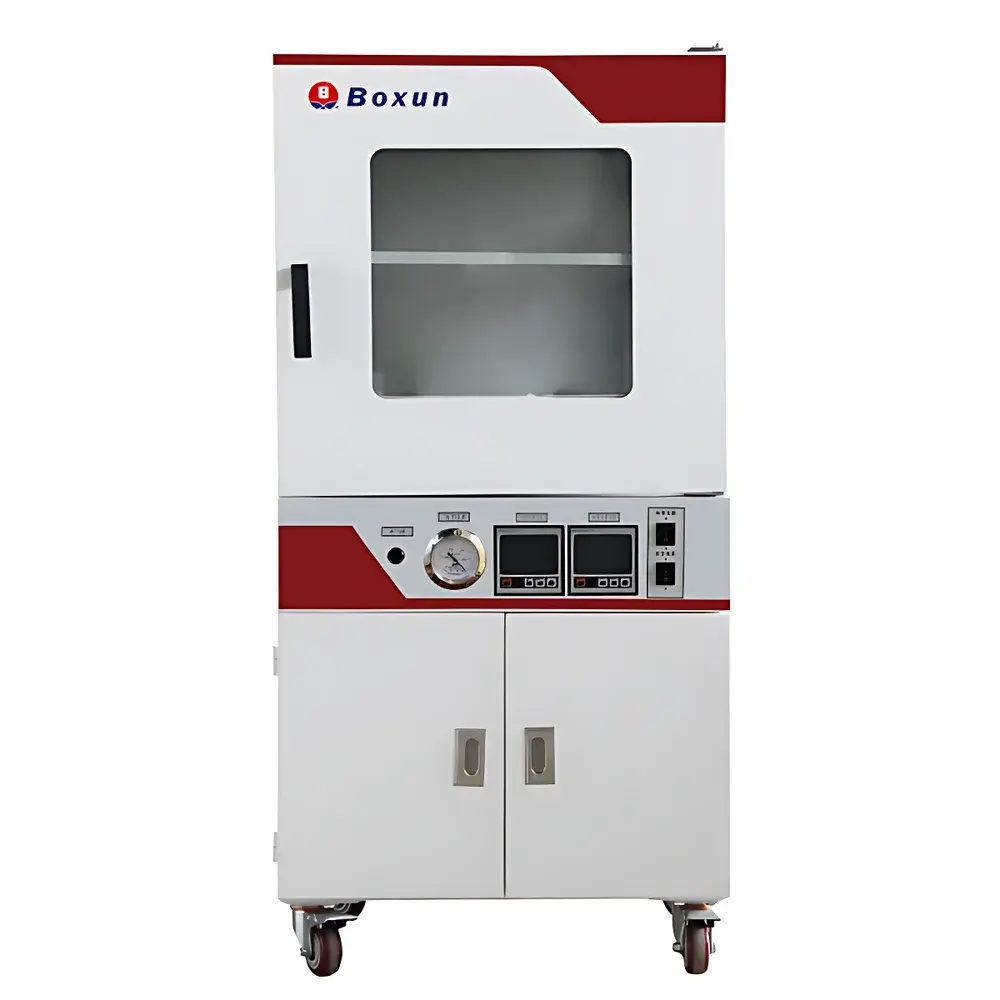
BOXUN BXK-250 Vacuum Drying Oven
| Brand | BOXUN |
|---|---|
| Origin | Shanghai, China |
| Manufacturer Type | Direct Manufacturer |
| Product Category | Domestic |
| Model | BXK-250 |
| Instrument Type | Vacuum Oven |
| Temperature Range | Ambient +2°C to 250°C |
| Temperature Uniformity | ±0.5°C |
| External Dimensions | 770 × 780 × 1515 mm |
| Internal Chamber Dimensions | 600 × 600 × 700 mm |
| Chamber Material | Stainless Steel (SUS304) |
| Heating Method | Bottom-mounted Heated Shelving with Forced Convection |
| Vacuum Level | ≤133 Pa |
| Pump Flow Rate | 2 L/s |
| Chamber Volume | 250 L |
| Power Supply | AC 220 V ±10%, 50/60 Hz |
| Rated Power | 2200 W |
| Timer Range | 0–9999 min |
| Shelving | 3 pcs, independently temperature-controlled |
Overview
The BOXUN BXK-250 Vacuum Drying Oven is an engineered solution for precise, low-temperature moisture removal under reduced pressure—designed specifically for thermally sensitive, oxidation-prone, or structurally complex samples. Unlike conventional convection ovens that rely on ambient-pressure air circulation, this system operates on the physical principle that lowering ambient pressure reduces the boiling point of volatile solvents and bound water, enabling efficient dehydration at significantly lower temperatures. This principle is critical in preserving molecular integrity during drying of biological extracts, pharmaceutical intermediates, polymer composites, and nanomaterial precursors. The BXK-250 integrates vacuum-compatible thermal architecture with microprocessor-based control logic to deliver reproducible, traceable, and GxP-aligned drying performance across academic, QC, and regulated manufacturing environments.
Key Features
- Triple-layer heated shelving system with independent PID temperature control per shelf—enabling simultaneous multi-zone drying protocols and selective energy activation when sample load is partial
- Bottom-mounted, uniformly distributed heating elements beneath stainless steel shelves—improving thermal transfer efficiency by >50% compared to jacketed or wall-heated configurations, especially under high vacuum where convective heat transfer is negligible
- Integrated noise-dampened cabinet housing a 2 L/s dual-stage rotary vane vacuum pump—reducing operational noise by up to 40 dB(A) while maintaining spatial efficiency and eliminating external pump cabling or vibration coupling
- Sealed chamber constructed from electropolished SUS304 stainless steel with radius-rounded internal corners—ensuring cleanability, corrosion resistance, and compliance with ISO 14644-1 Class 8 cleanroom-compatible maintenance practices
- Microcontroller-driven digital interface with backlit LCD display—supporting real-time monitoring of chamber temperature, setpoint, elapsed time, vacuum level (via optional gauge), and fault diagnostics including overtemperature, door seal failure, and power interruption recovery
- Patented silicone gasket door seal with adjustable torque latching mechanism—achieving and sustaining ≤133 Pa base vacuum without auxiliary sealing compounds or manual re-torquing
Sample Compatibility & Compliance
The BXK-250 accommodates diverse sample formats: lyophilized powders, ceramic green bodies, coated optical substrates, chromatography columns, sterilized glassware, and moisture-sensitive reference standards. Its inert stainless steel chamber and absence of airflow eliminate particle displacement, oxidation, or surface delamination—making it suitable for ASTM E145-22 (Standard Specification for Gravity-Convection and Forced-Ventilation Ovens) Annex B-compliant vacuum drying procedures. The system supports GLP/GMP documentation workflows via optional RS485/Modbus RTU output for integration with LIMS or electronic lab notebooks. While not intrinsically rated for hazardous area use, its sealed construction and lack of internal ignition sources meet IEC 61000-6-3 EMC emission limits for laboratory electromagnetic environments.
Software & Data Management
The onboard controller logs timestamped temperature and vacuum data (when equipped with optional vacuum transducer) into non-volatile memory with automatic power-fail recovery—retaining all active parameters and elapsed cycle time after unexpected shutdown. Export-ready CSV files can be retrieved via USB port for audit trail reconstruction. Optional PC software enables remote parameter setting, real-time graphing of multi-shelf thermal profiles, and generation of 21 CFR Part 11–compliant audit reports—including user ID, action timestamp, value change, and reason-for-change fields. All firmware updates are signed and verified to prevent unauthorized modification.
Applications
- Drying of heat-labile APIs and excipients in pharmaceutical development per USP <1208> guidance on residual solvent removal
- Pre-conditioning of hygroscopic calibration standards prior to gravimetric analysis (ISO/IEC 17025 Clause 7.7)
- Moisture stabilization of ceramic and composite substrates before sintering or coating deposition
- Post-cleaning drying of precision mechanical assemblies and MEMS devices where residual solvent entrapment must be avoided
- Dehydration of botanical extracts and enzyme preparations without denaturation or Maillard reaction interference
- Validation of sterilization cycles for reusable labware under vacuum-assisted dry-heat protocols (EN 285 Annex C)
FAQ
What vacuum level does the BXK-250 achieve, and how is it maintained?
The system achieves a base pressure of ≤133 Pa using its integrated 2 L/s dual-stage rotary vane pump. Vacuum integrity is sustained via a dual-lip silicone door gasket and zero-leakage chamber welds, verified per ISO 2859-1 sampling inspection during final QA.
Can multiple shelf temperatures be programmed independently?
Yes—each of the three supplied shelves has dedicated PT100 sensors and SSR-driven heating circuits, allowing discrete setpoints within the full 2–250°C range and real-time deviation monitoring.
Is the unit compatible with inert gas purging?
The chamber includes a dedicated gas inlet valve (¼” NPT) and exhaust port, enabling nitrogen or argon blanketing prior to vacuum pull—critical for oxygen-sensitive materials.
Does the controller support automated drying sequences?
The timer function supports multi-step ramp-soak cycles with up to 99 segments; each segment defines target temperature, dwell time, and shelf activation status—stored as reusable protocol templates.
What maintenance is required for long-term vacuum performance?
Annual oil replacement in the vacuum pump and quarterly inspection of door gasket compression force are recommended. No chamber recalibration is required—the PT100 sensors are factory-traceable to NIST standards.



