
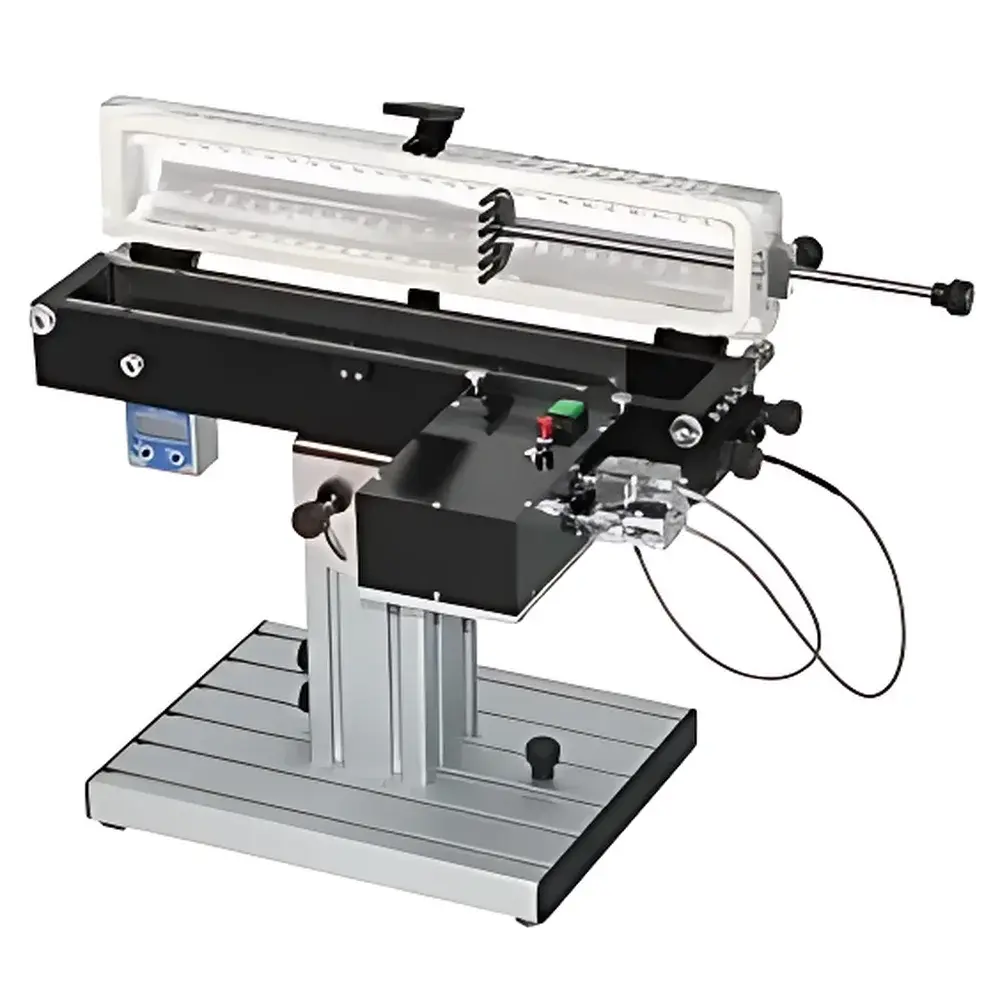
TSE Systems CaloTreadmill Advanced Motorized Treadmill System for Rodent Exercise Physiology and Metabolic Research
| Brand | TSE Systems |
|---|---|
| Origin | Germany |
| Model | CaloTreadmill Series |
| Speed Range | 0.07–2.0 m/s |
| Incline Adjustment | –10° to +25° |
| Max. Lanes | 8 independent motorized belts |
| Stimulus Output | Programmable foot shock (constant current, adjustable intensity/duration) |
| Data Export | CSV/Excel-compatible ASCII format |
| Software Platform | Windows-based TSE Treadmill Control Suite v5.x |
| Compliance | Designed for GLP-compliant rodent exercise protocols |
| Thermal Configuration | Integrated Peltier-based cooling/heating modules (CaloTreadmill variant) |
| Animal Detection | Adjustable infrared beam sensors per lane |
| Timing | Individual lane-specific start/stop timers with microsecond resolution |
Overview
The TSE Systems CaloTreadmill Advanced Motorized Treadmill System is a research-grade, computer-controlled platform engineered for quantitative assessment of locomotor performance, exercise tolerance, fatigue onset, and metabolic adaptation in murine models. Based on precision servo-motor actuation and closed-loop velocity regulation, the system implements standardized treadmill protocols grounded in established rodent exercise physiology methodology—including incremental load tests, constant-speed endurance trials, and forced-exercise paradigms with calibrated aversive stimuli. Its dual-capability architecture supports both standard behavioral endurance testing and thermally controlled metabolic studies via integrated Peltier modules, enabling precise ambient temperature modulation (±0.5 °C stability) across individual lanes. The system complies with methodological requirements outlined in NIH Guide for the Care and Use of Laboratory Animals and aligns with experimental design principles referenced in peer-reviewed journals such as Journal of Applied Physiology and Frontiers in Neuroscience.
Key Features
- Eight independently driven treadmill belts—each equipped with dedicated servo motors, real-time speed feedback, and isolated timing control—enabling parallel high-throughput experiments without cross-lane interference.
- Programmable incline mechanism with digital position encoding, allowing stepless adjustment from –10° (downhill descent simulation) to +25° (uphill resistance loading), critical for modeling graded workload conditions.
- Velocity range spanning 0.07 to 2.0 m/s, optimized for species-specific gait dynamics: lower thresholds support spontaneous ambulation analysis in C57BL/6 mice; upper limits accommodate maximal running capacity in Sprague-Dawley rats.
- Configurable aversive stimulus delivery: constant-current foot shock (0.05–0.8 mA, 0.1–3.0 s duration), triggered automatically upon beam-break detection or manually via software interface, adhering to IACUC-approved thresholds.
- Adjustable infrared beam arrays per lane—positionable along belt length—to detect latency to first exit, total time off-belt, and re-entry frequency—parameters essential for fatigue quantification and motivation assessment.
- Integrated thermal management (CaloTreadmill configuration): bidirectional Peltier elements maintain lane-specific ambient temperatures between 4 °C and 35 °C, supporting calorimetric coupling with indirect calorimetry systems (e.g., TSE PhenoMaster).
Sample Compatibility & Compliance
The CaloTreadmill system is validated for use with adult male and female mice (C57BL/6, BALB/c, FVB/N) and rats (Sprague-Dawley, Wistar, Long-Evans), aged 8–24 weeks and weighing 18–500 g. All mechanical and electrical components meet CE marking requirements under Directive 2014/30/EU (EMC) and 2014/35/EU (LVD). Software operation conforms to ALCOA+ data integrity principles: audit trails record user logins, protocol modifications, run initiations, and parameter overrides. Raw data files are timestamped, immutable ASCII exports compliant with FDA 21 CFR Part 11 requirements when deployed with validated electronic signature workflows. System documentation supports GLP audit readiness per OECD Principles of Good Laboratory Practice (ENV/MC/CHEM(98)17).
Software & Data Management
Control and analysis are executed via TSE Treadmill Control Suite v5.x—a Windows 10/11 native application built on .NET Framework 4.8. The GUI enables drag-and-drop protocol assembly using modular segments: warm-up (0.1 m/s, 2 min), ramp phase (0.02 m/s² acceleration), plateau (user-defined speed/duration), and cooldown. Each lane’s acquisition engine logs velocity, incline angle, beam-break events, shock triggers, and elapsed time at 100 Hz. Exported datasets include columnar headers (e.g., “Lane_3_Velocity_mps”, “Lane_5_BeamBreak_Count”) and are natively ingestible into GraphPad Prism, R, MATLAB, and Python pandas workflows. Batch processing tools permit automated calculation of fatigue index (time to exhaustion normalized to body weight), work output (force × distance), and velocity-dependent oxygen consumption estimates when synchronized with respirometry hardware.
Applications
- Cardiovascular phenotyping: longitudinal tracking of exercise capacity in transgenic models of heart failure or hypertension.
- Neuromuscular disease modeling: quantification of progressive gait deterioration in SOD1-G93A ALS mice or mdx dystrophic rats.
- Metabolic syndrome research: combined CaloTreadmill + indirect calorimetry assessments of substrate utilization shifts during graded exercise.
- Pharmacological intervention studies: dose-response evaluation of myostatin inhibitors, AMPK activators, or mitochondrial uncouplers on endurance metrics.
- Aging biology: comparative analysis of fatigue resistance and recovery kinetics across 6-, 12-, and 24-month-old cohorts.
- Behavioral neuroscience: integration with video-tracking (EthoVision XT) to correlate locomotor persistence with anxiety-like parameters in open-field pre-tests.
FAQ
What animal weight ranges are supported per lane?
The system accommodates mice (18–45 g) and rats (200–500 g) using lane-specific belt widths (50 mm for mice; 120 mm for rats) and adjustable restraint guides.
Can the system synchronize with third-party physiological monitors?
Yes—via TTL pulse outputs and RS-232/USB virtual COM port, enabling hardware-triggered ECG, EMG, or respiratory signal acquisition from devices including ADInstruments PowerLab and BIOPAC MP160.
Is calibration traceable to national standards?
Velocity and incline encoders are factory-calibrated against NIST-traceable laser interferometry and angular metrology standards; calibration certificates are supplied with each unit.
How is shock intensity validated prior to animal use?
A dedicated test mode delivers calibrated current pulses to a precision shunt resistor; measured voltage drop confirms compliance with preset mA thresholds before any animal session.
Does the software support multi-user role-based access control?
Yes—administrator, technician, and read-only analyst profiles enforce differential permissions for protocol editing, run execution, and data export functions.




