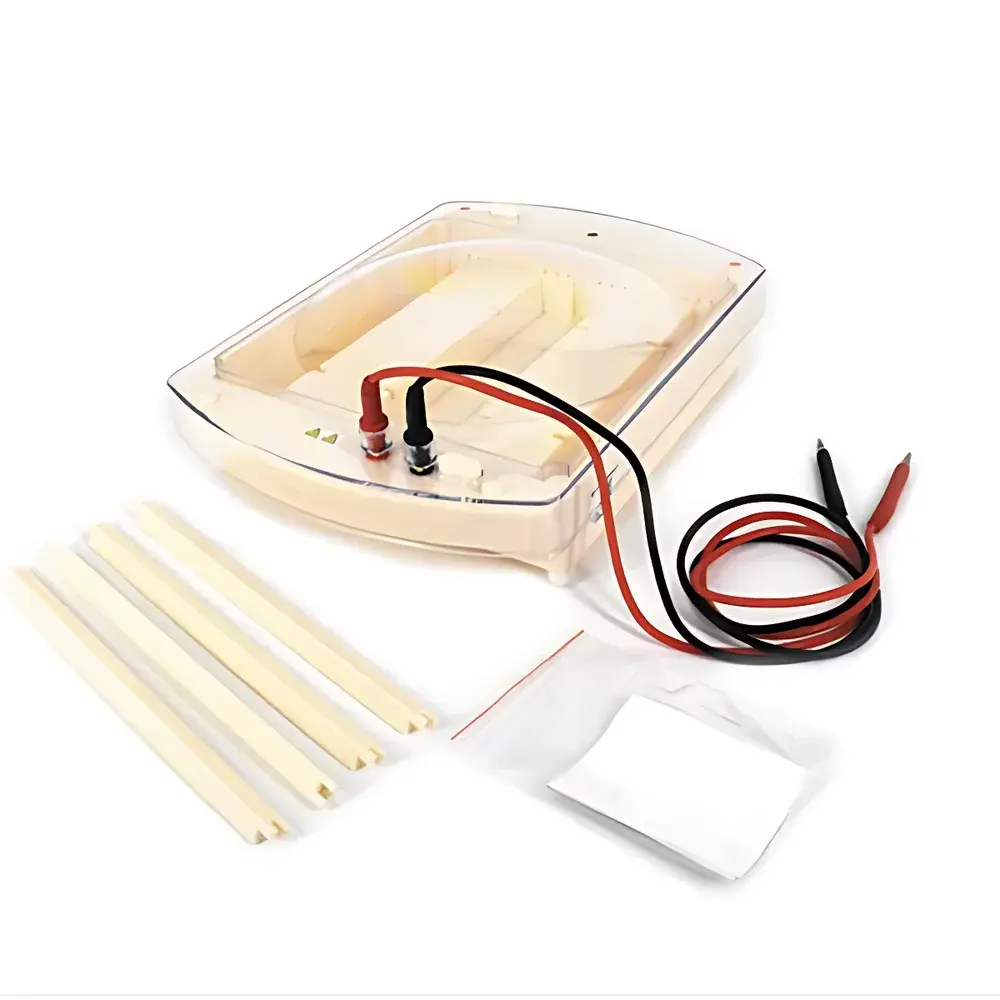
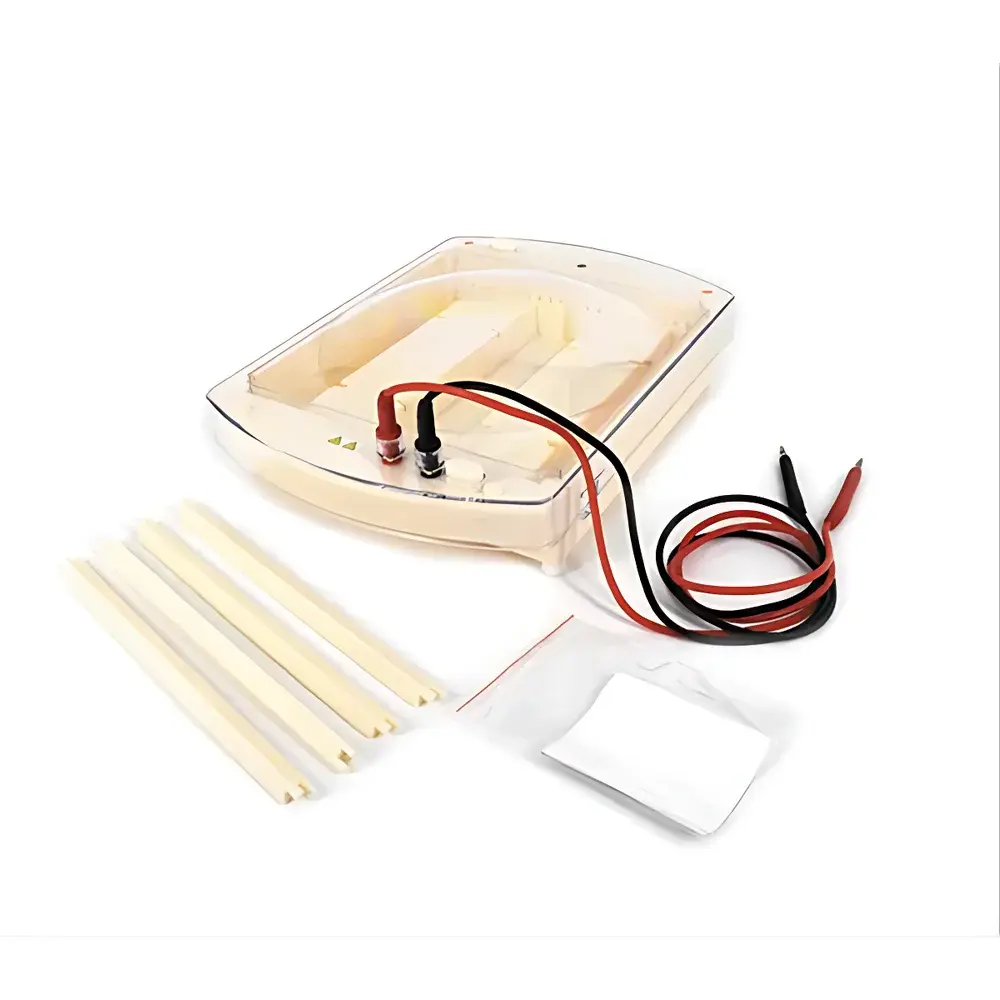
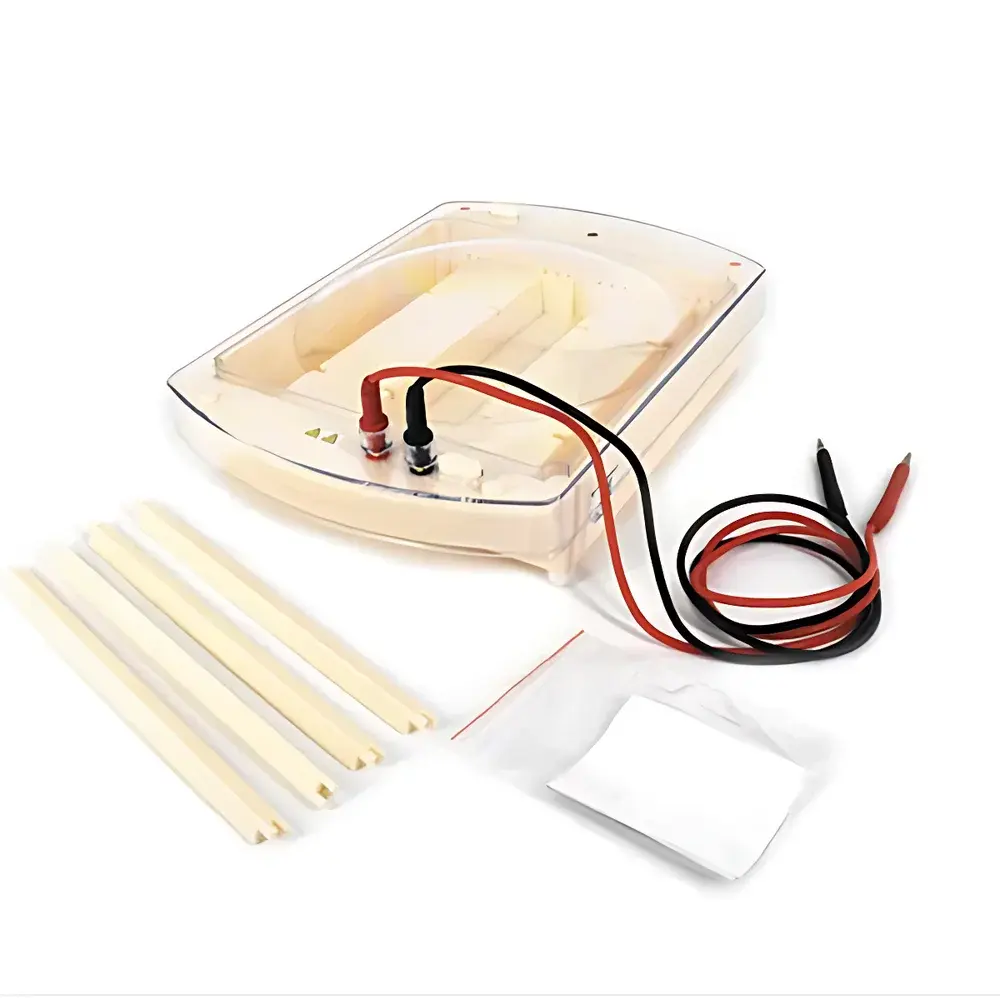
LY DYCP-38C Horizontal Electrophoresis Apparatus
| Brand | LY |
|---|---|
| Origin | Beijing, China |
| Model | DYCP-38C |
| Instrument Type | Cellulose Acetate Membrane Protein Electrophoresis System |
| Sample Capacity | 6–8 cellulose acetate membranes (1–2 samples per membrane) |
| Voltage Range | 0–600 V |
| Current Range | 0–100 mA |
| Operating Modes | Constant Voltage / Constant Current / Constant Power |
| Dimensions (L × W × H) | 370 × 270 × 110 mm |
| Buffer Volume | 1000 mL |
| Electrode Material | Triple Platinum Wire Electrodes |
| Gel/Matrix Compatibility | Cellulose acetate membranes (70 or 90 mm length × 250 mm width, dual-lane format) |
Overview
The LY DYCP-38C Horizontal Electrophoresis Apparatus is a precision-engineered benchtop system designed for routine and teaching-level electrophoretic separation of proteins, enzymes, and other charged biomolecules on cellulose acetate membranes. Unlike vertical slab-gel systems, this horizontal configuration establishes a stable, low-voltage electric field across a planar support medium—enabling reproducible migration under controlled buffer conditions. The instrument operates on the fundamental principle of electrophoretic mobility: charged analytes migrate through a porous matrix under the influence of a direct current electric field, with separation resolution governed by molecular charge-to-size ratio, buffer ionic strength, and field uniformity. Its architecture prioritizes operational stability over high-throughput automation, making it especially suitable for clinical protein profiling (e.g., serum albumin/globulin fractionation), hemoglobin variant screening, and undergraduate life science laboratories where hands-on technique development is essential.
Key Features
- Triple platinum wire electrodes ensure uniform current distribution and long-term corrosion resistance in common electrophoresis buffers (e.g., barbital, Tris-glycine, or phosphate-based systems).
- Adjustable leveling feet and movable bridge rods allow precise horizontal alignment of the electrophoresis chamber—critical for minimizing band distortion and ensuring consistent migration front progression.
- Ridge-shaped transparent acrylic lid reduces solvent evaporation during extended runs while permitting real-time visual monitoring without lid removal.
- Triple-mode power supply (constant voltage, constant current, or constant power) enables method flexibility: constant voltage supports rapid initial migration; constant current maintains steady ion flux under variable resistance; constant power mode accommodates dynamic impedance shifts during prolonged separations.
- Compact footprint (370 × 270 × 110 mm) and lightweight design (2 kg) facilitate integration into shared lab spaces, fume hoods, or mobile teaching carts.
- Integrated safety circuitry provides automatic shutdown upon overcurrent, short-circuit detection, or thermal overload—protecting both sample integrity and electrode longevity.
Sample Compatibility & Compliance
The DYCP-38C is optimized for cellulose acetate membrane electrophoresis (CAM-E), supporting standard dual-lane formats (70 mm or 90 mm length × 250 mm width). It is also compatible with filter paper, glass slides, and thin-layer agarose substrates when used with appropriate buffer reservoirs and sample application techniques. While not intended for high-resolution DNA fragment analysis (e.g., polyacrylamide sequencing gels), it meets core performance criteria outlined in CLSI EP12-A2 for qualitative electrophoretic assay validation. The system complies with IEC 61010-1:2010 for laboratory electrical equipment safety and incorporates grounding provisions aligned with ISO/IEC 17025 requirements for testing laboratory infrastructure. No FDA 21 CFR Part 11 compliance is claimed, as the device lacks digital data capture or audit trail functionality—consistent with its role as an analog, user-operated separation tool.
Software & Data Management
The DYCP-38C is a standalone analog instrument with no embedded microprocessor, touchscreen interface, or software connectivity. All operational parameters—including voltage, current, and elapsed time—are monitored via front-panel analog meters. Users manually record run conditions and interpret results visually post-staining (e.g., using amino black, Ponceau S, or immunofixation). This design eliminates firmware dependencies, cybersecurity vulnerabilities, or calibration drift associated with digital controllers. For GLP/GMP-aligned workflows, laboratories are expected to document instrument settings, buffer lot numbers, membrane batches, and staining protocols in bound lab notebooks or validated electronic lab notebooks (ELNs), following institutional SOPs for manual instrumentation.
Applications
- Clinical serum protein electrophoresis for detecting monoclonal gammopathies, liver disease patterns, and acute-phase response variants.
- Hemoglobinopathy screening (HbA, HbS, HbC, HbF) in point-of-care or regional diagnostic labs using alkaline or citrate buffer systems.
- Enzyme isoform separation (e.g., lactate dehydrogenase, creatine kinase) in tissue homogenates or cell lysates.
- Quality control of purified antibodies or recombinant proteins during upstream bioprocessing steps.
- Undergraduate biochemistry and molecular biology courses focusing on charge-based separation principles, buffer chemistry, and electrophoretic theory.
FAQ
What types of membranes are supported?
The DYCP-38C is calibrated for standard cellulose acetate membranes measuring either 70 mm or 90 mm in length and 250 mm in width, configured in dual-lane format. Filter paper and microscope slides may be used with minor procedural adjustments.
Is cooling capability integrated?
No. The system does not include active temperature control. Users must perform runs in climate-controlled environments (<25°C) or use chilled buffer solutions for heat-sensitive applications.
Can it be used for DNA electrophoresis?
It is not recommended for nucleic acid separation due to insufficient field homogeneity and resolution for sub-100 bp fragments. Agarose or polyacrylamide gel electrophoresis requires dedicated vertical or submarine horizontal systems.
What maintenance is required?
Rinse electrodes and chamber with deionized water after each use; inspect platinum wires for pitting or sulfide deposits; verify leveling foot integrity quarterly; calibrate analog meters annually using NIST-traceable reference sources.
Is CE or UL certification available?
The unit conforms to IEC 61010-1:2010 safety standards but carries no CE marking or UL listing, as it is distributed exclusively for research and educational use outside regulated medical device markets.