
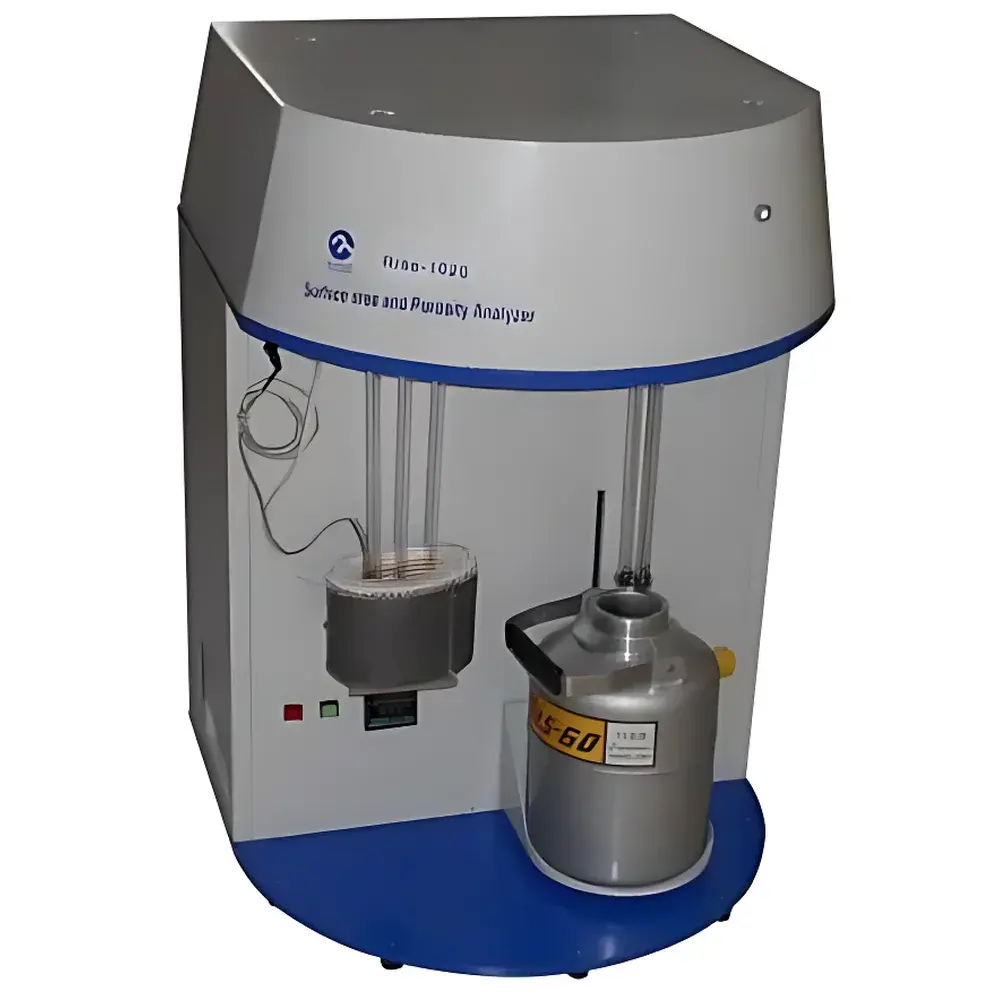
RISE Rise-1020 Automated Specific Surface Area and Pore Size Analyzer
| Brand | RISE |
|---|---|
| Origin | Beijing, China |
| Model | Rise-1020 |
| Instrument Type | Specific Surface Area and Pore Size Analyzer |
| Principle | Static Volumetric Method (Low-Temperature Nitrogen Physisorption) |
| Analysis Stations | 2 |
| Degassing Stations | 3 |
| Specific Surface Area Range | 0.0005 m²/g to no upper limit |
| Pore Size Range | 0.35–500 nm |
| Pressure Range | 0–133 kPa |
| P/P₀ Range | 1×10⁻⁶–0.998 |
| Vacuum Level | ≤1.0×10⁻⁴ Torr |
| Temperature Control | Liquid Nitrogen Bath (77 K), PT-100 Sensor (±0.1 °C) |
| Pressure Sensors | 4× Imported Absolute Transducers (0–133 kPa, ±0.1% FS) |
| AD Resolution | 22-bit |
| Theoretical Models | BET, Langmuir, BJH, t-plot, D-A, H-K, SF, MP, NLDFT, GCMC |
| Repeatability | R² ≥ 0.99 |
| Degassing Temp | Up to 400 °C |
| Sample Tube Material | Stainless Steel |
| Dewar | 2 L Metal Dewar (Cryogenic Stability) |
| Software | ISO 9277 / ISO 15901 / GB/T 19587 Compliant Data Acquisition & Reporting Suite |
Overview
The RISE Rise-1020 Automated Specific Surface Area and Pore Size Analyzer is a high-precision, dual-station instrument engineered for rigorous physical characterization of porous and powdered materials using the static volumetric method of low-temperature nitrogen physisorption. Operating at 77 K in a stable liquid nitrogen bath, the system quantifies gas adsorption isotherms by precisely measuring pressure differentials across calibrated volumes—enabling calculation of adsorbed moles via mass balance equations under controlled equilibrium conditions. Its architecture conforms to ISO 9277 (BET surface area), ISO 15901 (pore size distribution), and GB/T 19587 (Chinese national standard), ensuring metrological traceability and interlaboratory comparability. The instrument supports full-cycle automation—from sample degassing and outgassing validation to multi-point isotherm acquisition—without manual intervention, thereby minimizing operator-induced variability and enhancing reproducibility across routine QC and advanced R&D workflows.
Key Features
- Dual independent analysis stations housed within a single 2 L metal dewar, minimizing dead volume and thermal drift while enabling concurrent measurement of two samples under identical cryogenic conditions.
- Three dedicated degassing stations integrated into a flexible, temperature-controlled heating mantle (up to 400 °C), with individual thermal regulation and vacuum monitoring per station to ensure complete removal of physisorbed contaminants prior to analysis.
- Modular all-stainless-steel vacuum manifold with zero elastomer seals—eliminating hydrocarbon outgassing and adsorption artifacts common in traditional rubber-gasketed systems.
- Four high-stability absolute pressure transducers (0–133 kPa, ±0.1% full scale) coupled with 22-bit analog-to-digital conversion for sub-Pascal resolution in pressure change detection.
- Integrated P₀ saturation pressure measurement station with real-time vapor pressure tracking, supporting accurate relative pressure (P/P₀) determination across the full range of 1×10⁻⁶ to 0.998.
- Automated isotherm acquisition with adaptive equilibration algorithms that dynamically adjust dwell times based on rate-of-pressure-change thresholds, optimizing throughput without compromising data fidelity.
Sample Compatibility & Compliance
The Rise-1020 accommodates a broad spectrum of solid-phase materials—including zeolites, MOFs, silica gels, alumina catalysts, clays, activated carbons, battery electrode powders, and pharmaceutical excipients—provided they are thermally stable below 400 °C and chemically inert toward nitrogen. All measurements adhere to internationally recognized standards: ISO 9277 for BET surface area validation, ISO 15901 Parts 1–3 for meso-/macropore analysis (BJH, Dollimore-Healy), and microstructure modeling per IUPAC-recommended protocols. The system’s vacuum integrity (<1.0×10⁻⁴ Torr base pressure) and sensor calibration traceability support GLP-compliant documentation; raw data files retain full audit trails—including timestamped pressure/temperature logs, valve actuation sequences, and degassing history—for regulatory review under FDA 21 CFR Part 11 or EU Annex 11 frameworks.
Software & Data Management
The embedded acquisition and analysis software provides fully automated isotherm generation, model selection, and report compilation in accordance with ISO/IEC 17025 documentation requirements. Users may select from 12+ standardized theoretical models—including BET (single/multi-point), Langmuir, t-plot, D-A, H-K, SF, MP, BJH, and advanced kernel-based methods such as non-local density functional theory (NLDFT) and grand canonical Monte Carlo (GCMC) simulations—for pore size distribution reconstruction. All calculations are performed using vendor-validated, peer-reviewed algorithms with transparent parameter inputs (e.g., adsorbate cross-section, solid-fluid interaction potentials). Output formats include exportable CSV/Excel datasets, publication-ready SVG/PDF isotherm plots, and customizable summary reports containing uncertainty estimates derived from replicate measurements and instrumental noise profiles.
Applications
The Rise-1020 serves critical roles in catalyst development (e.g., correlating Pt dispersion with BET area), battery material qualification (anode/cathode porosity vs. Li⁺ diffusion kinetics), pharmaceutical formulation (excipient surface energetics affecting blend uniformity), and environmental science (soil clay mineralogy and contaminant sorption capacity). Its dual-station configuration enables comparative studies—such as aging effects on pore collapse or thermal treatment impact on micropore retention—with matched thermal histories and gas exposure conditions. In industrial QA/QC labs, the system supports batch release testing against predefined surface area and pore volume specifications, with pass/fail criteria programmable directly into the method template.
FAQ
What gases can be used besides nitrogen?
Nitrogen is the default adsorbate per ISO standards; argon (87 K) and carbon dioxide (273 K) are supported for specialized micropore analysis—subject to optional hardware configuration and certified calibration gas certificates.
Is the system compatible with U.S. or EU regulatory submissions?
Yes—raw data files include full metadata (instrument ID, operator, timestamps, calibration certificates), and software supports 21 CFR Part 11-compliant electronic signatures when deployed on validated Windows environments.
How is dead volume determined and corrected?
Dead volume is measured in situ using helium expansion at ambient temperature prior to each analysis cycle, with automatic correction applied during isotherm modeling to eliminate systematic bias in monolayer capacity estimation.
Can the instrument perform true density measurements?
Yes—the system includes a dedicated helium pycnometry module capable of determining skeletal density with ±0.02 g/cm³ repeatability, enabling accurate distinction between intraparticle and interparticle porosity.
What maintenance intervals are recommended for long-term accuracy?
Pressure sensors require annual recalibration against NIST-traceable standards; vacuum pump oil should be replaced every 500 operating hours; stainless-steel manifolds need no periodic cleaning due to absence of organic seals or lubricants.
Related Products



