
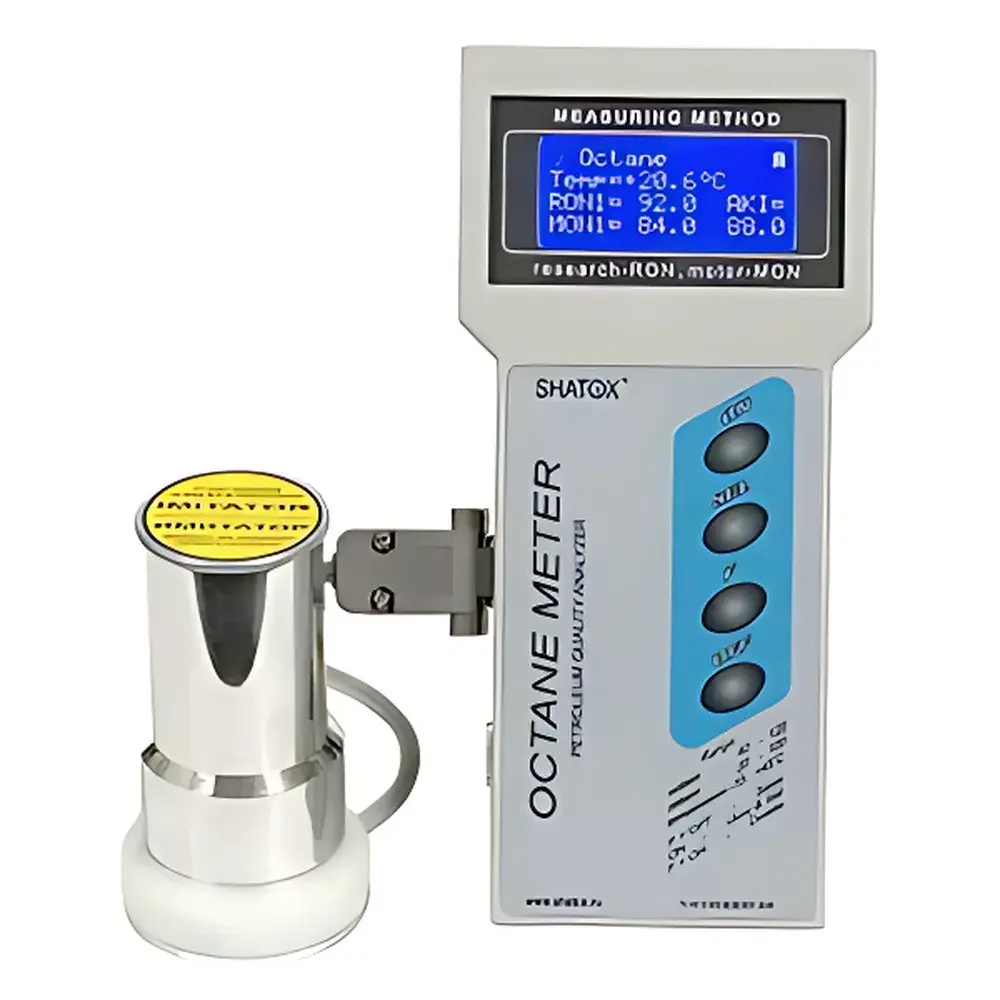
SHATOX SX-100M Portable Octane and Cetane Analyzer
| Origin | Canada |
|---|---|
| Manufacturer Type | Authorized Distributor |
| Origin Category | Imported |
| Model | SHATOX SX-100M |
| Pricing | Upon Request |
Overview
The SHATOX SX-100M Portable Octane and Cetane Analyzer is a field-deployable, microprocessor-controlled instrument engineered for rapid, on-site determination of gasoline octane numbers (RON and MON) and diesel cetane numbers using near-infrared (NIR) spectroscopy coupled with multivariate calibration models. Unlike traditional laboratory-based ASTM D2699/D2700 (octane) or ASTM D613/D4715 (cetane) test methods—which require engine-based combustion analysis—the SX-100M delivers empirical correlations validated against reference fuel standards across broad compositional ranges. Its measurement principle relies on spectral absorption patterns in the 1100–2500 nm range, where hydrocarbon branching, aromaticity, oxygenate content, and paraffinic chain length produce distinct, quantifiable signatures. Designed for refinery quality control, fuel distribution terminals, regulatory inspection teams, and emergency response units, the analyzer operates independently of external gas supplies, combustion chambers, or climate-controlled labs—enabling real-time decision-making at the point of custody transfer or blending.
Key Features
- Simultaneous display of Research Octane Number (RON), Motor Octane Number (MON), and Anti-Knock Index (AKI = (RON + MON)/2) on a four-line backlit LCD with temperature compensation
- Dual-fuel capability: measures octane values for all gasoline types (leaded, unleaded, oxygenated, and additive-blended fuels including ethers, amines, and metallic compounds—excluding ferrocene)
- Cetane number estimation for diesel fuels, accompanied by approximate cloud point prediction based on spectral thermal response modeling
- High repeatability: ±0.5 ON units for octane; ±1.0 CN units for cetane under controlled ambient conditions
- Integrated digital thermometer with automatic temperature correction (range: –10 °C to +40 °C; resolution: 0.1 °C)
- Low-power architecture: 30 mA typical current draw; >100 hours of continuous operation per full battery charge
- Ruggedized enclosure rated for solvent resistance, mechanical shock, and low-temperature environments (operating humidity: 30–80% RH; pressure: 64–106 kPa)
- USB interface compatible with Windows 95 through Windows XP for data export and firmware updates
- Non-volatile RAM storage for up to 1,000 measurement records with timestamp, fuel type flag, and environmental metadata
Sample Compatibility & Compliance
The SX-100M accepts undiluted liquid fuel samples (minimum volume: 2 mL) without pre-treatment. It is validated for use with conventional gasoline, reformulated gasoline (RFG), ethanol-gasoline blends (E10, E15), MTBE- and ETBE-containing fuels, and standard diesel fuels (EN 590, ASTM D975). While not a primary reference method per ASTM or ISO standards, its calibration traceability follows NIST-traceable reference fuel sets and is routinely verified against certified reference materials (CRMs) per ISO/IEC 17025 laboratory practice guidelines. The instrument supports GLP-aligned workflows through audit-ready data logging and user-accessible calibration history. It does not comply with ASTM D4814 or EN 228 requirements for certification of finished gasoline but serves as a qualified screening tool under internal QC protocols and field verification programs.
Software & Data Management
Data acquisition and reporting are managed via proprietary Windows-compatible software that enables batch export to CSV or Excel formats. Each stored record includes RON/MON/AKI, cetane number, sample temperature, instrument ID, operator code, and measurement timestamp. The software supports user-defined calibration updates, outlier detection flags, and statistical summary reports (mean, SD, min/max) per fuel lot. All firmware revisions adhere to version-controlled release notes, and configuration changes are logged with date/time stamps—supporting basic 21 CFR Part 11 readiness when deployed in regulated environments requiring electronic record integrity.
Applications
- On-site verification of gasoline octane grade during tanker unloading at service stations or depots
- Rapid assessment of blendstock compatibility during refinery blending operations
- Field inspection of fuel quality compliance in customs, transportation safety, and environmental enforcement
- Support for ASTM D4814 Annex A4 (screening test for octane number deviation)
- Pre-screening prior to submission of samples to certified laboratories for definitive ASTM testing
- Emergency response evaluation of fuel adulteration or contamination incidents
- Mobile laboratory support for research institutions conducting fuel formulation studies
FAQ
Does the SX-100M meet ASTM D2699 or D2700 requirements for official octane certification?
No. It is a correlative field analyzer, not a primary engine-based test method. Results must be interpreted as screening-level estimates aligned with local QC specifications.
Can it measure ethanol content directly?
No. Ethanol concentration is inferred indirectly through its spectral contribution to octane response; dedicated ethanol analyzers (e.g., ASTM D7343) are required for quantitative ethanol determination.
What is the minimum sample volume required?
2 mL of homogenous, room-temperature fuel is sufficient for stable optical path acquisition.
Is calibration transferable between instruments?
No. Each unit requires individual calibration using its own reference set; cross-instrument calibration is not supported due to optical path variability.
How often should calibration verification be performed?
Daily verification with at least one CRM is recommended for critical applications; weekly full recalibration is advised under high-use conditions.




