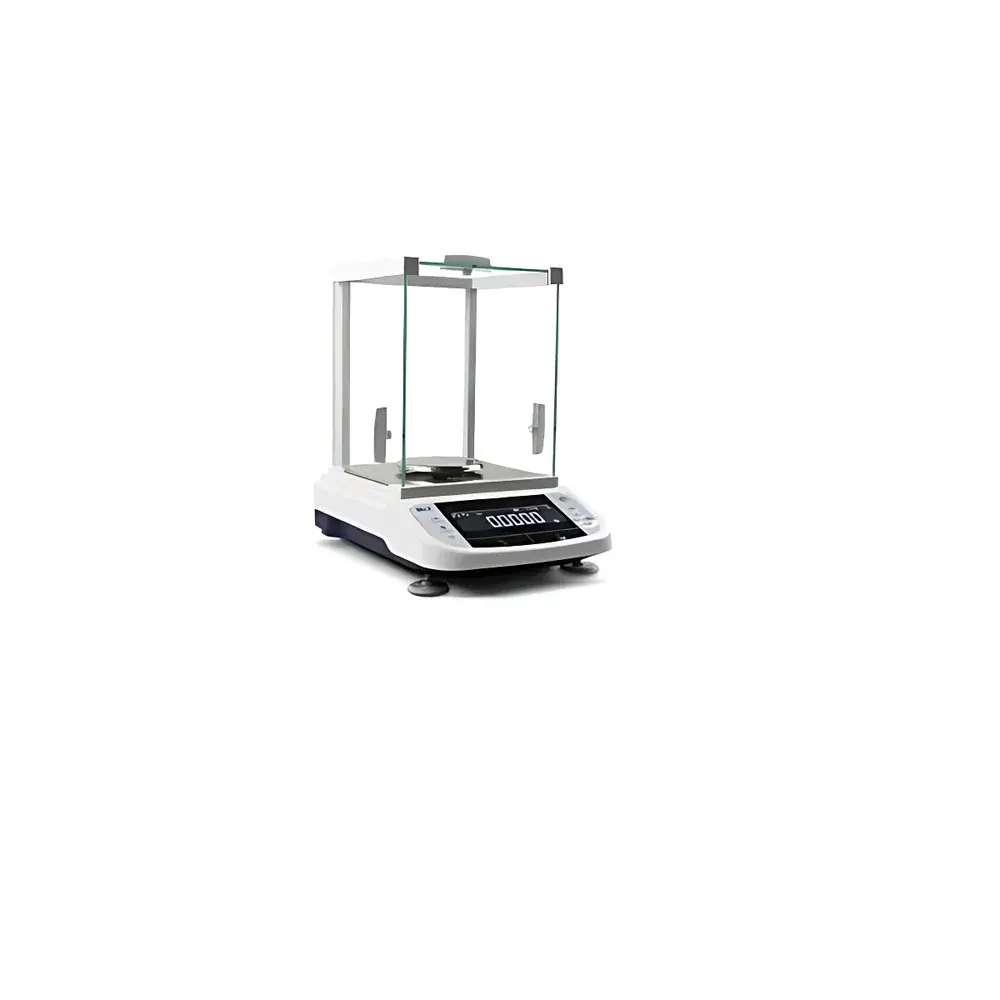
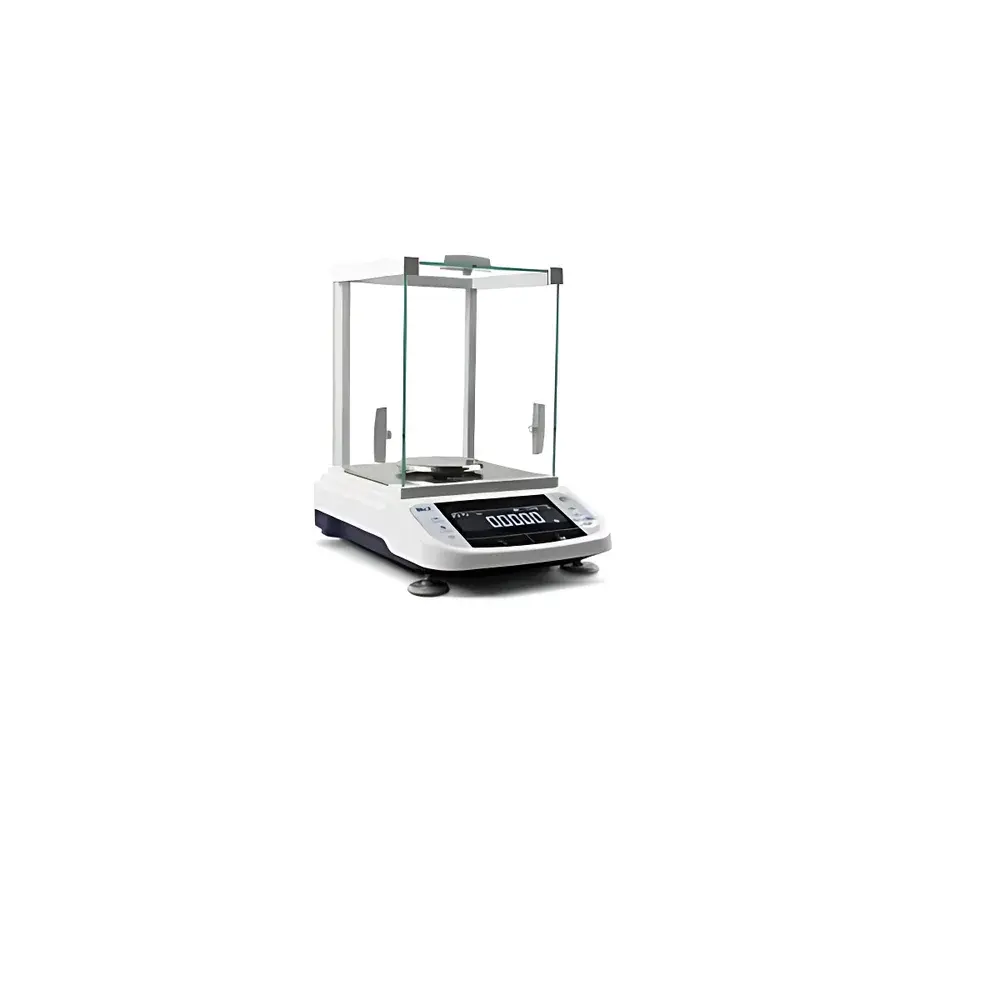
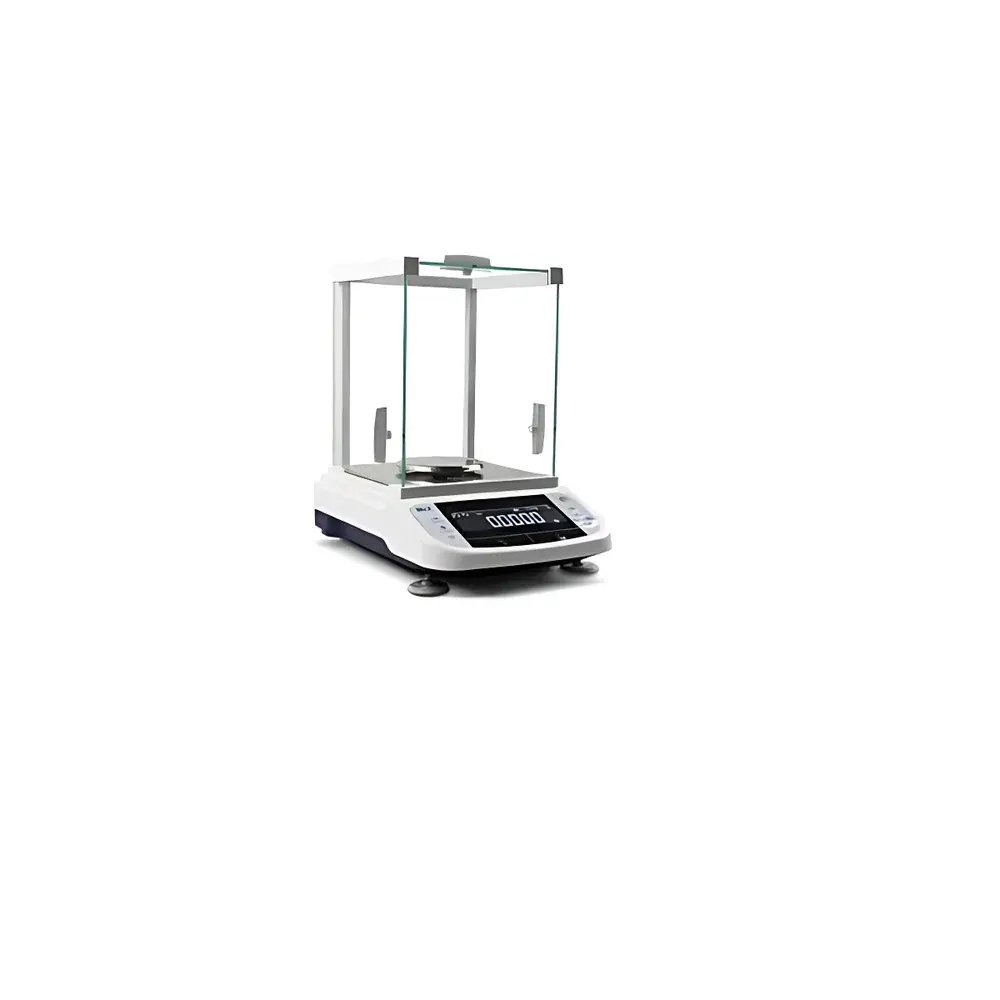
D&T JP1204 Analytical Balance
| Brand | D&T |
|---|---|
| Origin | Zhejiang, China |
| Manufacturer Type | Authorized Distributor |
| Product Category | Domestic |
| Model | JP1204 |
| Instrument Type | Analytical Balance |
| Maximum Capacity | 120 g |
| Readability | 0.1 mg |
| Repeatability (5% load) | ±0.2 mg |
| Repeatability (near full load) | ±0.3 mg |
| Linearity Error | ±0.3 mg |
| Calibration Method | Internal (isoCAL) |
| Stabilization Time | ≤3 s |
| Pan Diameter | Φ90 mm |
| Dimensions (W×D×H) | 210 × 310 × 315 mm |
| Draft Shield Height | 210 mm |
| Operating Temperature | 10–30 °C |
| Operating Humidity | 20–85% RH (non-condensing) |
| Temperature Drift | ≤5 ppm/°C |
| Warm-up Time | <15 min |
| Power Supply | 100–240 VAC, 50/60 Hz |
| DC Output | 12 VDC, 1 A |
| Communication Interface | RS232 (configurable baud rates: 300–9600) |
| Display | VA LCD |
| Environmental Compensation | Automatic temperature & time-triggered isoCAL |
| Shock Protection | Four-stage damping system |
| Accuracy Class | ISO 9001-compliant design |
Overview
The D&T JP1204 Analytical Balance is a precision laboratory instrument engineered for high-accuracy mass measurement in regulated and research-intensive environments. It operates on the principle of electromagnetic force compensation (EMFC), where the mass of a sample generates a downward gravitational force that is precisely counterbalanced by an electromagnetically induced upward force. The resulting current required to maintain equilibrium is linearly proportional to the sample mass and is digitized with 0.1 mg resolution across its 120 g maximum capacity. Designed to meet international metrological standards—including OIML R76-1 Class I and ISO/IEC 17025 traceability requirements—the JP1204 delivers consistent repeatability (±0.2 mg at 5% load; ±0.3 mg near full scale) and linearity error within ±0.3 mg. Its compact footprint (210 × 310 × 315 mm), integrated draft shield (210 mm height), and Φ90 mm stainless steel weighing pan support routine gravimetric analysis under controlled lab conditions.
Key Features
- Electromagnetic force compensation sensor architecture ensures long-term stability, minimal hysteresis, and immunity to mechanical wear.
- isoCAL internal calibration system—fully automatic, temperature- and time-triggered—maintains accuracy without manual intervention or external weights.
- Four-stage shock absorption mechanism mitigates vibration-induced drift in non-isolated benchtop installations.
- Intelligent thermal compensation algorithm corrects for ambient fluctuations up to ±1 °C/hour, reducing sensitivity drift to ≤5 ppm/°C over 10–30 °C operating range.
- VA LCD display with high-contrast, wide-view-angle rendering ensures legibility under varied lighting and viewing angles.
- RS232 serial interface supports configurable baud rates (300–9600 bps) for seamless integration with LIMS, ELN, or data acquisition systems compliant with ASTM E2500 and FDA 21 CFR Part 11 audit-trail requirements.
Sample Compatibility & Compliance
The JP1204 accommodates standard laboratory samples including powders, granules, filter membranes, crucibles, and small-volume liquid containers. Its draft shield design minimizes air-current interference during low-mass measurements (e.g., 10 mg minimum weighable quantity per USP ). The balance conforms to ISO 9001 manufacturing controls and is validated for use in GLP and GMP environments where documentation of calibration history, environmental logs, and operator access is required. While not certified for hazardous-area operation, it meets CE marking requirements for electromagnetic compatibility (EN 61326-1) and safety (EN 61010-1). Calibration traceability is supported via NIST-traceable reference masses (optional accessory).
Software & Data Management
Data output is ASCII-formatted via RS232 and compatible with standard terminal emulators or custom scripts. The balance supports auto-print functionality when paired with D&T-compatible serial printers (e.g., DP-200 series), enabling direct generation of GLP-compliant printouts with date/time stamp, gross/net/tare values, and calibration status. For digital workflows, third-party middleware (e.g., LabWare LIMS drivers or custom Python/Node.js serial parsers) can ingest real-time weight streams with metadata tagging. All calibration events—including isoCAL triggers and manual overrides—are timestamped and stored in non-volatile memory for audit review. No proprietary software is required; configuration is managed entirely via front-panel menu navigation.
Applications
The JP1204 serves core functions in pharmaceutical QC (e.g., active ingredient assay, dissolution tablet weight checks), environmental testing (filter weighing for PM2.5/PM10 analysis per EPA Method 201A), academic chemistry labs (reagent preparation, stoichiometric calculations), metallurgical R&D (alloy composition verification), and agricultural research (seed mass distribution studies). Its fast stabilization time (≤3 s) and robust microgram-level repeatability make it suitable for routine gravimetric titration, loss-on-drying (LOD), and residue-on-ignition (ROI) protocols. In educational settings, its intuitive interface and visual feedback reduce training overhead while maintaining metrological rigor aligned with ISO/IEC 17025 competency frameworks.
FAQ
Does the JP1204 support external calibration with user-provided weights?
Yes—it accepts manual calibration using Class E2 or better stainless steel砝码 (not included), though isoCAL internal calibration is recommended for daily use.
Is the RS232 interface compatible with modern Windows/macOS systems?
Yes, via USB-to-serial adapters (e.g., FTDI-based); driver installation is required, and baud rate must match device configuration.
What is the minimum weighable quantity (MWQ) under typical lab conditions?
Based on USP criteria (k = 2, repeatability = ±0.2 mg), MWQ is 10 mg—validated at 5% load with proper draft shield usage and stable environment.
Can the balance be integrated into a 21 CFR Part 11–compliant workflow?
Yes—when used with validated third-party data capture software that enforces electronic signatures, audit trails, and role-based access control.
Is temperature compensation fully automatic or user-configurable?
Fully automatic: isoCAL initiates calibration when internal temperature changes by ≥1 °C or after predefined time intervals (default: 2 hours), requiring no user input.