
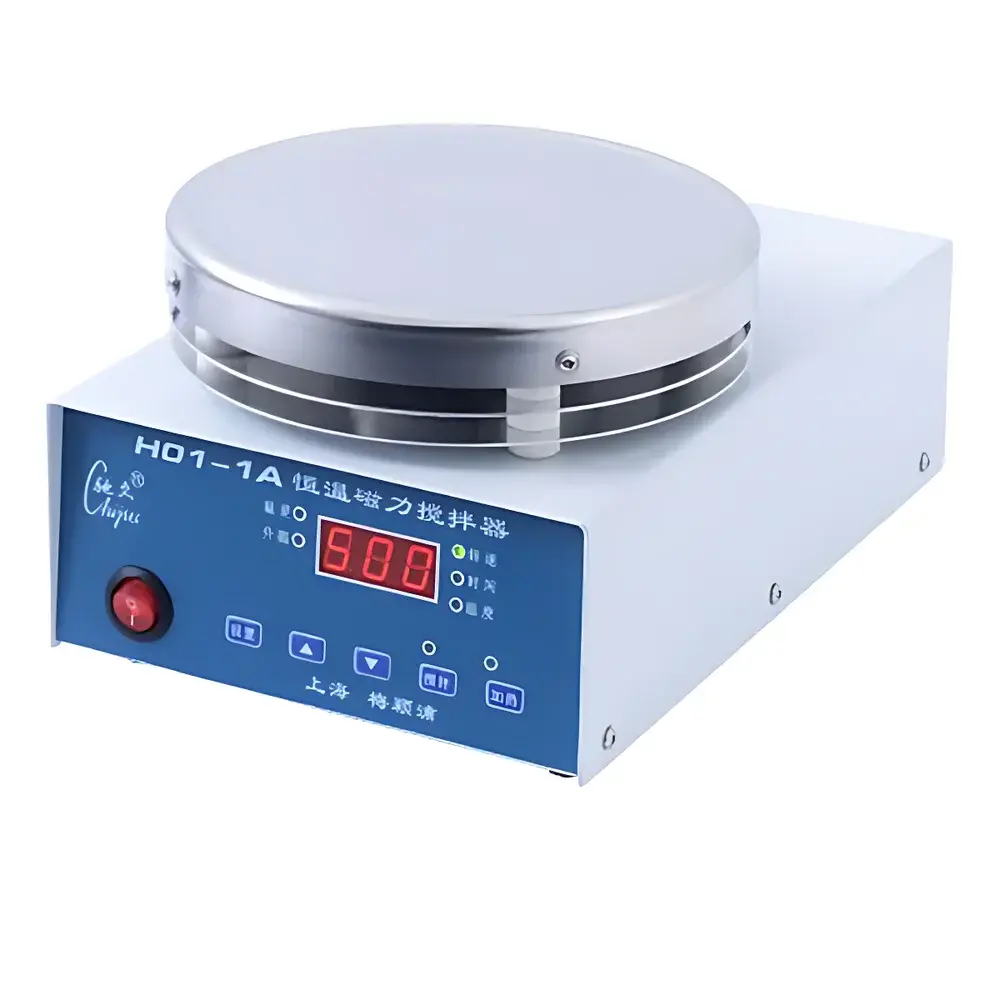
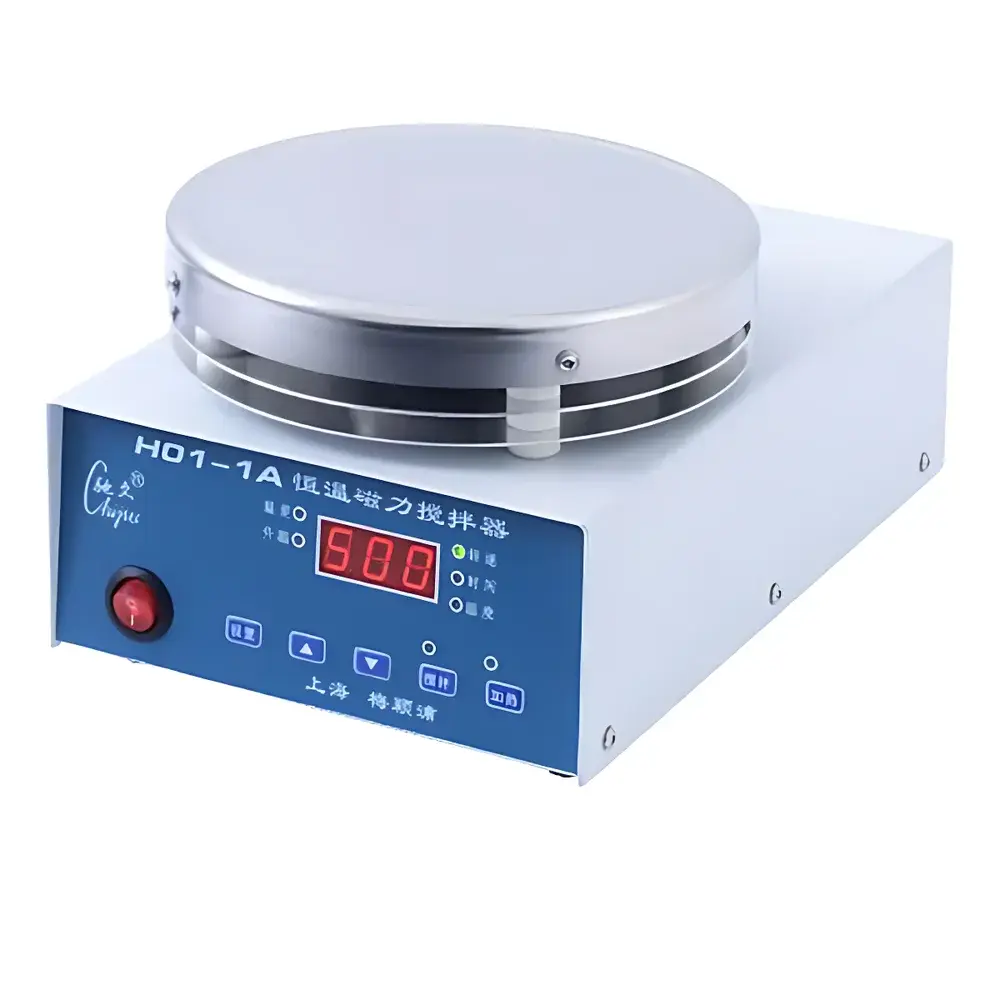
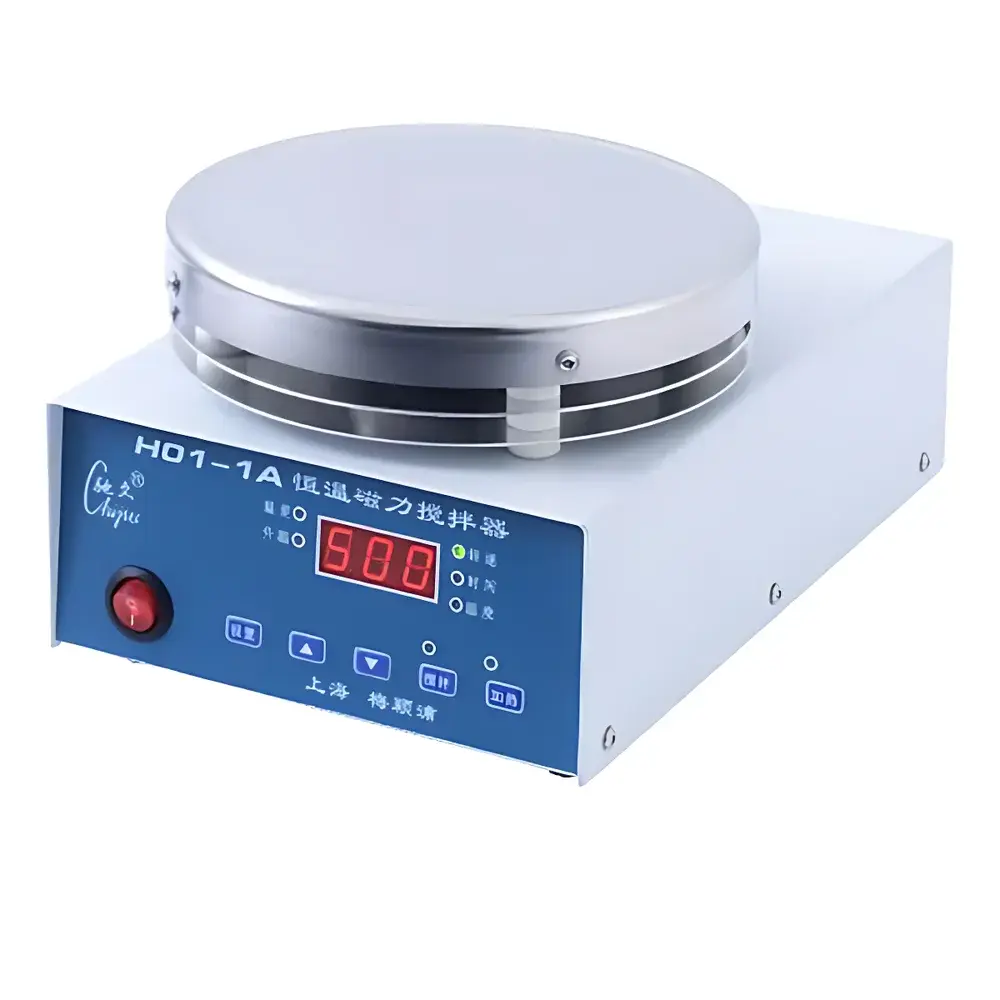
Myinglypu H01-1A Intelligent Digital Magnetic Stirrer with Dual-Temperature Control
| Brand | Myinglypu |
|---|---|
| Model | H01-1A |
| Type | Magnetic Stirrer |
| Max. Stirring Volume | 10,000 mL |
| Speed Range | 100–1500 rpm |
| Heating Plate Temp. Range | RT to 350 °C |
| Liquid Temp. Control Range | RT to 150 °C (for ≤1000 mL) |
| Temp. Control Accuracy | ±1 °C |
| Torque | 25 mN·m |
| Timer Range | 0–250 min |
| Timer Accuracy | ±1 min |
| Power Supply | AC 220 V ±10%, 50 Hz |
| Dimensions | 280 × 175 × 145 mm |
Overview
The Myinglypu H01-1A Intelligent Digital Magnetic Stirrer is an engineered laboratory instrument designed for precise, reproducible mixing and temperature-controlled sample preparation in analytical, synthetic, and quality control workflows. It operates on the principle of magnetic coupling—where a rotating permanent magnet beneath a thermally conductive ceramic or aluminum heating plate induces rotation of a PTFE- or glass-coated magnetic stir bar immersed in the sample vessel. Unlike mechanical overhead stirrers, this contactless drive mechanism eliminates shaft seals, reduces contamination risk, and ensures maintenance-free operation. The H01-1A distinguishes itself through its dual-temperature control architecture: independent regulation of both the heating plate surface temperature (up to 350 °C) and real-time liquid-phase temperature (measured via integrated Pt100 sensor, range RT–150 °C for volumes ≤1000 mL). This compensates for thermal lag and interfacial heat transfer variability caused by vessel material (e.g., borosilicate glass vs. stainless steel), bottom flatness, contact area, ambient drafts, and solution viscosity—enabling stable, application-specific thermal management without manual intervention.
Key Features
- Intelligent dual-loop temperature control: Simultaneous monitoring and regulation of heating plate surface temperature and actual liquid temperature, with user-definable offset compensation (1–250 °C delta) to correct for thermal resistance across vessel interfaces.
- Digital speed regulation: Precise microprocessor-controlled motor drive delivering consistent rotational output from 100 to 1500 rpm, with low-speed stability critical for viscous or shear-sensitive solutions.
- High-torque DC motor: 25 mN·m nominal torque ensures reliable agitation of high-viscosity media and large-volume batches up to 10,000 mL in standard round-bottom or beaker configurations.
- Extended programmable timer: 250-minute countdown function with ±1 minute accuracy supports unattended overnight reactions, dissolution testing, and standardized extraction protocols.
- Ceramic/aluminum composite heating plate: Uniform thermal distribution, rapid ramp-up, and chemical-resistant surface compatible with common solvents and aqueous buffers.
- Compact ergonomic design: Footprint of 280 × 175 mm and height of 145 mm optimizes bench space while maintaining structural rigidity and vibration damping for quiet, stable operation.
Sample Compatibility & Compliance
The H01-1A accommodates standard laboratory glassware—including 50 mL to 5 L beakers, Erlenmeyer flasks, and round-bottom flasks—with optimal performance observed using vessels with flat, clean bases and diameters matching the heating zone (≥90 mm). Stir bar selection (e.g., cross-shaped, octagonal, or flea-type) is recommended based on volume, viscosity, and required homogeneity. While not certified for hazardous area use, the unit complies with IEC 61010-1:2010 safety standards for electrical equipment for measurement, control, and laboratory use. Its temperature and timing functions support adherence to method-defined parameters in ASTM D1298 (density of crude oil), USP (dissolution apparatus calibration), and ISO 17025-accredited QA/QC procedures where documented thermal consistency is required.
Software & Data Management
The H01-1A operates as a standalone analog-digital hybrid instrument with no embedded firmware-based data logging or USB/RS232 connectivity. All operational parameters—including setpoints, timer status, and real-time RPM and temperature readings—are displayed on a high-contrast LED interface. For GLP/GMP environments requiring audit trails, external validation-grade data loggers (e.g., compliant with FDA 21 CFR Part 11 when paired with validated software) may be used to record plate and liquid temperature profiles over time. Calibration certificates for the integrated Pt100 sensor and speed encoder are available upon request to support internal instrument qualification (IQ/OQ).
Applications
- Chemical synthesis: Homogeneous reagent dispersion during reflux, esterification, or Grignard reactions under controlled thermal conditions.
- Pharmaceutical QC: Dissolution testing per USP apparatus II, buffer equilibration, and standard solution preparation at defined temperatures.
- Environmental analysis: Extraction of heavy metals from soil/sediment matrices using hot acid digestion protocols.
- Materials science: Dispersion of nanoparticles in polymer precursors or solvent-based slurries prior to casting or coating.
- Food & beverage R&D: Viscosity stabilization trials, enzyme activity assays, and thermal denaturation studies requiring precise liquid-phase temperature hold.
FAQ
What is the maximum recommended volume for accurate liquid temperature control?
Liquid temperature feedback and control are optimized for volumes up to 1000 mL. For larger volumes (up to 10,000 mL), the heating plate temperature remains fully controllable; however, users should apply a calibrated offset based on empirical validation for target bulk liquid temperature.
Can the H01-1A be used with corrosive solvents such as concentrated acids or halogenated organics?
The heating plate surface is chemically resistant to most common laboratory solvents. However, direct spillage of strong oxidizers (e.g., fuming nitric acid) or molten alkalis may degrade the ceramic coating over time. Use secondary containment and routine surface inspection.
Is the unit suitable for applications requiring GMP documentation?
As a Class I standalone instrument, it supports GMP workflows when operated within a validated environment. Full compliance requires periodic calibration of the Pt100 sensor and speed encoder, documented in instrument logs per internal SOPs.
Does the timer function retain settings during power interruption?
No—the timer is volatile and resets upon power loss. For fail-safe operation, integrate with an uninterruptible power supply (UPS) or use external process controllers.
How is thermal offset configured for different vessel types?
Via the front-panel menu: Users input a fixed delta value (1–250 °C) representing the empirically determined difference between plate setpoint and measured liquid temperature under representative operating conditions (e.g., +22 °C for a 1000 mL Pyrex beaker at 95 °C).



