
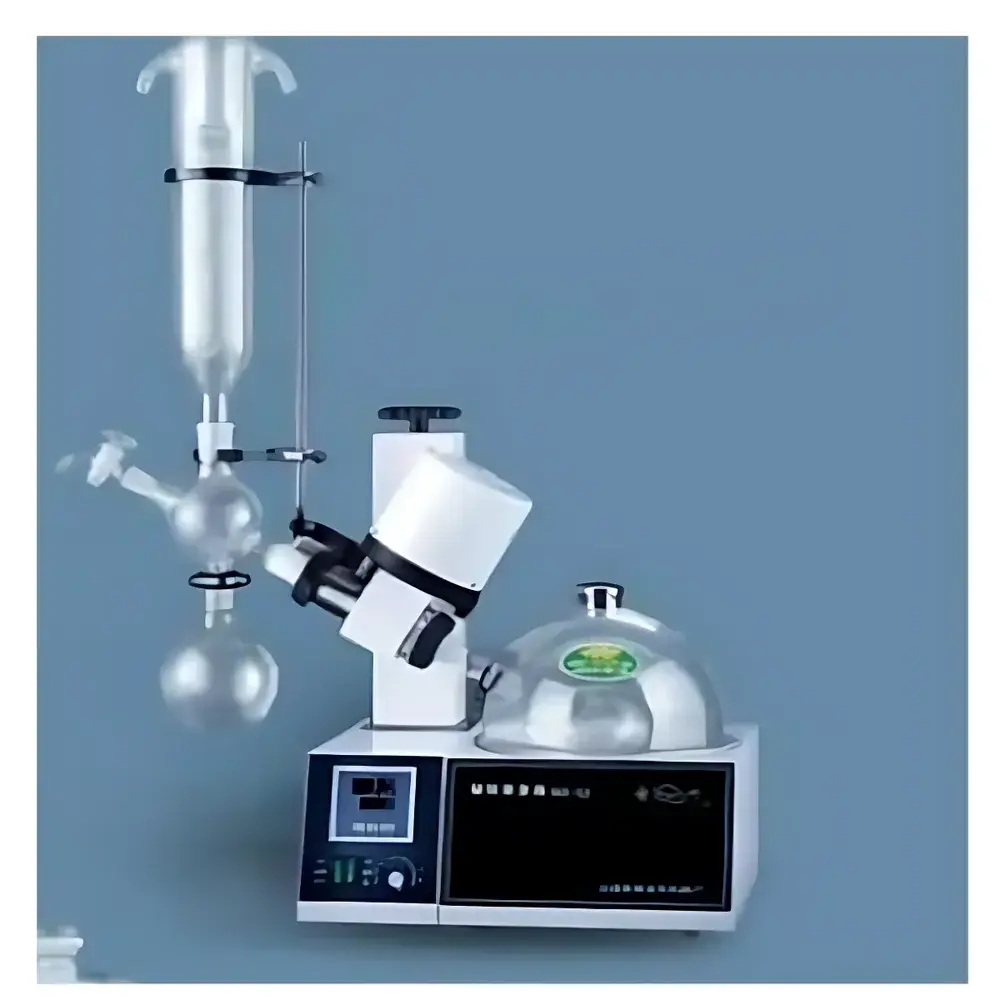
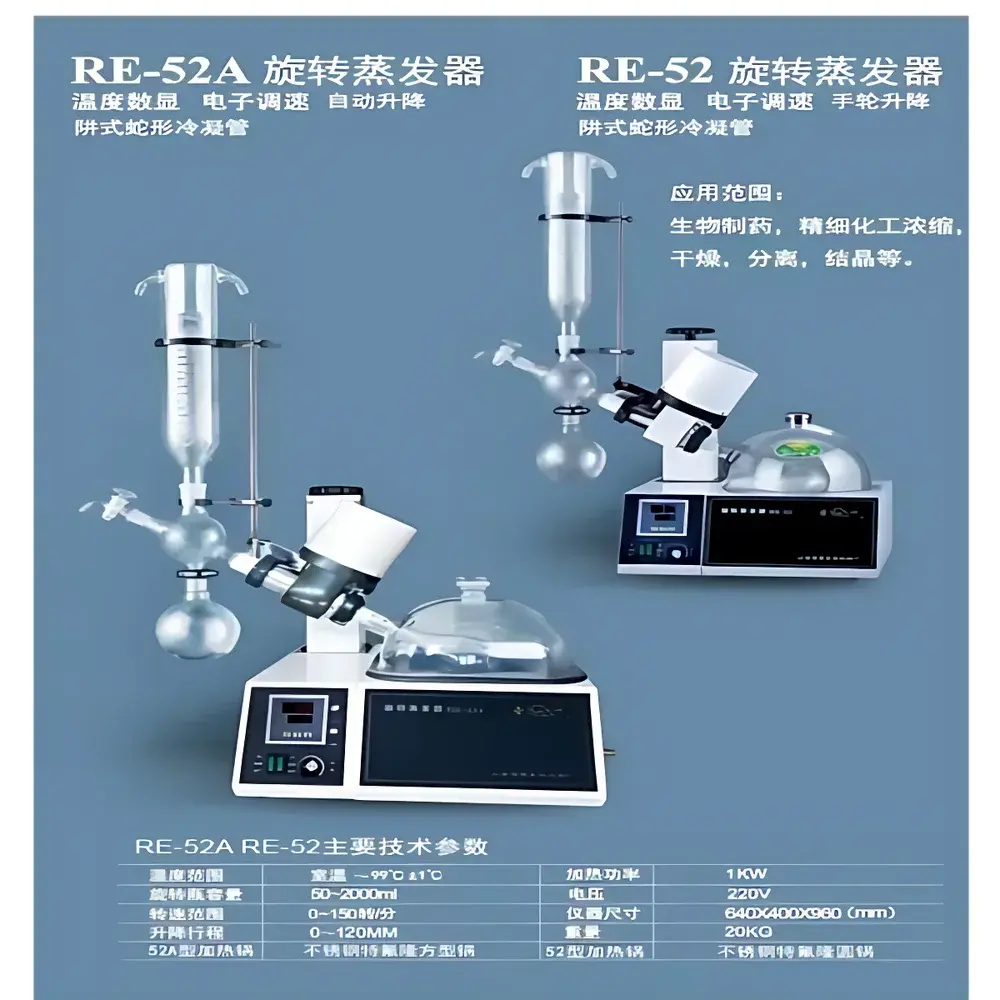
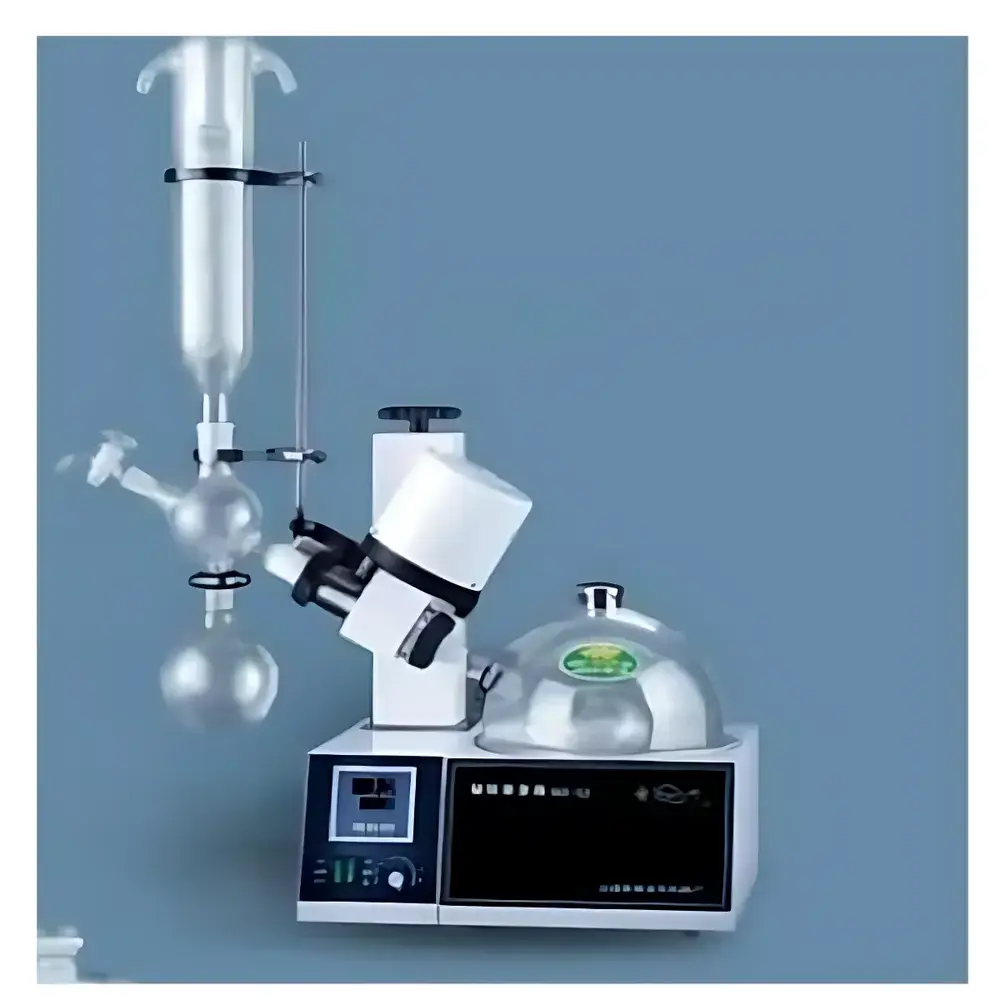
Shanghai Yarong RE-52C Rotary Evaporator
| Brand | Shanghai Yarong / Yarong |
|---|---|
| Origin | Shanghai, China |
| Manufacturer Type | General Distributor |
| Region of Manufacture | Domestic (China) |
| Model | RE-52C |
| Price | ¥2,620 |
| Temperature Range | Ambient to 99 °C (±1 °C) |
| Rotating Flask Capacity | 50–2000 mL |
| Rotation Speed | 0–150 rpm |
| Vertical Lift Travel | 0–120 mm |
| Condenser Type | U-tube vertical condenser with auxiliary feed tube, large-diameter condensing and evaporation tubes |
| Evaporation Efficiency | Higher than comparable models in class |
| Heating Bath | Stainless steel bath with PTFE-coated circular heating element and transparent protective罩 |
| Heating Power | 1000 W |
| Voltage/Frequency | 220 V / 50 Hz |
| Cooling System | Internal recirculating coolant path |
Overview
The Shanghai Yarong RE-52C Rotary Evaporator is a precision-engineered laboratory instrument designed for efficient solvent removal, concentration, drying, and recovery under reduced pressure. Based on the fundamental principle of rotary evaporation—where a rotating flask increases surface area while simultaneous gentle heating and vacuum application lower the boiling point of solvents—the RE-52C enables controlled, reproducible evaporation of heat-sensitive compounds across academic, pharmaceutical, and industrial R&D environments. Its upright configuration integrates a stainless steel water/oil bath with PTFE-coated heating elements, ensuring uniform thermal distribution and corrosion resistance. The system operates within a calibrated temperature range of ambient to 99 °C (±1 °C), supporting both aqueous and organic solvent workflows without thermal degradation. Vacuum compatibility is optimized via sealed glass joints and a robust vapor pathway design, minimizing bumping and foaming during distillation.
Key Features
- Adjustable rotation speed from 0 to 150 rpm, enabling precise control over film thickness and mass transfer dynamics on the inner flask wall.
- Vertical lift mechanism with 120 mm travel range allows seamless flask immersion and removal without manual repositioning or vacuum breakage.
- U-tube vertical condenser assembly features oversized condensing and evaporation tubing, enhancing heat exchange efficiency and condensate recovery rate compared to standard coil-type designs.
- PTFE-coated stainless steel heating bath provides chemical inertness, thermal stability, and long-term durability—even during extended operation with aggressive solvents.
- Integrated transparent protective shield ensures operator safety while permitting real-time visual monitoring of evaporation progress and flask behavior.
- Modular glassware set (including 50 mL to 2000 mL rotating flasks) supports scalable workflow adaptation—from micro-scale synthesis purification to preparative batch processing.
Sample Compatibility & Compliance
The RE-52C accommodates a broad spectrum of sample types, including volatile organic solvents (e.g., acetone, dichloromethane, ethanol), aqueous solutions, thermolabile natural product extracts, and polymer solutions. Its all-glass vapor path (borosilicate 3.3) complies with general laboratory material compatibility standards for Class I and II solvents per ASTM D4291. While not certified to ISO/IEC 17025 or GLP/GMP out-of-the-box, the unit’s stable temperature control, repeatable rotational performance, and vacuum integrity support data traceability when integrated into validated SOPs. Users performing regulated work (e.g., pharmaceutical QC) are advised to implement external calibration logs, maintenance records, and audit-ready operational documentation consistent with FDA 21 CFR Part 11 expectations for instrument qualification.
Software & Data Management
The RE-52C operates as a standalone analog-controlled system without embedded digital firmware or proprietary software. Temperature is regulated via a mechanical thermostat with ±1 °C accuracy; rotation speed is adjusted using a manually calibrated rheostat. For laboratories requiring electronic data capture, the unit can be interfaced with external PID controllers, digital vacuum gauges, or LabVIEW-compatible DAQ systems via analog signal outputs (0–10 V or 4–20 mA, if retrofitted). No built-in data logging, user authentication, or electronic signature functionality is provided—consistent with its role as a foundational benchtop tool rather than a fully compliant GxP instrument.
Applications
- Solvent removal following column chromatography or solid-phase extraction in organic synthesis labs.
- Concentration of enzyme assays, protein fractions, or nucleic acid samples prior to HPLC or MS analysis.
- Recovery and recycling of high-purity solvents in pilot-scale process development.
- Drying of hygroscopic intermediates under mild thermal conditions to preserve crystallinity and assay integrity.
- Preparative isolation of essential oils, alkaloids, or flavonoids from botanical extracts using low-residue evaporation protocols.
- Teaching applications in undergraduate chemistry curricula for demonstrating phase equilibria, Raoult’s law, and vacuum thermodynamics.
FAQ
What vacuum level is recommended for optimal performance with the RE-52C?
A working vacuum of 10–100 mbar is typically sufficient for most low-boiling solvents; final pressure should be selected based on solvent vapor pressure curves and thermal sensitivity of the analyte.
Can the RE-52C be used with corrosive solvents such as concentrated HCl or HF?
No—standard borosilicate glass components are incompatible with hydrofluoric acid and strongly oxidizing acids; users must verify chemical resistance of all wetted parts (including seals and condenser gaskets) before exposure.
Is the heating bath compatible with silicone oil or other high-temperature media?
Yes, the stainless steel bath accepts silicone oil up to 200 °C; however, the factory-set temperature controller is rated only to 99 °C, requiring external regulation for higher-temperature operation.
Does the RE-52C include a vacuum pump or chiller?
No—these are optional accessories; the system requires an external vacuum source and coolant circulation (e.g., tap water or recirculating chiller) for condenser operation.
What maintenance practices ensure long-term reliability?
Regular inspection of PTFE seals, lubrication of lift mechanism threads, periodic cleaning of condenser tubing with appropriate solvents, and verification of bath temperature calibration every 6 months are recommended.



