
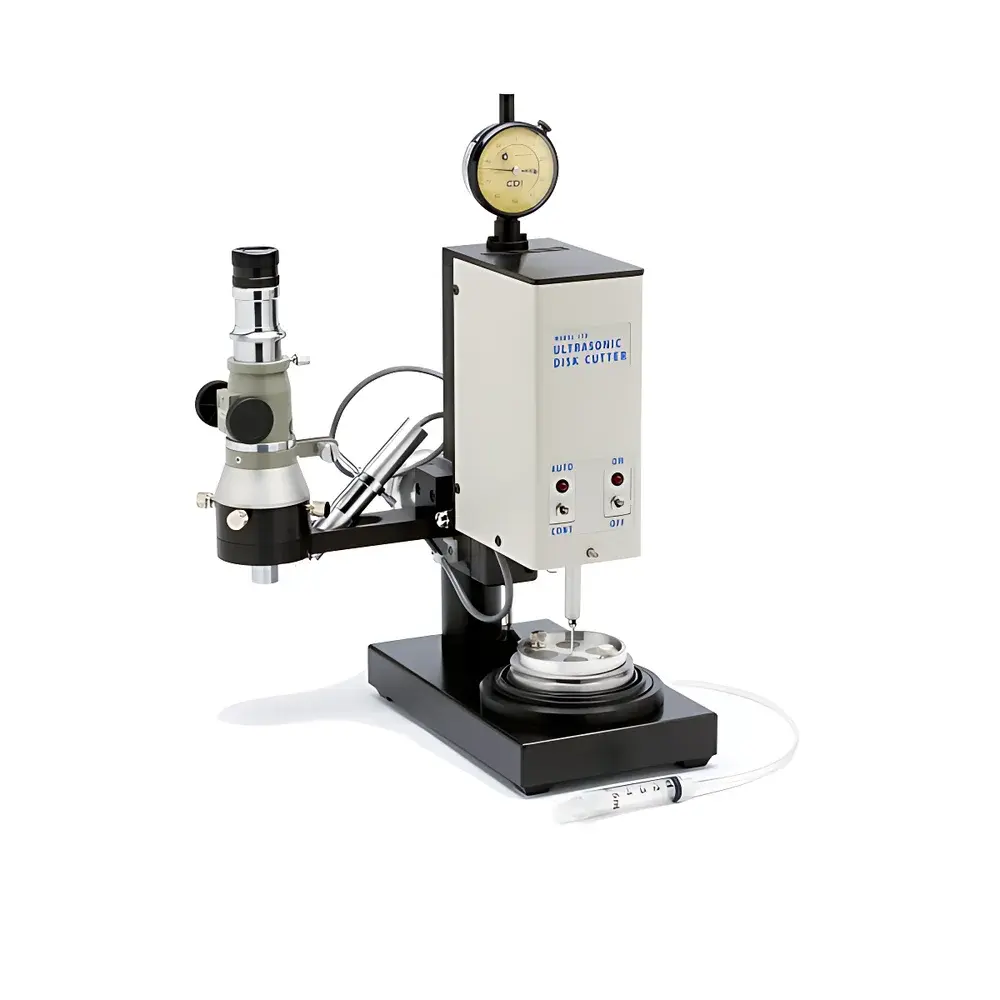
Fischione Model 170 Ultrasonic Disk Cutter
| Brand | Fischione |
|---|---|
| Origin | USA |
| Manufacturer Status | Authorized Distributor |
| Origin Category | Imported |
| Model | 170 |
| Price | Upon Request |
Overview
The Fischione Model 170 Ultrasonic Disk Cutter is a precision-engineered instrument designed for the non-destructive, room-temperature sectioning of hard and brittle materials used in transmission electron microscopy (TEM) sample preparation. Unlike conventional mechanical sawing or ion milling techniques—which introduce plastic deformation, heat-affected zones, or preferential sputtering—the Model 170 employs high-frequency ultrasonic vibration (typically 20–40 kHz) coupled with diamond-impregnated cutting tools to achieve material removal via micro-fracture rather than abrasion or melting. This mechanism preserves crystallographic integrity, minimizes amorphous layer formation, and eliminates thermal artifacts—critical requirements for high-resolution TEM, electron backscatter diffraction (EBSD), and atom probe tomography (APT) analyses.
Key Features
- Ultrasonic-assisted cutting at controlled frequency and amplitude to suppress mechanical stress accumulation and localized heating
- Capable of producing circular disk specimens ≥10 μm thick from thin foils or wafers, as well as cylindrical rods up to 10 mm in length from bulk samples
- Integrated automatic termination system that halts cutting upon full penetration or predefined depth—ensuring repeatability and preventing tool overtravel
- Modular stage design accommodating rectangular wafers (e.g., Si, GaAs, ceramic substrates) for subsequent cross-sectional TEM lamella extraction
- Tooling compatibility with standard diamond-coated wire, blade, and core-drill geometries for application-specific optimization
- Compact benchtop footprint with ESD-safe enclosure and integrated dust extraction port compliant with ISO 14644-1 Class 5 cleanroom practices
Sample Compatibility & Compliance
The Model 170 is validated for use with ceramics (Al₂O₃, SiC, YSZ), intermetallics, hardened steels, optical crystals (sapphire, quartz), and semiconductor wafers (Si, SiC, GaN). It supports specimen geometries including disks (3–6 mm diameter), rods (Ø1–3 mm × up to 10 mm), and planar wafers (up to 25 × 25 mm). The system conforms to ASTM E1558–22 (Standard Guide for Preparation of Transmission Electron Microscopy Specimens by Mechanical Methods) and aligns with ISO/IEC 17025 requirements for method validation in accredited laboratories. All operational logs—including time-stamped cutting parameters, tool usage cycles, and termination events—are retained for GLP/GMP audit readiness.
Software & Data Management
The Model 170 operates via a dedicated embedded controller with a tactile LCD interface; no external PC is required for routine operation. Parameter sets (vibration amplitude, feed rate, dwell time, termination threshold) are stored in non-volatile memory with user-defined naming and version control. Optional RS-232/USB-C connectivity enables integration into laboratory information management systems (LIMS) and supports CSV export of session metadata for traceability. Audit trails comply with FDA 21 CFR Part 11 requirements when paired with validated electronic signature modules and time-synchronized NTP servers.
Applications
- Preparation of artifact-free TEM disks from sintered ceramic coatings for grain boundary analysis
- Rapid isolation of cylindrical pillars from additively manufactured Ni-based superalloys prior to FIB lift-out
- Sectioning of brittle III–V semiconductor heterostructures without interfacial delamination
- Generation of wafer-scale cross-section blanks for focused ion beam (FIB) site-specific thinning in failure analysis labs
- Production of reference standards for quantitative EDS calibration where stoichiometric fidelity must be preserved
FAQ
What types of materials are compatible with the Model 170?
The instrument is optimized for hard, brittle, and polycrystalline materials including oxides, carbides, nitrides, intermetallics, and single-crystal semiconductors. Ductile metals (e.g., pure Cu, Al) are not recommended due to excessive plastic flow under ultrasonic loading.
Can the Model 170 cut curved or irregular surfaces?
No—it requires flat, parallel surfaces for stable acoustic coupling and consistent energy transfer. Samples must be mounted on precision-ground holders with ≤5 µm surface flatness tolerance.
Is tool wear monitored automatically?
While no real-time wear sensor is integrated, the controller logs cumulative cutting time per tool ID and triggers configurable alerts based on manufacturer-recommended service intervals (e.g., every 8–12 hours of active ultrasonic operation).
Does the system support automated batch processing?
Yes—up to 12 pre-programmed protocols can be queued sequentially via the front-panel interface, enabling unattended overnight processing of identical specimen geometries across multiple samples.
What safety certifications does the Model 170 hold?
It carries UL 61010-1 and CE marking per Directive 2014/30/EU (EMC) and 2014/35/EU (LVD), with documented risk assessment per ISO 14121-1 and noise emission <72 dB(A) at 1 m.




