
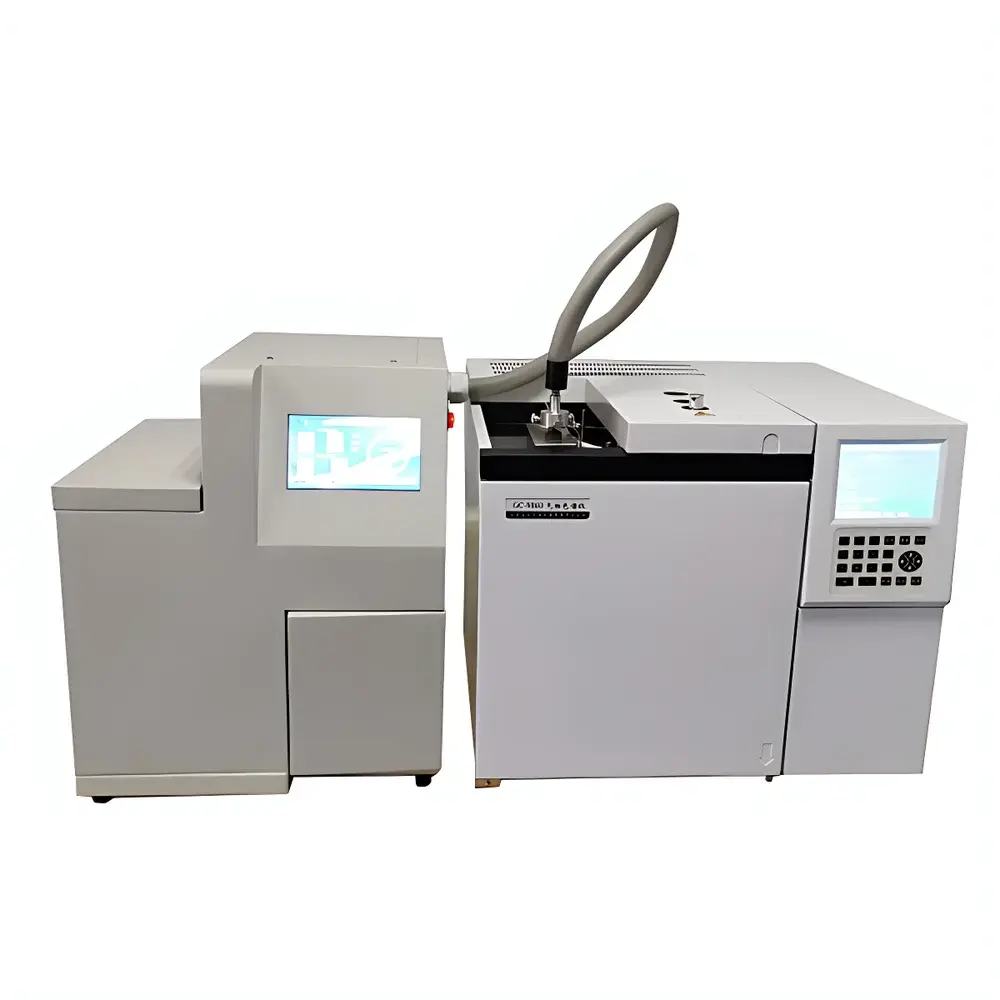
Beifen Sanpu AHS-20A Plus Automated Static Headspace Sampler for Water Analysis of BTEX and Styrene
| Brand | Beifen Sanpu |
|---|---|
| Origin | Beijing, China |
| Manufacturer Type | Direct Manufacturer |
| Instrument Type | Static Headspace Sampler |
| Automation Level | Fully Automatic |
| Vial Heating Range | Ambient to 200 °C (1 °C increments) |
| Valve & Transfer Line Temperature Control Range | 40–220 °C (±1 °C accuracy) |
| Sample Loop Volume | 1 mL |
| Vial Capacity | 20 positions |
| Compatible Vial Sizes | 10 mL or 20 mL |
Overview
The Beifen Sanpu AHS-20A Plus is a fully automated static headspace sampler engineered for precise, reproducible quantification of volatile aromatic hydrocarbons—including benzene, toluene, ethylbenzene, xylenes (o-, m-, p-), cumene, and styrene—in aqueous matrices. Designed in strict alignment with HJ 1067–2019 (“Determination of Benzene Homologues in Water by Headspace Gas Chromatography”), this system implements the fundamental thermodynamic principle of phase equilibrium: at controlled temperature and pressure, volatile analytes partition between liquid and headspace phases according to their vapor pressures and matrix composition. The resulting headspace vapor concentration exhibits linear proportionality to aqueous-phase concentration within defined dynamic ranges—enabling robust external calibration and trace-level detection. Its integration with standard GC-FID systems supports routine compliance testing across environmental monitoring laboratories, wastewater treatment facilities, and regulatory QA/QC departments operating under GLP or ISO/IEC 17025 frameworks.
Key Features
- Fully automated 20-position carousel with programmable vial selection and sequential processing—eliminates manual handling and enhances throughput consistency.
- Precise thermal control architecture: independent PID-regulated heating zones for vial oven (ambient to 200 °C, ±1 °C), injection valve (40–220 °C), and transfer line (40–220 °C), ensuring minimal carryover and thermal degradation.
- 1 mL fixed-volume sample loop with inert stainless-steel construction and heated pathway—guarantees volumetric accuracy and prevents condensation during transfer.
- Compatible with standard 10 mL and 20 mL crimp-top or screw-cap headspace vials fitted with PTFE/silicone septa—supports method flexibility per HJ 1067–2019 Section 5.6.
- Integrated agitation function (optional magnetic stirring or vortex shaking) prior to equilibration—improves mass transfer kinetics and analytical reproducibility for heterogeneous or viscous samples.
- Robust firmware with audit-trail-enabled method storage, run-time logging, and error diagnostics—facilitates 21 CFR Part 11-compliant data integrity when paired with validated GC software.
Sample Compatibility & Compliance
The AHS-20A Plus is validated for use with surface water, groundwater, domestic sewage, and industrial effluents per HJ 1067–2019 scope. Sample preparation follows standardized acidification (pH ≤2 using 1+1 HCl), sodium chloride saturation (3 g NaCl per 10 mL sample), and ambient-temperature equilibration (60 °C, 30 min). Method detection limits range from 2 to 3 µg/L; practical quantitation limits fall between 8 and 12 µg/L at 10 mL sample volume. The instrument complies with requirements for thermal stability and precision outlined in ISO 15686-3 (VOC analysis in water) and ASTM D6866–22 (headspace sampling performance criteria). All operational parameters—including vial temperature ramp profiles, valve dwell times, and loop purge cycles—are fully configurable to meet site-specific validation protocols required by CNAS-accredited laboratories.
Software & Data Management
Controlled via Beifen Sanpu’s HS-Link™ PC software (Windows 10/11 compatible), the AHS-20A Plus supports method-driven workflows with password-protected user roles, electronic signature capture, and immutable run logs. Each sequence file embeds metadata including operator ID, vial map, thermal setpoints, and timestamped status events. Raw acquisition data (e.g., valve actuation timing, temperature deviation alerts) are exported in .csv format for third-party LIMS ingestion. When interfaced with chromatography data systems (CDS) such as OpenLab CDS or Chromeleon, the sampler triggers GC start commands via TTL or Ethernet—ensuring synchronized instrument control and full chain-of-custody documentation. Audit trails satisfy GLP audit requirements and support FDA inspection readiness under 21 CFR Part 11 Subpart B.
Applications
- Regulatory monitoring of BTEX compounds in drinking water sources per China’s “Environmental Quality Standards for Surface Water” (GB 3838–2002) and “Standards for Wastewater Discharge” (GB 8978–1996).
- Leachate characterization from landfill sites and contaminated soil remediation projects.
- Process water quality assurance in petrochemical, pharmaceutical, and coating manufacturing facilities.
- Method validation and interlaboratory comparison studies under CNAS accreditation (CNAS-CL01:2018).
- Research applications involving kinetic partitioning studies, salinity effects on Henry’s law constants, and matrix interference assessment in complex wastewater streams.
FAQ
What sample volume is supported for quantitative analysis?
The system is optimized for 10.0 mL or 20.0 mL aqueous samples in standard headspace vials, consistent with HJ 1067–2019 protocol requirements.
Does the AHS-20A Plus support dynamic headspace or purge-and-trap configurations?
No—it is a static headspace sampler only. Dynamic extraction requires separate purge-and-trap instrumentation.
Can the instrument be integrated with third-party GC systems from Agilent, Shimadzu, or Thermo Fisher?
Yes—via standard RS-232, USB, or Ethernet interfaces with customizable trigger logic and vendor-neutral command syntax.
Is validation documentation provided for IQ/OQ/PQ protocols?
Beifen Sanpu supplies a comprehensive Instrument Qualification Package—including factory test reports, calibration certificates traceable to NIM (National Institute of Metrology, China), and blank run verification data—for customer-led PQ execution.
What maintenance intervals are recommended for long-term reliability?
Valve seals and septa should be replaced every 1,000 injections; loop tubing inspected quarterly; and thermal calibration verified semiannually using NIST-traceable reference standards.





