
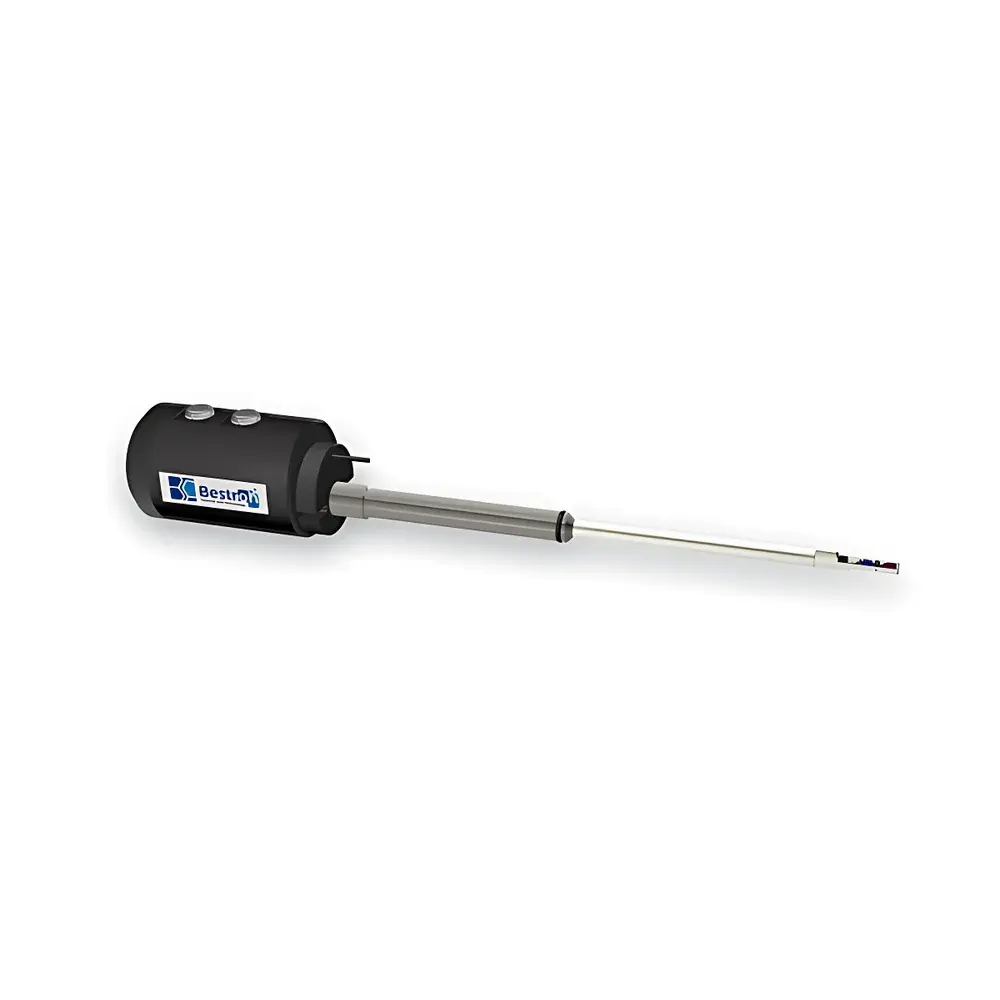
Bestron INSTEMS-MT In Situ Dual-Tilt Mechanical-Thermal Coupling System for Transmission Electron Microscopy
| Brand | Bestron |
|---|---|
| Model | INSTEMS-MT |
| Category | In Situ TEM Sample Holder |
| Heating Range | RT to 1200 °C |
| Temperature Accuracy | < 0.1 °C |
| Programmable Thermal Ramp Rate | >10,000 °C/s |
| Mechanical Load Capacity | >100 mN |
| Drive Resolution | < 500 pm |
| Dual-Axis Tilt | α ±20°, β ±10° |
| Sample Drift | < 50 pm/s |
| Spatial Resolution (TEM-compatible) | ≤0.1 nm |
| EDS-Compatible | Yes |
| Current Range | 0–2 A |
| Voltage Range | 0–150 V |
Overview
The Bestron INSTEMS-MT is a high-precision, dual-axis tilting in situ sample holder engineered for atomic-resolution transmission electron microscopy (TEM) under synchronized mechanical loading and controlled thermal stimulation. It implements a localized Joule-heating architecture integrated with a piezoelectric-driven nanomechanical actuator, enabling simultaneous application of calibrated uniaxial stress/strain and precisely programmable temperature fields within the TEM column. Unlike conventional single-field holders, the INSTEMS-MT operates on a coupled-field design principle—where thermal gradients and mechanical boundary conditions are co-registered at sub-nanometer spatial scales—making it suitable for investigating thermally activated deformation mechanisms, phase nucleation kinetics, and dislocation–precipitate interactions under realistic service conditions. Its compact, low-power heating module minimizes thermal drift and electromagnetic interference, preserving both beam coherence and detector fidelity during long-duration dynamic experiments.
Key Features
- Dual-axis mechanical tilt capability: independent α-axis rotation up to ±20° and β-axis up to ±10°, enabling crystallographic zone-axis alignment and multi-angle diffraction contrast analysis during active loading.
- Ultra-stable thermal-mechanical coupling: real-time synchronization between temperature ramping (RT to 1200 °C), dwell control (<0.1 °C stability), and force application (100 mN maximum, <500 pm displacement resolution).
- Low-drift mechanical platform: sample displacement drift maintained below 50 pm/s under full thermal load, ensuring uninterrupted atomic-scale imaging continuity over extended acquisition windows.
- Four-probe electrical configuration: integrated voltage/current sensing ports support in situ resistivity and thermopower measurements concurrent with mechanical testing.
- EDS-compatible geometry: optimized pole-piece clearance and minimal holder mass ensure unobstructed X-ray collection angles and high solid-angle detection efficiency.
- Modular sample mounting interface: accepts standard 3 mm TEM grids and custom microfabricated devices; compatible with focused ion beam (FIB)-lifted lamellae and MEMS-based test structures.
Sample Compatibility & Compliance
The INSTEMS-MT accommodates a broad spectrum of TEM-specimen geometries—including bulk thin foils, nanoparticle arrays, heterostructured multilayers, and FIB-prepared single-crystal pillars—without compromising mechanical or thermal fidelity. Its sample stage conforms to ISO 16700:2018 requirements for in situ mechanical testing instrumentation, and thermal calibration protocols follow ASTM E2550-21 guidelines for high-temperature thermogravimetric analysis validation. All electrical interfaces comply with IEC 61000-4-5 surge immunity standards, and the holder housing meets vacuum compatibility specifications per ISO 14644-1 Class 5 cleanroom requirements for UHV TEM environments (≤1×10⁻⁷ Pa base pressure). The system supports GLP-compliant experimental logging when paired with validated TEM acquisition software.
Software & Data Management
The INSTEMS-MT integrates via USB 3.0 and analog I/O with third-party TEM control platforms (e.g., Thermo Fisher Velox, JEOL JEM-ARM series, and CEOS aberration-corrected systems). A dedicated Bestron Control Suite provides synchronized waveform generation for thermal ramps, load profiles, and tilt sequences, with timestamped metadata export in HDF5 format. All parameter sets—including force setpoints, temperature dwell durations, and tilt angles—are stored with cryptographic hash verification to satisfy FDA 21 CFR Part 11 audit-trail requirements. Real-time feedback loops enable closed-loop temperature stabilization and adaptive load compensation based on in situ strain gauge output.
Applications
- High-temperature creep and stress relaxation kinetics in Ni-based superalloys and refractory metals.
- Nucleation and growth dynamics of metastable phases during rapid thermal cycling (e.g., martensitic transformations, spinodal decomposition).
- Atomic-scale observation of dislocation climb, cross-slip, and jog formation under combined thermal–mechanical stress.
- In situ quantification of solute drag effects and vacancy-mediated diffusion pathways using time-resolved EDS mapping.
- Mechano-thermal fatigue behavior in oxide dispersion strengthened (ODS) steels and ceramic matrix composites.
- Interface stability studies at metal–ceramic and semiconductor–oxide heterojunctions under thermal gradient-induced stresses.
FAQ
Is the INSTEMS-MT compatible with aberration-corrected TEMs operating at 200–300 kV?
Yes—the holder’s electromagnetic shielding and low outgassing materials have been validated on monochromated Titan G2 and ARM200F platforms without observable image distortion or energy-loss peak broadening.
Can the system perform simultaneous heating, tilting, and mechanical loading?
Yes—hardware-level trigger synchronization ensures sub-millisecond coordination among all three stimulus domains, verified via high-speed TEM video correlation with external DAQ timestamps.
What vacuum level is required for optimal performance?
The holder achieves stable operation at ≤5×10⁻⁷ Pa; bake-out to 120 °C for 12 hours is recommended prior to first use in ultra-high-vacuum TEM columns.
Does the system support automated experiment sequencing?
Yes—through Python API integration, users can script multi-step protocols including ramp-hold-load cycles, tilt-series acquisition, and conditional termination based on real-time image entropy metrics.
Are calibration certificates traceable to NIST standards provided?
Each unit ships with a factory calibration report referencing NIST-traceable thermocouple standards (ITS-90) and certified dead-weight force calibration up to 150 mN.





