
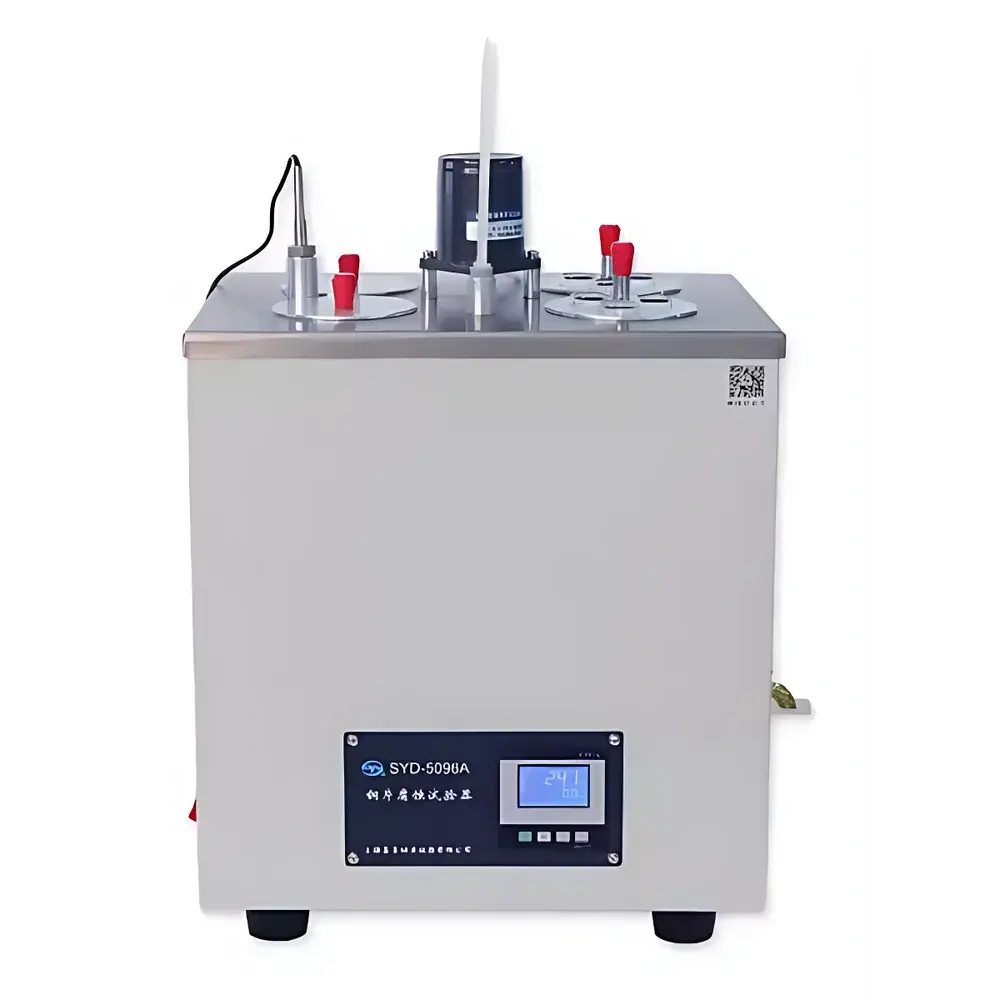
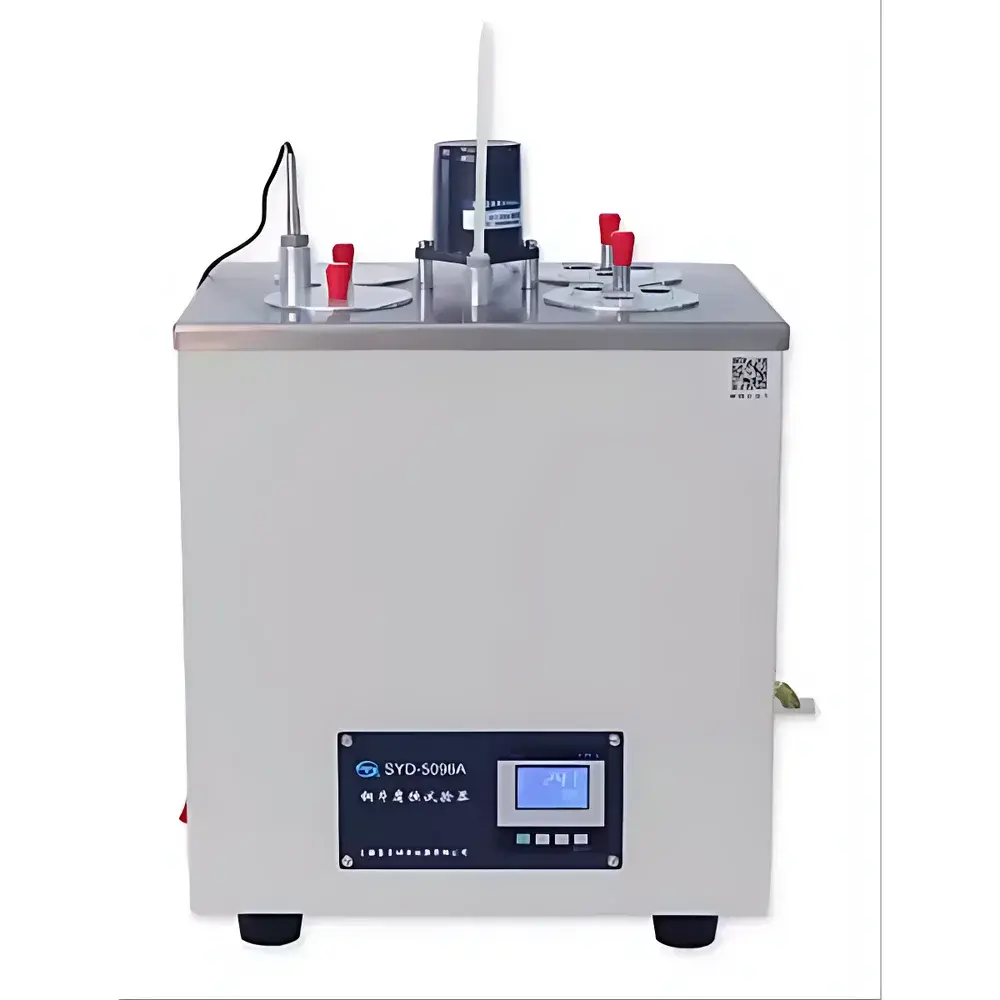
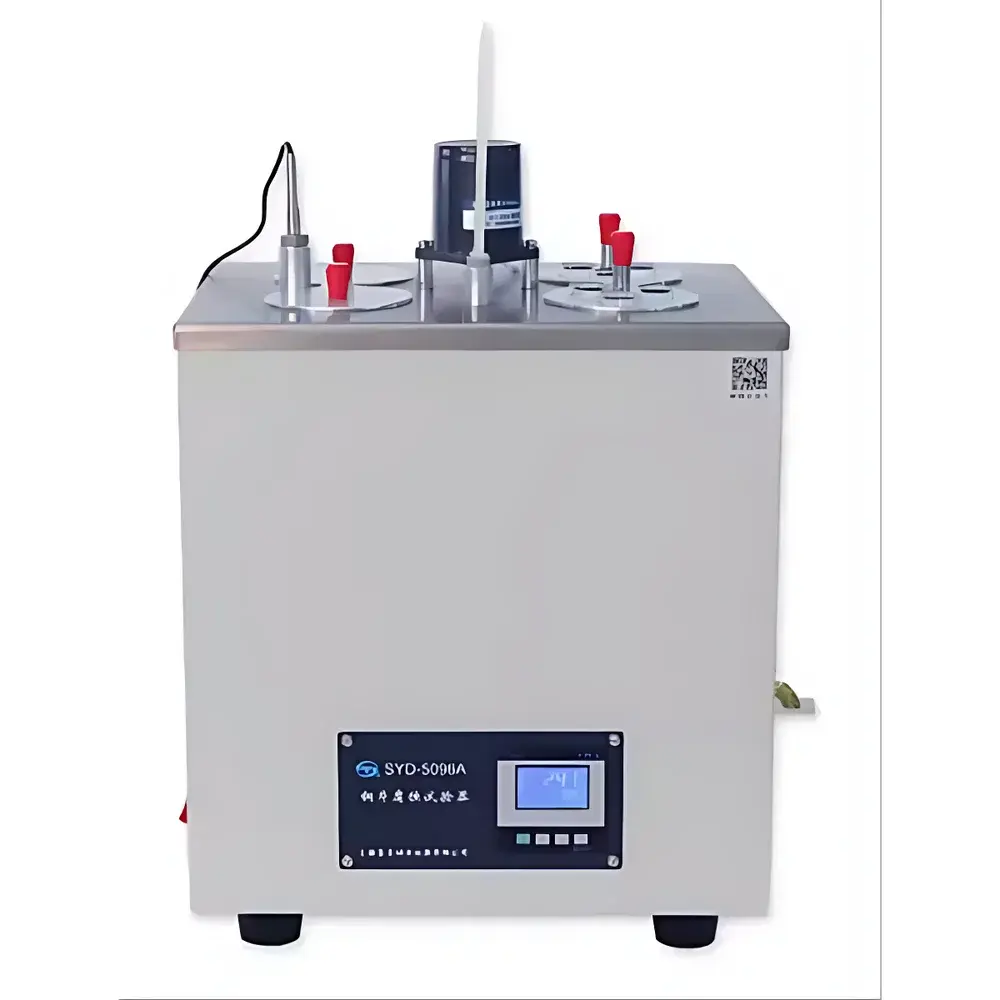
Changji Instruments SYD-5096A Copper Strip Corrosion Tester
| Brand | Changji Instruments |
|---|---|
| Origin | Shanghai, China |
| Manufacturer Type | Authorized Distributor |
| Country of Origin | China |
| Model | SYD-5096A |
| Price | Upon Request |
| Power Supply | AC (220 ± 10%) V, 50 Hz |
| Temperature Control Range | Ambient to 100 °C |
| Temperature Stability | ±1 °C |
| Sample Capacity | 4–12 copper strips (4 test bomb positions, each accommodating 1 bomb or up to 3 glass tubes) |
| Display | LCD temperature controller with integrated timer and audible alarm |
| Reference Standard | GB/T 5096 |
| Calibration Reference | NIST-traceable ASTM D130-compliant copper strip color chart (imported from USA) |
Overview
The Changji Instruments SYD-5096A Copper Strip Corrosion Tester is a precision-engineered laboratory instrument designed to perform standardized copper strip corrosion assessments in accordance with GB/T 5096—China’s national adoption of the internationally aligned methodology equivalent to ASTM D130. This apparatus operates on the principle of controlled thermal exposure: copper strips are immersed in the test sample and held at a precisely regulated temperature for a defined duration (typically 3 hours at 50 °C or 2 hours at 100 °C), after which the surface discoloration and tarnish patterns are visually evaluated against a certified reference color chart. The system replicates real-world storage and handling conditions under which petroleum-based fluids may interact with copper-containing components in fuel systems, lubrication circuits, or refining infrastructure. Its robust bath architecture ensures uniform thermal distribution across all sample positions, minimizing inter-test variability and supporting high-reproducibility pass/fail determinations required for quality control and regulatory compliance.
Key Features
- LCD-based digital temperature controller with dual functionality: real-time bath temperature monitoring and programmable countdown timer with audible end-of-test alert
- Four independent test bomb stations—each configurable to hold either one standard pressure-resistant test bomb (per GB/T 5096 Annex A) or up to three open-end glass test tubes (per Annex B), enabling flexible throughput scaling from 4 to 12 simultaneous copper strip evaluations
- Electrically driven magnetic stirrer integrated into the constant-temperature bath to eliminate thermal stratification and ensure consistent heat transfer across all sample zones
- Included U.S.-sourced, NIST-traceable copper strip color comparison chart compliant with ASTM D130 specifications, enabling objective, operator-independent assessment of corrosion grades (from 1a—light straw—to 4c—jet black with heavy pitting)
- Stainless steel bath vessel with insulated housing, optimized for thermal efficiency and long-term stability under continuous operation
Sample Compatibility & Compliance
The SYD-5096A accommodates a broad range of hydrocarbon-based samples specified in GB/T 5096, including aviation gasoline (AVGAS), aviation turbine fuel (Jet A-1, JP-8), automotive gasoline, diesel fuel, kerosene fractions, industrial solvent naphthas, and refined lubricating base oils. It supports both sealed-bomb and open-tube test configurations, allowing laboratories to align methodology with product volatility and vapor pressure characteristics. The instrument conforms to the mechanical and procedural requirements outlined in GB/T 5096, and its operational parameters—including temperature accuracy (±1 °C), uniformity (<0.5 °C deviation across bath), and timing resolution (±1 second)—meet the metrological rigor expected for GLP-compliant testing environments. While not FDA-certified per se, its design facilitates full auditability in GMP-aligned QC labs where traceability, calibration records, and operator log entries are maintained per ISO/IEC 17025 guidelines.
Software & Data Management
The SYD-5096A is a hardware-only platform with no embedded firmware or network connectivity; data recording and result documentation are performed manually in accordance with standard laboratory practice. Users are expected to maintain written test logs—including bath setpoint, actual measured temperature, start/end timestamps, sample identification, observed corrosion grade, and analyst signature—as part of their internal quality management system. For laboratories implementing electronic lab notebooks (ELN) or LIMS integration, the instrument’s deterministic behavior (fixed temperature setpoints, repeatable timing cycles, unambiguous visual endpoints) supports structured data entry and retrospective analysis. Optional accessories include calibrated RTD probes (traceable to CNAS-accredited labs) and validated logbook templates compatible with ISO 9001 and API RP 4200 documentation frameworks.
Applications
- Quality assurance screening of finished fuels prior to shipment, ensuring compliance with refinery specifications and downstream distributor requirements
- Batch release testing of lubricants and specialty oils where copper compatibility impacts bearing life and system integrity
- Research and development of antioxidant additives, metal deactivators, and sulfur-scavenging compounds in petroleum formulations
- Root cause analysis of field failures involving copper gaskets, fuel line connectors, or heat exchanger tubing exposed to contaminated hydrocarbons
- Third-party certification testing for export markets requiring GB/T 5096 or ASTM D130 conformance statements
FAQ
What standards does the SYD-5096A comply with?
It is engineered specifically to meet the physical and procedural requirements of GB/T 5096, which is technically equivalent to ASTM D130 and widely accepted across Asia-Pacific refining and trading networks.
Can the instrument be used for non-petroleum samples such as biofuels or synthetic esters?
Yes—provided the sample remains thermally stable below 100 °C and does not chemically degrade the copper strip or glassware during immersion; method validation per ASTM D7462 is recommended for novel formulations.
Is calibration certification included with purchase?
Factory calibration verification is provided; users must perform periodic in-house verification using traceable reference thermometers and documented procedures aligned with their internal QA protocols.
How often should the color chart be replaced?
The imported U.S. color chart is light-sensitive; it must be stored in its opaque protective sleeve and replaced every 12 months or after 200 visual assessments, whichever occurs first, to maintain grading fidelity.
Does the unit support multi-language interface or data export?
No—the SYD-5096A operates via analog/digital controls only; all documentation and reporting are external to the device and governed by the user’s laboratory information management practices.




