
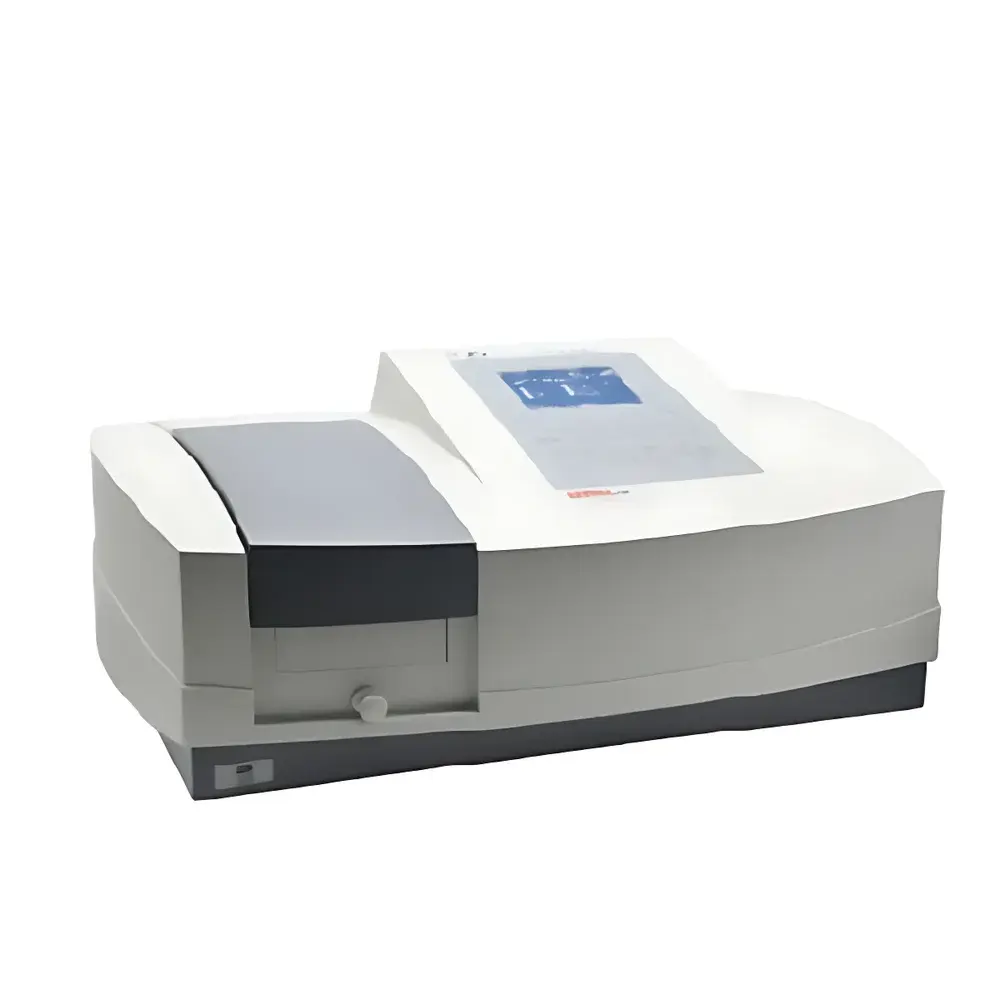
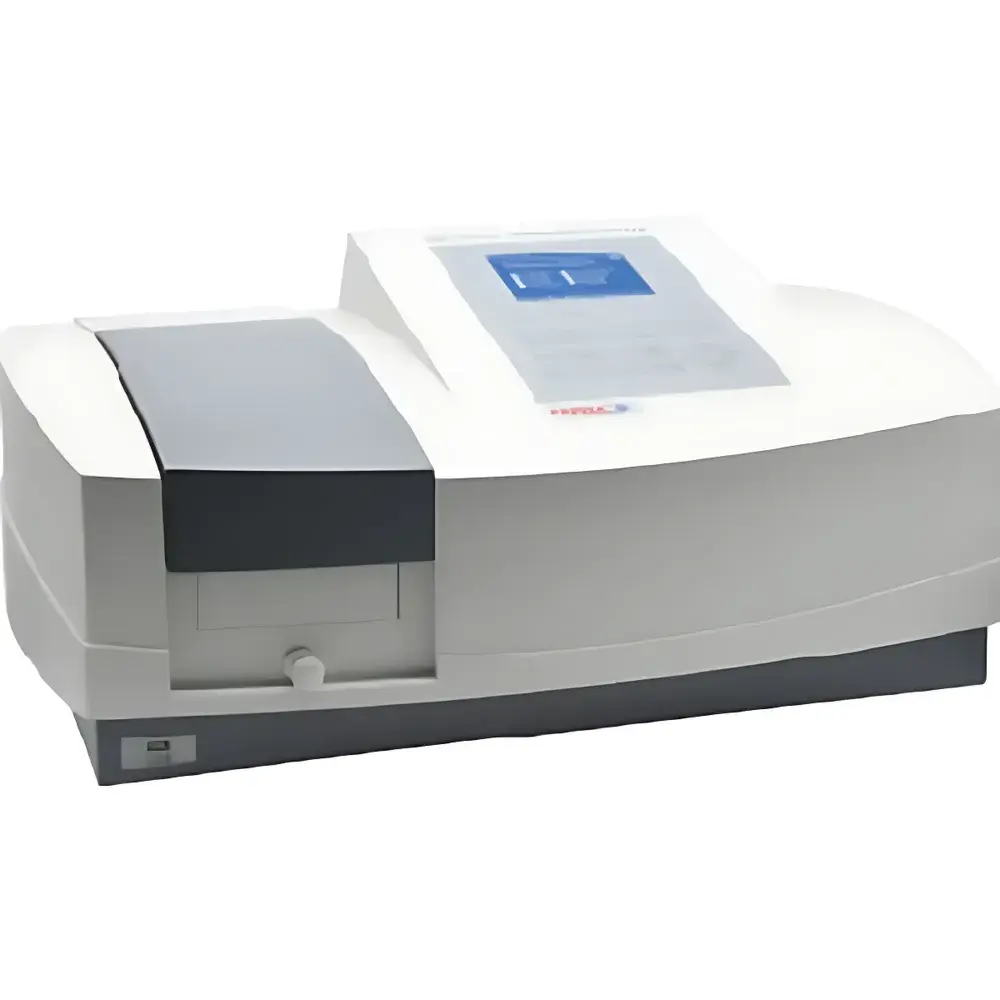
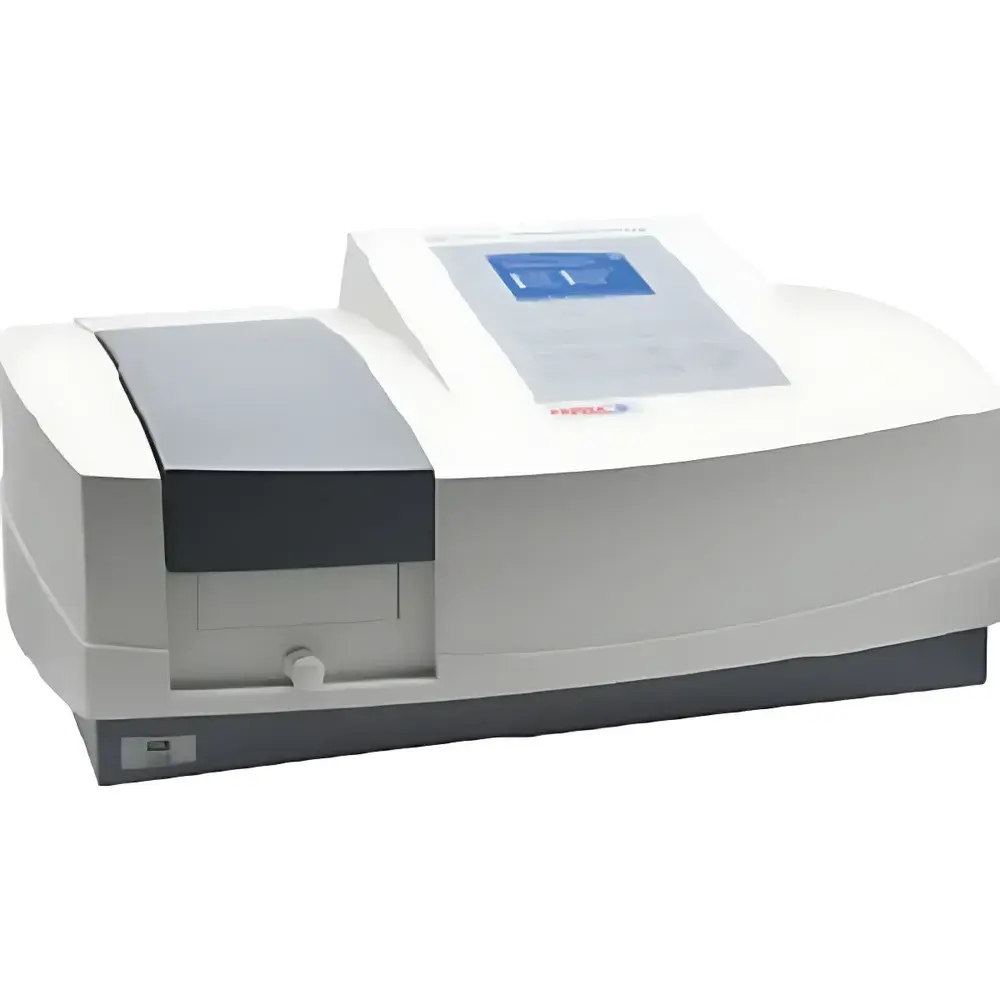
UniCo UV-4802S-4 Slit Width Variable Dual-Beam Ultraviolet-Visible Spectrophotometer
| Brand | UniCo |
|---|---|
| Origin | Shanghai, China |
| Model | UV-4802S-4 Slit Width |
| Optical System | Dual-Beam |
| Detector | Photomultiplier Tube (PMT) |
| Wavelength Range | 190–1100 nm |
| Wavelength Accuracy | ±0.1 nm at 656.1 nm / ±0.3 nm across range |
| Wavelength Repeatability | ≤0.1 nm |
| Spectral Bandwidth | 0.5, 1, 2, and 4 nm (selectable) |
| Stray Light | ≤0.05% T |
| Photometric Accuracy | ±0.004 Abs (0–0.5 Abs), ±0.004 Abs (0.5–1.0 Abs), ±0.5% T |
| Photometric Repeatability | ±0.001 Abs (0–0.5 Abs), ±0.002 Abs (0.5–1.0 Abs), ±0.2% T |
| Baseline Stability | ±0.002 A/h (at 500 nm, after warm-up) |
| Display | 320 × 240 graphical LCD |
| Interface | USB port for data export and software communication |
| Dimensions (W × D × H) | 625 × 405 × 280 mm |
| Weight | 24 kg |
Overview
The UniCo UV-4802S-4 Slit Width Variable Dual-Beam Ultraviolet-Visible Spectrophotometer is a precision optical instrument engineered for high-fidelity absorbance, transmittance, and concentration measurements across the ultraviolet, visible, and near-infrared spectral regions (190–1100 nm). Based on a dual-beam optical architecture with real-time reference beam compensation, it mitigates errors arising from source drift, detector instability, or environmental fluctuations—ensuring long-term measurement reproducibility critical for regulated laboratory workflows. The system employs a 1200 lines/mm holographic grating monochromator and a high-gain photomultiplier tube (PMT) detector, delivering superior signal-to-noise ratio and low-level detection sensitivity. Its variable spectral bandwidth (0.5, 1, 2, and 4 nm) enables method-specific resolution tuning—essential for resolving narrow absorption peaks in pharmaceutical impurity profiling or nucleic acid quantification. Designed for compliance-ready operation, the UV-4802S-4 supports traceable wavelength calibration (certified at 656.1 nm via deuterium line), meets ISO 9001-aligned manufacturing controls, and provides baseline linearity (±0.001 A) and thermal stability (±0.002 A/h at 500 nm post-warm-up) required for GLP and routine QC applications.
Key Features
- Dual-beam optical design with real-time reference channel compensation for enhanced photometric stability and reduced baseline drift
- Selectably variable spectral bandwidth (0.5, 1, 2, and 4 nm) optimized for resolution-flexible method development and validation
- High-precision wavelength accuracy (±0.1 nm at 656.1 nm; ±0.3 nm across full range) verified against NIST-traceable standards
- Low stray light performance (≤0.05% T) enabling reliable measurements of highly absorbing samples and extended dynamic range (–0.3 to 3.0 A)
- Integrated 320 × 240 graphical LCD display with intuitive touch-sensitive keypad for standalone operation—no PC required for basic assays
- USB interface supporting direct data export to USB flash drives and bidirectional communication with UniCo Advanced Spectroscopy Software
- Comprehensive built-in application modes: photometric scanning, multi-wavelength analysis, kinetic time-course monitoring, quantitative standard curve generation, and preconfigured DNA/protein A260/A280 ratio protocols
Sample Compatibility & Compliance
The UV-4802S-4 accommodates standard 10-mm pathlength cuvettes—including matched quartz (for UV < 220 nm), optical glass (visible range), and disposable plastic variants—enabling seamless transition between routine screening and high-sensitivity UV analysis. Its optical path geometry complies with ASTM E275 and ISO 6059 for spectrophotometric performance verification. While not FDA 21 CFR Part 11–certified out-of-the-box, the instrument’s audit-trail-capable software package (supplied with encrypted dongle and version-controlled installer) supports configuration for GMP/GLP environments when deployed with controlled user access, electronic signature enforcement, and raw-data archiving policies. All firmware and calibration parameters are stored internally with non-volatile memory retention, ensuring integrity during power cycles.
Software & Data Management
UniCo Advanced Spectroscopy Software (v4.2+) provides a Windows-based platform for instrument control, spectral processing, and report generation. It supports method templates compliant with USP , EP 2.2.25, and JP 2.03, including automatic peak identification, derivative spectroscopy, and baseline correction algorithms. Data files are saved in vendor-neutral CSV and XML formats, facilitating integration into LIMS or ELN systems. The software enforces data integrity through timestamped acquisition logs, operator ID tagging, and immutable raw-data storage—critical for regulatory submissions. USB-driven firmware updates ensure field-upgradable functionality without service engineer intervention.
Applications
- Pharmaceutical QC: Active pharmaceutical ingredient (API) assay, dissolution testing, and excipient interference studies per USP
- Biochemistry: Quantification of nucleic acids (DNA/RNA) and proteins using A260/A280 ratios; enzyme kinetics (e.g., NADH oxidation at 340 nm)
- Environmental analysis: Nitrate/nitrite determination (UV at 220/275 nm), COD assessment, and heavy metal complexation studies
- Academic research: Ligand-binding stoichiometry, polymer degradation kinetics, and thin-film optical characterization
- Food & beverage: Colorimetric analysis (e.g., anthocyanin content), preservative quantification (sorbic/benzoic acid), and authenticity verification
FAQ
What is the minimum detectable absorbance change supported by the UV-4802S-4?
The instrument achieves photometric repeatability of ±0.001 Abs in the 0–0.5 Abs range, enabling reliable detection of sub-millimolar concentration shifts in well-calibrated systems.
Can the UV-4802S-4 be used for kinetic measurements over extended time periods?
Yes—its thermal stabilization design and dual-beam architecture support kinetic scans up to 2 hours with baseline drift ≤±0.002 A/h, suitable for enzymatic reaction monitoring and slow-release formulation studies.
Is quartz cuvette calibration required before each use?
No; however, blanking with matched quartz cuvettes is mandatory for UV-range measurements below 220 nm to correct for inherent material absorbance and window variability.
Does the system support automated wavelength calibration verification?
Manual verification using certified holmium oxide or didymium filters is recommended per ISO/IEC 17025; automated self-calibration is not implemented, preserving metrological transparency.
How is data security maintained during USB transfer?
All exported files include embedded metadata (operator ID, timestamp, instrument serial number, and method name); no encryption is applied at the device level, so secure host-system policies must govern subsequent handling.




