
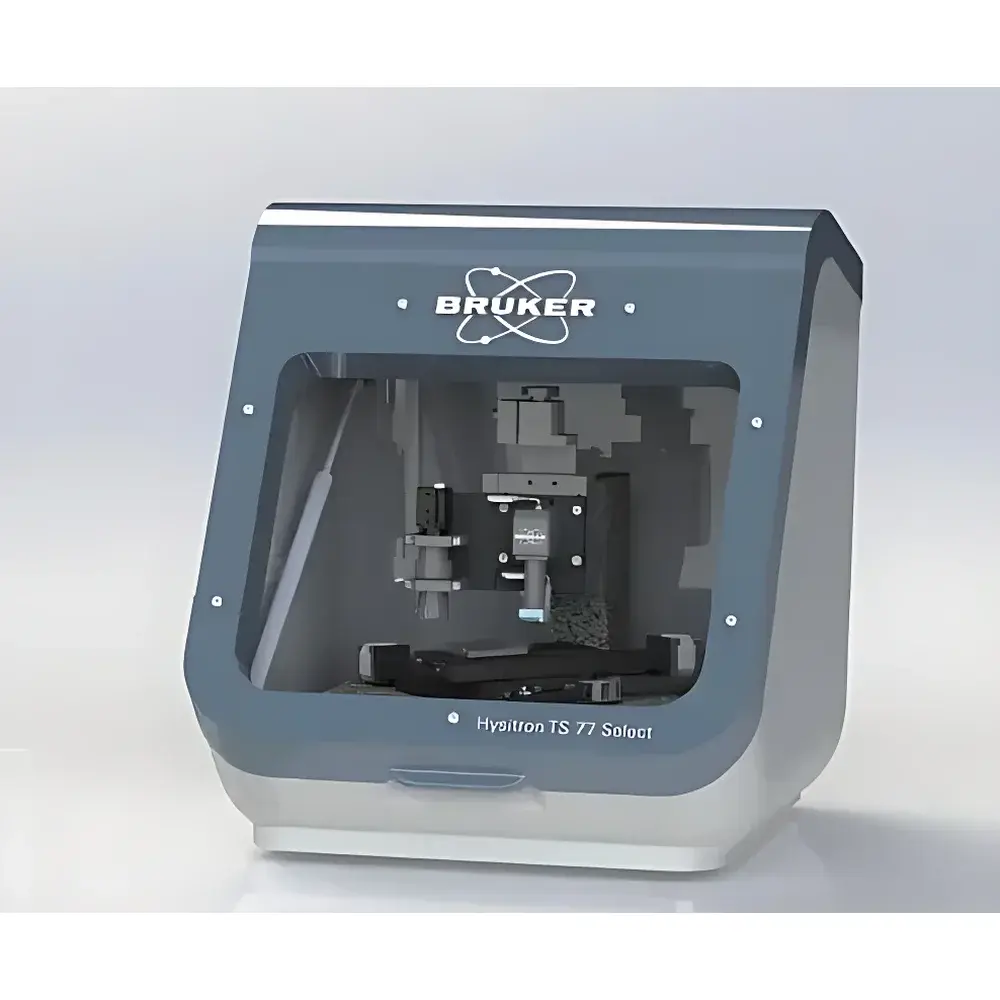
Bruker Hysitron TS 77 Select Nanoindenter
| Brand | Bruker |
|---|---|
| Origin | Malaysia |
| Manufacturer Type | Authorized Distributor |
| Origin Category | Imported Instrument |
| Model | Hysitron TS 77 Select Nanoindenter |
| Instrument Type | Nanoindenter |
| Maximum Indentation Depth | µm |
| Effective Load Range | 100 nN – 10 mN |
| Load Resolution | <1 nN |
| Displacement Range | 1 nm – 10 µm |
| Displacement Resolution | <0.05 nm |
| Maximum Friction Force | 10 mN |
| Indenter Tip Geometry | Berkovich (triangular pyramid), Cube-corner, Flat-punch, and Custom trapezoidal tips |
| Thermal Drift | <0.05 nm/s |
Overview
The Bruker Hysitron TS 77 Select Nanoindenter is a benchtop nanomechanical testing system engineered for quantitative, high-fidelity characterization of mechanical and tribological properties at length scales ranging from sub-nanometer to several micrometers. Built upon Bruker’s proprietary TriboScope® capacitive transduction architecture, the TS 77 Select delivers exceptional force and displacement resolution—enabling precise measurement of elastic modulus, hardness, creep, stress relaxation, fracture toughness, adhesion, and wear behavior in thin films, interfaces, coatings, composites, and heterogeneous microstructures. Unlike conventional piezoresistive or strain-gauge-based indenters, the electrostatically actuated capacitive sensor design ensures intrinsic linearity, minimal hysteresis, and ultra-low thermal drift (<0.05 nm/s), critical for long-duration, high-stability nanoindentation and in situ SPM imaging.
Key Features
- Capacitive Sensor Architecture: Dual-axis electrostatic actuation and capacitance-based sensing provide real-time, closed-loop control of both normal load and lateral displacement with sub-nanometer resolution and negligible thermal drift.
- High-Speed Mechanical Property Mapping: Capable of acquiring >120 indentation points per second—up to 180× faster than conventional systems—enabling rapid generation of modulus/hardness maps over mm²-scale areas with pixel resolutions down to 100 nm.
- In Situ SPM Imaging: Integrated scanning probe microscopy functionality allows simultaneous topographic imaging and nanomechanical testing on the same location without sample relocation—ensuring spatial correlation between morphology and local mechanical response.
- Multimodal Testing Capability: Supports standardized quasi-static nanoindentation, dynamic nanoindentation (with phase-resolved modulus mapping), nanoscratch (for interfacial adhesion and coating delamination analysis), nanowear (quantitative volumetric wear rate assessment), and creep/stress-relaxation protocols.
- Tip Flexibility & Calibration Traceability: Compatible with certified Berkovich, cube-corner, flat-punch, and custom trapezoidal diamond tips; all tip geometry calibrations are traceable to NIST standards and validated via continuous stiffness measurement (CSM) and area function verification per ISO 14577-1.
Sample Compatibility & Compliance
The TS 77 Select accommodates a broad range of solid-state samples—including brittle ceramics, ductile metals, polymer films, biomaterials, semiconductor wafers, and multilayer stacks—without requiring conductive coating. Its open-stage design supports custom environmental enclosures (e.g., humidity-controlled or vacuum chambers) and optional heating/cooling stages (–50 °C to +300 °C). All test routines adhere to internationally recognized standards: ISO 14577 (Metallic and non-metallic materials — Instrumented indentation test), ASTM E2546 (Standard Test Method for Instrumented Indentation Testing), and ASTM E2846 (Standard Practice for Scanning Probe Microscopy). Data acquisition and reporting support audit-ready documentation compliant with GLP and GMP environments, including full electronic signatures and 21 CFR Part 11–compatible metadata logging.
Software & Data Management
TriboScan™ software provides an intuitive, workflow-driven interface optimized for both novice users and expert researchers. It integrates automated calibration routines (tip area function, frame compliance, thermal drift compensation), multi-sample batch programming, and real-time statistical analysis (Weibull distribution fitting, confidence interval estimation, outlier rejection). Raw force-displacement curves are stored in HDF5 format with embedded metadata (timestamp, operator ID, environmental conditions, tip serial number). Export options include CSV, MATLAB .mat, and industry-standard MTEX-compatible formats for advanced microstructure-property correlation. Optional modules enable machine-learning-assisted clustering of mechanical property distributions and automated grain-boundary property extraction from EBSD-aligned maps.
Applications
- Quantitative mechanical profiling of ALD/PVD/CVD thin films and multilayer optical/electronic coatings
- Interfacial strength assessment in bonded wafer stacks and die-attach materials
- Creep resistance evaluation of high-temperature superalloys and turbine blade thermal barrier coatings
- Nanoscale wear mechanisms in biomedical implants (e.g., UHMWPE, hydroxyapatite composites)
- Mechanical heterogeneity mapping in additively manufactured alloys and gradient materials
- Time-dependent deformation behavior of soft polymers and hydrogels under physiological loading conditions
FAQ
What standards does the TS 77 Select comply with for nanoindentation testing?
The system implements test protocols fully aligned with ISO 14577 Parts 1–4 and ASTM E2546, including CSM-based modulus/hardness calculation, tip area function calibration, and frame compliance correction.
Can the TS 77 Select perform tests inside controlled environments?
Yes—its modular stage design supports integration with environmental chambers for humidity, temperature, or inert gas control; optional vacuum-compatible configurations are available.
Is in situ SPM imaging performed during mechanical testing or as a separate step?
Both modes are supported: true in situ imaging occurs concurrently with indentation using the same probe, while ex situ high-resolution topography can be acquired prior to or after testing without breaking vacuum or repositioning the sample.
How is data integrity ensured for regulated laboratories?
TriboScan™ includes full 21 CFR Part 11 compliance features: role-based access control, electronic signatures, immutable audit trails, and encrypted raw data storage with checksum validation.
What level of training is required to operate the TS 77 Select independently?
The system is designed for operational readiness within one day of installation; standard operating procedures (SOPs) are preloaded for common test types, and automated calibration eliminates manual setup dependencies.
Related Products



