
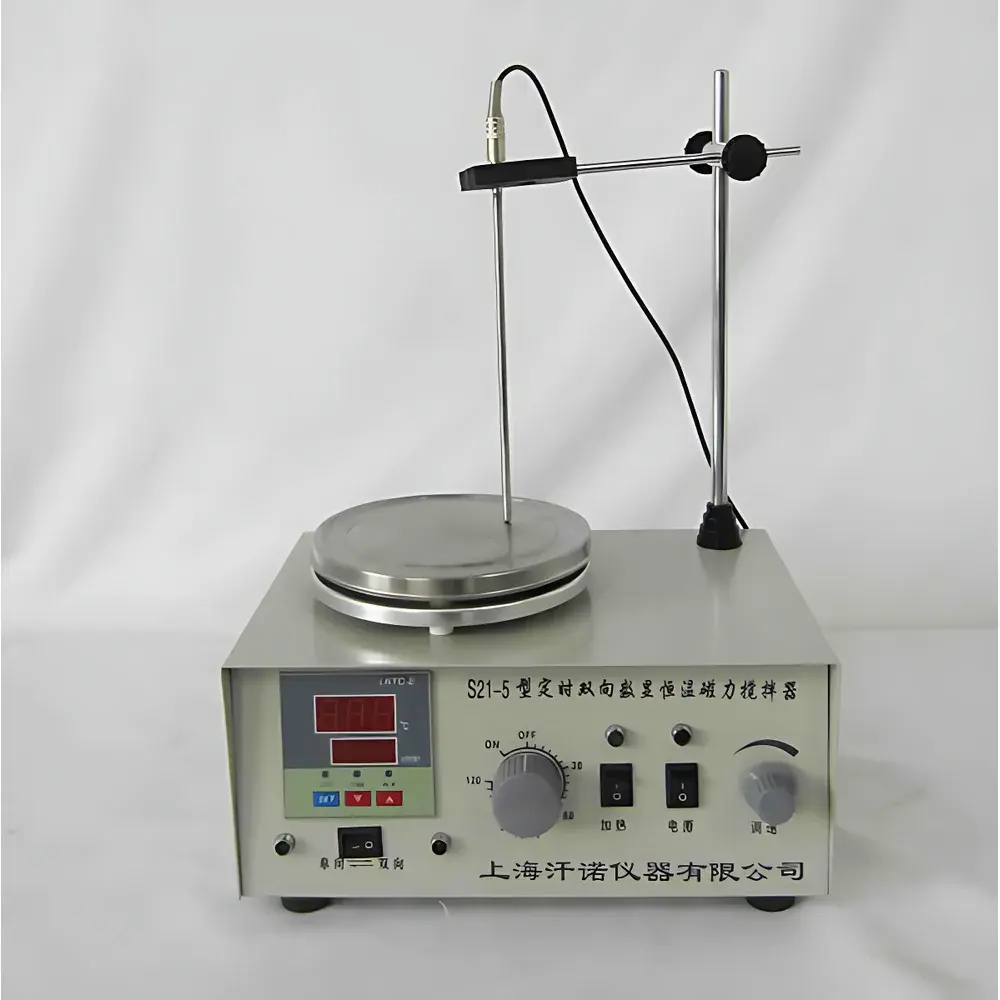
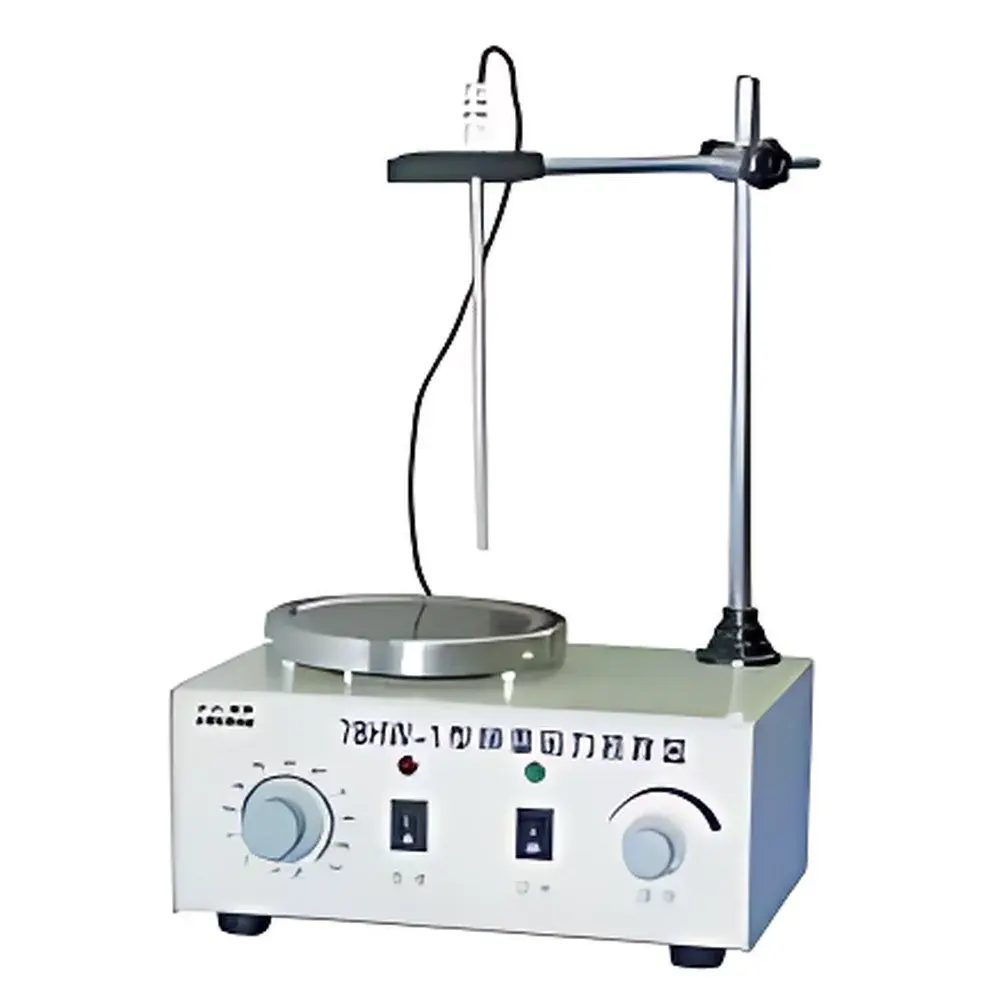
Hanuo 85-2 Digital Display Constant-Temperature Magnetic Stirrer
| Brand | Hanuo |
|---|---|
| Origin | Shanghai, China |
| Model | 85-2 |
| Stirring Capacity | 1000 mL |
| Speed Range | 0–2400 rpm |
| Temperature Control Range | Ambient to 100 °C |
| Heating Power | 300 W |
| Display Type | Dual Digital (Temperature & Speed) |
| Instrument Type | Magnetic Stirrer |
| Country of Manufacture | China |
Overview
The Hanuo 85-2 Digital Display Constant-Temperature Magnetic Stirrer is an engineered laboratory tool designed for precise, reproducible mixing and thermal control in routine and research-grade applications. Utilizing a rotating magnetic field generated by a permanent magnet rotor driven by a brushless DC motor, the device induces rotational motion in a magnetic stir bar immersed in the sample vessel—enabling contactless agitation without mechanical shaft penetration. Integrated resistive heating elements beneath the ceramic-coated aluminum plate provide uniform thermal distribution across the working surface, while dual digital displays independently monitor real-time stirring speed (rpm) and plate temperature (°C). This architecture supports stable operation under prolonged duty cycles and ensures minimal thermal gradient deviation across standard 1000 mL glassware (e.g., beakers, flasks), making it suitable for dissolution studies, buffer preparation, reagent synthesis, and pre-analytical sample conditioning.
Key Features
- Dual independent digital LED displays: one for set/actual temperature (ambient to 100 °C, ±1 °C accuracy), another for set/actual rotational speed (0–2400 rpm, ±10 rpm resolution)
- Ceramic-coated aluminum heating plate with high thermal conductivity and chemical resistance, supporting rapid heat-up and consistent surface uniformity
- Brushless DC motor drive ensuring low noise, extended service life, and maintenance-free operation without carbon brush wear
- Precise proportional-integral (PI) temperature control algorithm minimizing overshoot and stabilizing setpoint within ±0.5 °C after equilibration
- Overheat protection circuitry automatically deactivates heating if plate temperature exceeds 110 °C or sensor failure is detected
- Non-slip silicone rubber feet and compact footprint (220 × 160 × 120 mm) optimized for benchtop integration in ISO-certified cleanrooms and GLP-compliant labs
Sample Compatibility & Compliance
The Hanuo 85-2 accommodates standard laboratory glassware up to 1000 mL volume, including borosilicate beakers (≥50 mm diameter base), round-bottom flasks, and crystallization dishes. It is compatible with PTFE- or glass-coated magnetic stir bars ranging from 20 to 50 mm in length. While not certified to IEC 61010-1 for hazardous area use, the unit complies with general safety requirements for Class I, Division 1 laboratory equipment per EN 61010-1:2010. Its thermal and rotational performance aligns with common method validation protocols referenced in ASTM E2917 (Standard Practice for Validation of Analytical Methods) and USP (Analytical Instrument Qualification), particularly for temperature-dependent dissolution testing and homogeneity verification workflows.
Software & Data Management
The Hanuo 85-2 operates as a standalone analog-digital hybrid instrument with no embedded microprocessor-based data logging or PC interface. All operational parameters are manually configured via front-panel rotary encoder and push-button controls. For laboratories requiring audit trails or electronic records, external USB data loggers (e.g., Omega OM-DAQPRO-5300 series) may be deployed to capture serial TTL output from optional RS232 modules (sold separately). When integrated into validated environments governed by FDA 21 CFR Part 11, users must implement procedural controls—including operator training logs, calibration records per ISO/IEC 17025, and periodic performance verification using NIST-traceable thermocouples and tachometers—to satisfy GxP documentation requirements.
Applications
- Preparation of homogeneous aqueous and organic solutions under controlled thermal conditions (e.g., pH buffer standardization, enzyme assay buffers)
- Dissolution testing of pharmaceutical dosage forms per USP Apparatus II methodology at fixed temperatures (37 °C ± 0.5 °C)
- Accelerated stability studies involving temperature-cycled mixing of polymer dispersions or nanoparticle suspensions
- Chemical synthesis requiring inert-atmosphere stirring with simultaneous heating (when used inside gloveboxes with appropriate power feedthroughs)
- QC/QA workflows in food, environmental, and materials testing labs where batch-to-batch consistency of mixed standards is critical
FAQ
Does the Hanuo 85-2 support external temperature probe input for solution-phase monitoring?
No—the built-in temperature sensor measures only the heating plate surface temperature. For solution-specific thermal feedback, a separate calibrated PT100 probe connected to an external PID controller is required.
Is the unit compatible with corrosive solvents such as concentrated acids or halogenated organics?
The ceramic coating provides moderate resistance to mild acids and bases; however, prolonged exposure to HF, fuming HNO₃, or chlorinated solvents may degrade the surface. Use of secondary containment trays is recommended.
Can the stirrer maintain speed stability under high-viscosity loads (e.g., >500 mPa·s)?
At speeds above 1200 rpm, torque limitation becomes evident with viscosities exceeding 300 mPa·s in 1000 mL volumes. Optimal performance is achieved with Newtonian fluids below 200 mPa·s.
What is the calibration interval recommendation for routine GLP use?
Annual calibration of both temperature and speed channels against traceable standards is advised, with interim verification checks performed before each critical experiment.
Does the device meet electromagnetic compatibility (EMC) requirements for use near sensitive analytical instruments?
It meets EN 61326-1:2013 emission limits for laboratory environments but should be positioned ≥1 m from mass spectrometers or NMR consoles to avoid low-frequency magnetic interference.



