
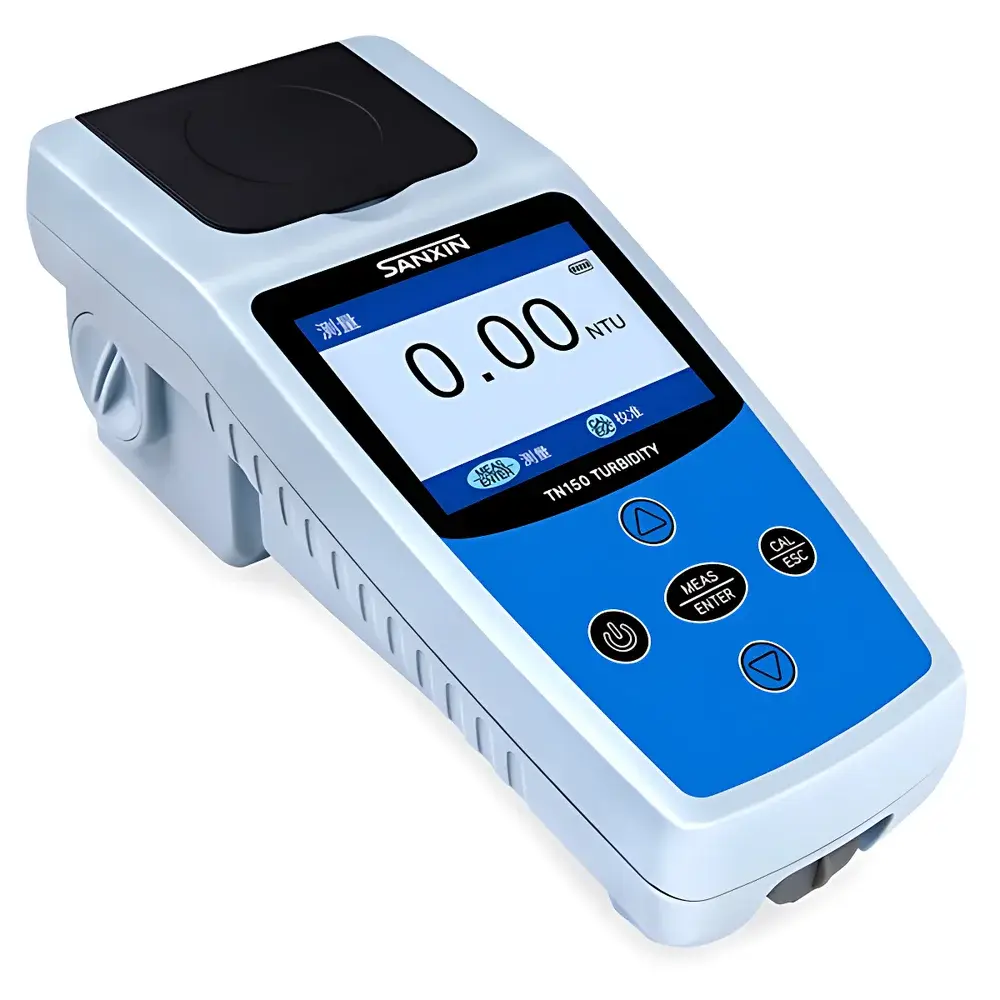
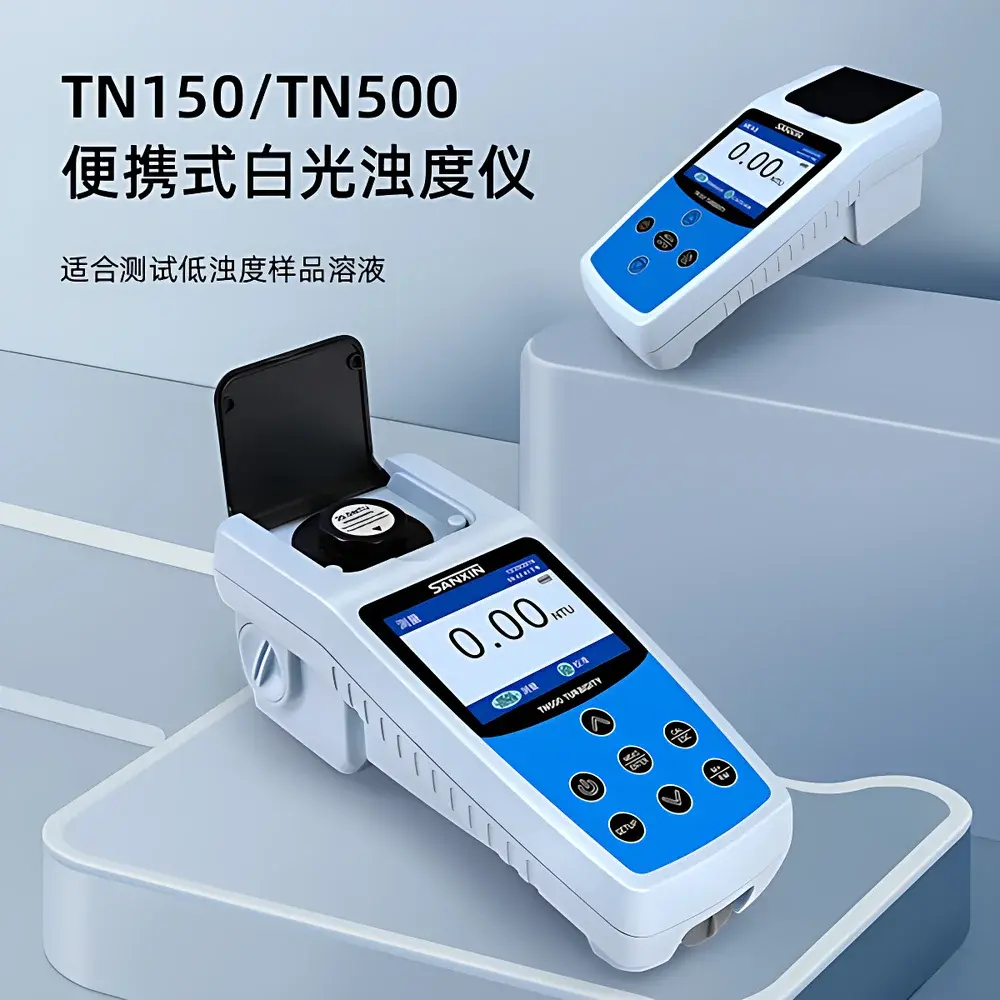
SANXIN TN150 Portable Turbidimeter
| Brand | SANXIN |
|---|---|
| Origin | Shanghai, China |
| Model | TN150 |
| Type | Portable |
| Measurement Range | 0–1000 NTU (FNU), auto-ranging across three sub-ranges: 0.01–19.99 NTU (FNU), 20.0–99.9 NTU (FNU), 100–1000 NTU (FNU) |
| Resolution | 0.01 / 0.1 / 1 NTU (FNU) |
| Operating Temperature | 0–50 °C |
| Accuracy | ≤ ±8% |
| IP Rating | IP67 |
| Display | TFT color screen |
| Light Source | Tungsten filament lamp (400–600 nm) |
| Detection Principle | 90° nephelometric scattering |
| Compliance | HJ 1075–2019, EPA Method 180.1, ASTM D6508, ISO 7027–1:2016 (white light mode) |
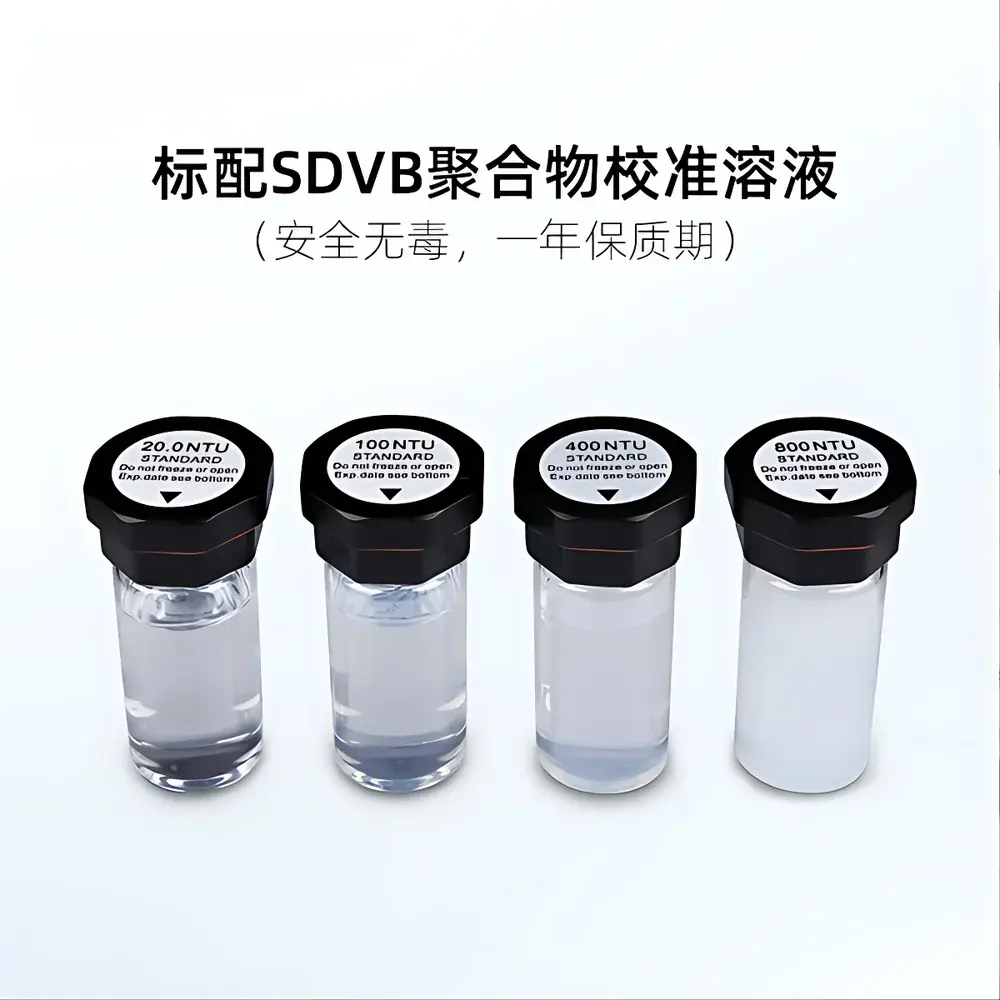
| Calibration Standards | Certified polymer standards (0, 20, 100, 400, 800 NTU/FNU), EPA- and ASTM-compliant, 1-year shelf life |
| Battery | Rechargeable 3.7 V Li-ion (7 V system equivalent), >20 h continuous operation |
| Dimensions (instrument) | 90 × 203 × 80 mm |
| Weight (instrument) | 385 g |
| Certifications | ISO 9001:2015, CE |
Overview
The SANXIN TN150 Portable Turbidimeter is a field-deployable, white-light nephelometer engineered for high-reproducibility turbidity measurement in aqueous samples—particularly low-turbidity applications such as drinking water, potable distribution systems, swimming pool management, and environmental monitoring. It operates on the 90° scattered light detection principle per ISO 7027–1:2016 (white light mode), fully aligned with U.S. EPA Method 180.1 and China’s HJ 1075–2019 standard for turbidity determination. Unlike infrared-based instruments, the TN150 employs a tungsten filament lamp emitting broadband visible light (400–600 nm), ensuring compatibility with traditional Formazin- and polymer-based calibration matrices and enabling traceable comparability to legacy laboratory data. Its optical architecture minimizes stray light interference and optimizes signal-to-noise ratio in sub-1 NTU ranges—critical for regulatory compliance in drinking water QA/QC where turbidity thresholds are often set at ≤0.3 NTU (e.g., WHO Guidelines, U.S. EPA Surface Water Treatment Rule).
Key Features
- Triple-range auto-switching optics (0.01–19.99 / 20.0–99.9 / 100–1000 NTU), eliminating manual range selection and reducing operator error.
- High-stability tungsten light source with spectral output certified for HJ 1075–2019 and EPA 180.1 conformance; lamp replaceable in-field without recalibration.
- TFT color display with multilingual GUI (English, Chinese, Spanish) and icon-driven navigation—designed for intuitive operation under variable lighting and glove use.
- IP67-rated enclosure ensures dust-tight integrity and submersion resistance up to 1 m for 30 minutes—validated for rigorous outdoor, wastewater plant, or emergency response deployment.
- Integrated averaging mode: captures and computes mean of up to 10 sequential readings, mitigating transient fluctuations from settling particles or flow-induced turbulence.
- Rechargeable 3.7 V lithium-ion battery delivering >20 hours of continuous measurement—fivefold increase over AA-powered competitors—supporting multi-site surveys without logistical battery replenishment.
- Built-in diagnostics including zero drift monitoring (≤±0.5 FS/30 min), stability tracking (≤±1.0 FS/30 min), and low-voltage warning with graceful shutdown protocol.
Sample Compatibility & Compliance
The TN150 accepts standard Φ25 × 60 mm high-borosilicate glass sample vials (18 mL capacity), minimizing refractive index artifacts and thermal expansion errors. Its optical path design accommodates both clear and moderately colored samples, with documented performance validation against humic-acid-spiked matrices per ASTM D6508 Annex A3. Calibration uses NIST-traceable polymer standards (0, 20, 100, 400, 800 NTU/FNU), each certified to EPA and ASTM specifications and validated for 12-month shelf life at 5–30 °C. The instrument meets ISO 9001:2015 manufacturing quality requirements and carries CE marking for EMC and safety compliance. While not inherently 21 CFR Part 11 compliant, audit-ready features—including timestamped measurement logs, user ID fields, and immutable calibration history—support GLP/GMP-aligned workflows when integrated into validated laboratory information management systems (LIMS).
Software & Data Management
Data output is via USB-C interface supporting direct export of CSV-formatted measurement records (timestamp, sample ID, NTU value, range, battery level, temperature). No proprietary software is required: exported files are natively readable in Excel, LabArchives, or ELN platforms. Internal memory retains ≥500 measurements with full metadata. Firmware updates are performed offline using signed .bin files—ensuring integrity and version control. All calibration events are logged with date/time stamp, operator ID (if entered), and reference standard lot number—enabling full traceability during regulatory audits.
Applications
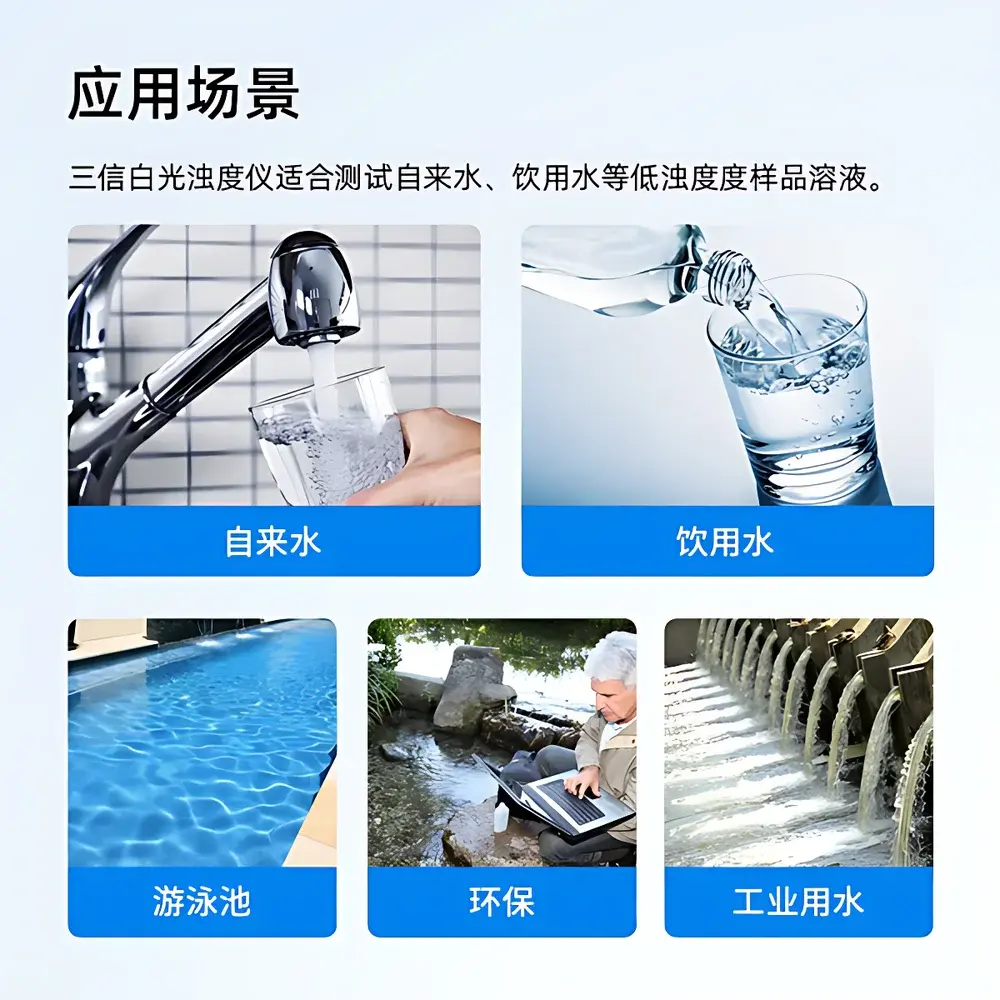
- Drinking water utilities: Routine verification of filtration efficiency and disinfection barrier integrity at entry points, distribution nodes, and consumer taps.
- Environmental field surveys: Monitoring turbidity plumes near construction sites, dredging operations, or stormwater outfalls per EPA NPDES permit requirements.
- Swimming pool & spa maintenance: Real-time assessment of filter performance and coagulant dosing efficacy against CDC Model Aquatic Health Code thresholds.
- Wastewater treatment plants: Clarifier effluent monitoring and sludge blanket depth estimation via rapid turbidity profiling.
- Pharmaceutical water systems: Preliminary assessment of purified water (PW) and water-for-injection (WFI) loop integrity during commissioning and routine checks.
FAQ
Does the TN150 support Formazin calibration?
Yes—the instrument accepts both certified polymer standards and Formazin suspensions (0, 20, 100, 400, 800 NTU); however, polymer standards are recommended for long-term stability and reduced health/safety handling requirements.
Is the light source wavelength adjustable?
No—the tungsten lamp emits fixed broadband white light (400–600 nm) optimized for HJ 1075–2019 and EPA 180.1 compliance; it does not support monochromatic or IR modes.
Can measurement data be synchronized wirelessly?
No—data transfer is wired-only via USB-C to ensure electromagnetic immunity in industrial environments; Bluetooth or Wi-Fi are intentionally omitted to maintain IP67 integrity and cybersecurity boundaries.
What is the warranty coverage for calibration standards?
Polymer standards carry a 12-month shelf-life guarantee from manufacture date; instrument hardware is covered under a 24-month limited warranty from date of purchase, excluding consumables and misuse-related damage.
How is zero-point verification performed?
Using the supplied 0 NTU polymer blank in clean, scratch-free vials; the instrument performs automated dark-current compensation prior to each measurement cycle, with drift correction applied per internal thermal sensor feedback.





