
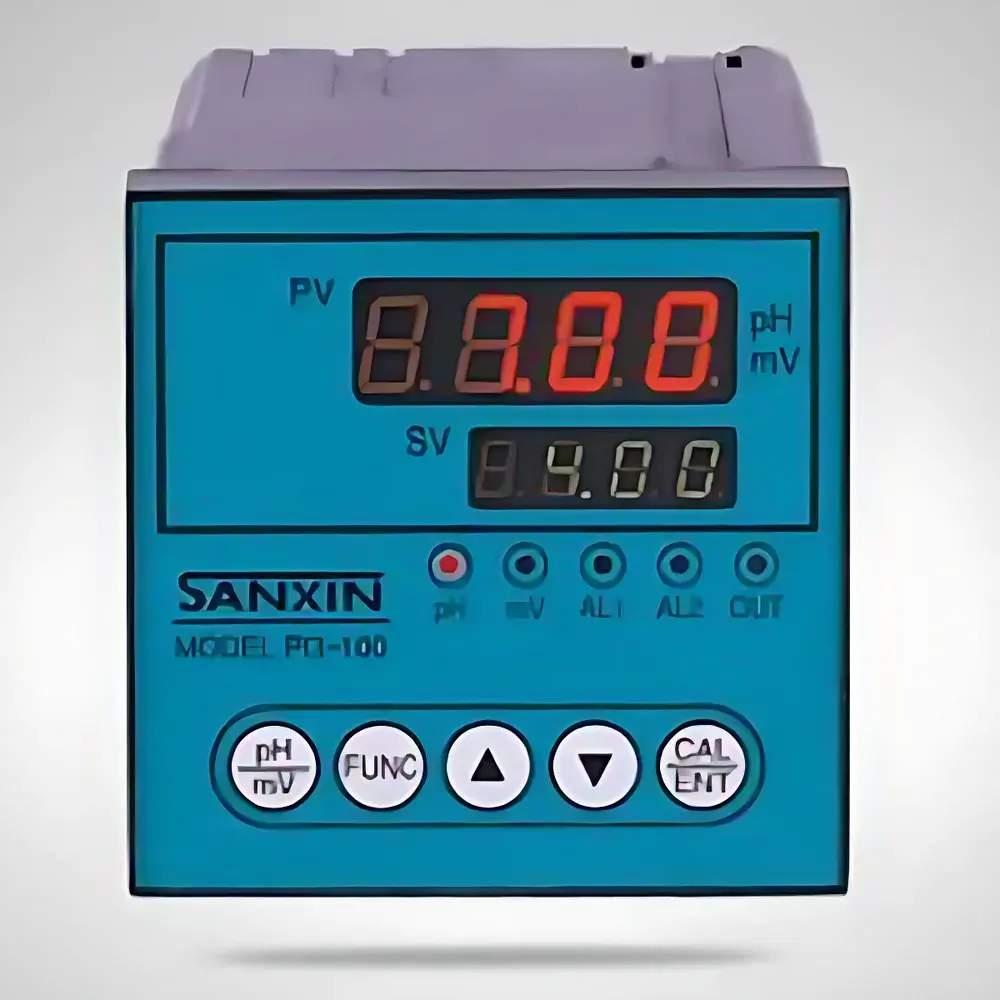
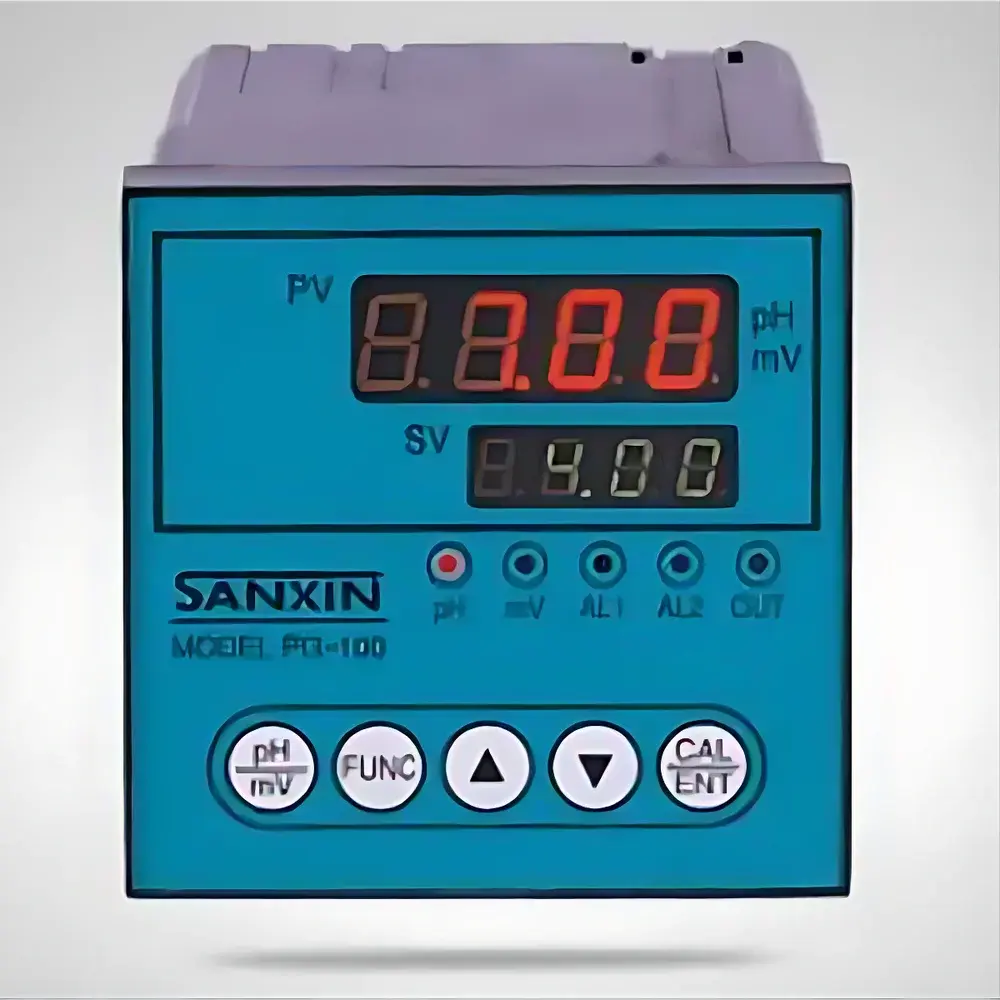
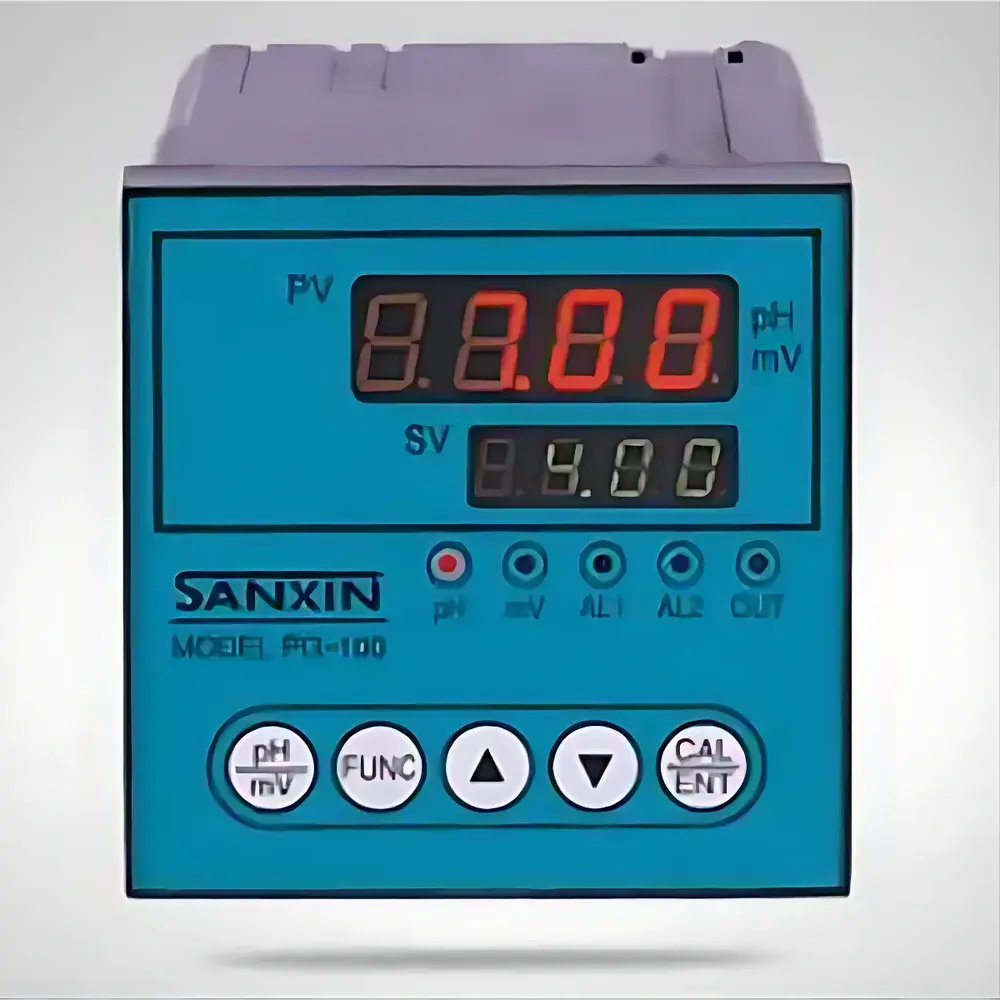
SANXIN PG100 Intelligent Digital pH/ORP Controller
| Brand | SANXIN Peirui |
|---|---|
| Origin | Shanghai, China |
| Model | PG100 |
| Instrument Type | Multiparameter Process Controller |
| Measurement Accuracy | ±0.02 pH / ±2 mV |
| pH Range | 0.00–14.00 |
| ORP Range | −1999 to +1999 mV |
| pH Resolution | 0.01 pH |
| ORP Resolution | 1 mV |
| Calibration Solutions | NIST-traceable pH buffer standards (pH 4.00, 6.86, 9.18) |
| Input Signals | 0–5 V DC, 1–5 V DC, 0–10 mA DC, 4–20 mA DC |
| Output Signals | 0–10 V DC, 4–20 mA DC |
| Alarm Outputs | 2 independent relay outputs (configurable as high/low limit with adjustable hysteresis) |
| Control Output | 1 SPST switch output (ON/OFF, selectable direct/reverse action) |
| Power Supply | 90–260 V AC, 50/60 Hz |
| Operating Environment | 0–50 °C, 35–85 % RH (non-condensing) |
| Weight | 0.25 kg |
| Compliance | Designed for industrial process monitoring per IEC 61000-6-2 (EMC immunity) and IEC 61000-6-4 (EMC emissions) |
Overview
The SANXIN PG100 Intelligent Digital pH/ORP Controller is a compact, DIN-rail mountable process instrument engineered for continuous, real-time monitoring and control of aqueous acidity (pH) and oxidation-reduction potential (ORP) in industrial water treatment, chemical dosing, electroplating, food & beverage processing, and wastewater management systems. Based on potentiometric measurement principles, the PG100 accepts standardized analog input signals from compatible pH and ORP electrodes—converting millivolt-level electrode potentials into calibrated digital readings via high-stability analog-to-digital conversion. Its dual-channel display simultaneously presents primary pH or ORP values alongside secondary process variables (e.g., temperature-compensated reading or alarm status), enabling operators to verify measurement integrity without toggling menus. The unit integrates digital signal filtering algorithms to suppress electromagnetic interference and transient noise common in factory-floor environments—ensuring stable readings even when installed near variable-frequency drives, solenoid valves, or high-current distribution panels.
Key Features
- Dual-line LED display showing primary measurement (pH or ORP) and auxiliary parameter (e.g., temperature, alarm state, or input signal status) concurrently
- Two independently configurable relay outputs supporting programmable high/low limit alarms with user-defined hysteresis (deadband) to prevent chattering in fluctuating processes
- One SPST solid-state switch output for ON/OFF control of dosing pumps, solenoid valves, or aeration systems—with selectable direct or reverse action logic
- Flexible calibration support: single-point (one buffer) or two-point (two buffers) pH calibration using standard NIST-traceable solutions (pH 4.00, 6.86, and/or 9.18)
- Built-in digital filtering with adaptive time constants to attenuate high-frequency noise while preserving dynamic response to genuine process changes
- Wide-range analog input compatibility: accepts 0–5 V DC, 1–5 V DC, 0–10 mA DC, and 4–20 mA DC signals from third-party transmitters or electrode amplifiers
- Standard analog output options: isolated 0–10 V DC or 4–20 mA DC for integration into PLCs, SCADA systems, or DCS networks
- Switch-mode power supply (90–260 V AC, 50/60 Hz) ensures stable operation across global industrial mains voltages with low heat dissipation
Sample Compatibility & Compliance
The PG100 is designed for use with standard glass-body pH electrodes and platinum or gold ORP electrodes compliant with ISO 7027, ASTM D1293, and USP . It supports automatic or manual temperature compensation when paired with Pt100 or thermistor-based temperature sensors (not included). While the controller itself does not perform sample preparation, its input architecture accommodates electrodes used in liquid streams ranging from ultrapure water (conductivity < 1 µS/cm) to aggressive chemical solutions (e.g., chlorine bleach, sulfuric acid, caustic soda). The device meets IEC 61000-6-2 (industrial immunity) and IEC 61000-6-4 (emissions) standards, and its enclosure rating (IP65 front panel) enables wall or cabinet mounting in non-hazardous, indoor industrial environments. It is not intrinsically safe and is not certified for Class I Div 1 or ATEX Zone 0/1 applications.
Software & Data Management
The PG100 operates as a standalone, firmware-based controller with no embedded operating system or remote connectivity. Configuration is performed locally via front-panel membrane keys; all settings—including calibration coefficients, alarm thresholds, hysteresis values, and output scaling—are retained in non-volatile memory during power loss. No PC software, drivers, or cloud services are required or supported. For auditability in regulated environments, users must maintain manual logs of calibration events, sensor verification checks, and maintenance actions per internal SOPs. While the unit does not provide electronic audit trails or 21 CFR Part 11 compliance features (e.g., user authentication, electronic signatures), its deterministic behavior and fixed-function firmware make it suitable for GLP-aligned applications where procedural documentation suffices.
Applications
- pH stabilization in cooling tower and boiler feedwater systems to inhibit corrosion and scale formation
- ORP-guided chlorine dosing control in municipal drinking water disinfection and swimming pool sanitation
- Real-time acidity monitoring during batch neutralization in pharmaceutical effluent treatment
- Process endpoint detection in electroplating baths (e.g., nickel strike, copper cyanide plating)
- Quality assurance in dairy processing—monitoring whey pH during cheese-making or cleaning-in-place (CIP) cycle validation
- Environmental compliance tracking for industrial wastewater discharge permits requiring continuous pH/ORP reporting
FAQ
Does the PG100 support automatic temperature compensation (ATC)?
Yes—when connected to a compatible Pt100 or thermistor temperature sensor (input via dedicated terminal block), the PG100 applies Nernst equation-based compensation to pH readings. ORP compensation is not applied, as redox potential exhibits minimal predictable temperature dependence.
Can the PG100 be used with differential or ISFET pH electrodes?
It accepts standard millivolt outputs from any electrode meeting typical industrial pH transmitter specifications (±1500 mV range, >1 GΩ input impedance). However, ISFET and differential electrodes often require proprietary signal conditioning; verify output compatibility with the PG100’s 0–5 V or 4–20 mA input ranges before integration.
Is calibration data stored with timestamps?
No—the PG100 stores only calibration slope and offset values. Timestamped calibration records must be maintained externally per quality system requirements.
What is the maximum cable length between the PG100 and a pH electrode?
For optimal noise immunity, keep shielded coaxial cable runs under 15 meters. Longer distances require an in-line electrode amplifier or a pH transmitter with 4–20 mA output.
Does the unit support Modbus RTU or other digital communication protocols?
No—the PG100 provides analog I/O only. For Modbus integration, pair it with a standalone analog-to-Modbus converter or select a higher-tier controller from the SANXIN product line.





