
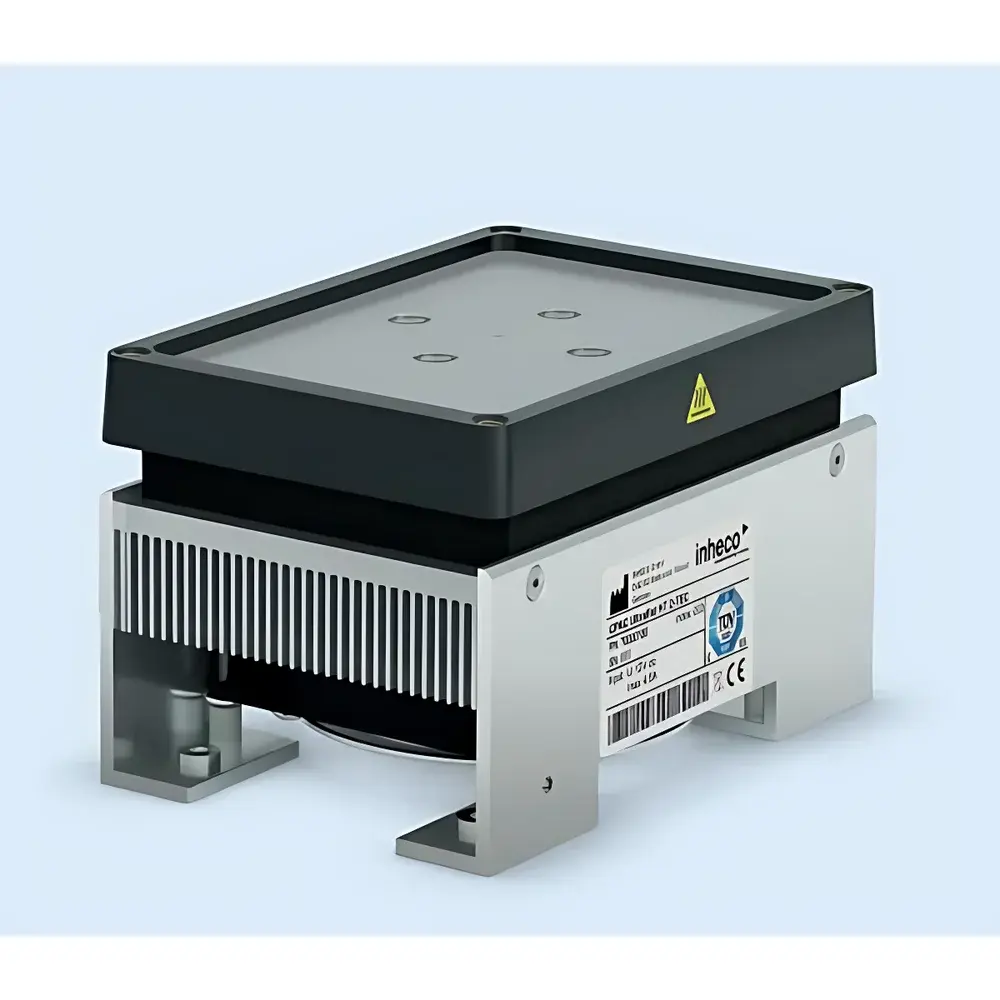
Inheco CPAC Ultraflat & CPAC Microplate Peltier-Based Heating and Cooling Modules for NGS Library Preparation Workstations
| Brand | Inheco |
|---|---|
| Origin | Germany |
| Model | CPAC Ultraflat, CPAC Microplate |
| Temperature Range (1-TEC) | 4 °C to 70 °C |
| Temperature Range (2-TEC) | 4 °C to 110 °C |
| Plate Compatibility | 96-well, 384-well microplates |
| Mounting Options | Surface-mounted (Ultraflat), Embedded (Microplate) |
| Height (Ultraflat) | 80 mm |
| Height (Microplate active surface) | ~14 mm above deck |
| System Integration | Compatible with Agilent Bravo/BioCel, Beckman Biomek FX/NX/i-Series, Hamilton STAR/Nimbus/Vantage, PerkinElmer Sciclone/Zephyr/JANUS/Multiprobe II, Protodyne BioCube, Tecan Freedom EVO/Genesis/TEMO/Fluent |
| Control Interface | STC (Single TEC Control), MTC or MTC Compact (Multi-Module Control, up to 6 units) |
| Power Supply | 24 V DC |
| Weight | 10 kg |
| Dimensions (W×D×H) | 300 mm × 600 mm × 900 mm |
| Application | Integrated thermal control for NGS library preparation — amplicon-based workflows, enzymatic reactions, adapter ligation, cleanup incubations, and QC-compatible temperature staging |
Overview
The Inheco CPAC Ultraflat and CPAC Microplate modules are precision-engineered Peltier-based thermal control platforms designed specifically for integration into automated liquid handling workstations used in next-generation sequencing (NGS) library preparation. Unlike conventional heating blocks or ambient-air incubators, the CPAC series employs solid-state thermoelectric cooling (TEC) technology to deliver bidirectional, rapid, and highly stable temperature regulation — from 4 °C for enzyme preservation and cold-step stabilization, up to 110 °C for high-stringency denaturation or hot-start polymerase activation. The modules operate on the principle of reversible Joule–Thomson heat transfer across semiconductor junctions, enabling precise, contact-based thermal coupling to microplates, tubes, or reservoirs without forced convection — a critical advantage in enclosed or vibration-sensitive automation environments where airflow interference must be minimized.
Key Features
- Two distinct mechanical configurations: CPAC Ultraflat mounts directly onto the workstation deck (80 mm total height); CPAC Microplate embeds beneath the deck plane, presenting only a 14 mm thermal interface above the deck — ideal for spatially constrained or multi-layered automation layouts.
- Modular thermal architecture: 1-TEC variants provide stable isothermal control (4–70 °C); 2-TEC variants enable dynamic ramping (4–110 °C) with typical transition times under 3 minutes between extremes — suitable for multi-stage enzymatic protocols requiring sequential incubation temperatures.
- Zero-airflow thermal management: No internal fans or external blowers; heat dissipation occurs passively or via optional external liquid-cooled heat sinks — eliminating cross-contamination risk and preserving laminar flow integrity in biosafety-critical workcells.
- Scalable control infrastructure: Single-module operation via STC (Single TEC Control); multi-module orchestration (up to six CPAC units) via MTC (with LCD interface) or MTC Compact (headless, RS-485/Ethernet-enabled) — each module independently addressable and programmable.
- Universal plate interface: Interchangeable thermal adapters accommodate insulated and non-insulated 96-well and 384-well plates (including skirted, semi-skirted, and low-profile formats), ensuring uniform thermal transfer across all wells with ≤ ±0.3 °C inter-well variance (verified per ISO 13485-compliant calibration protocol).
Sample Compatibility & Compliance
The CPAC platform supports standard ANSI/SLAS-format microplates (SBS footprint), PCR tubes (0.2 mL and 0.5 mL), and reservoir troughs used in NGS library construction — including fragmentation, end-repair, A-tailing, adapter ligation, and PCR amplification steps. All variants comply with IEC 61000-6-2 (EMC immunity) and IEC 61000-6-4 (EMC emissions) standards. When operated under validated control firmware (v3.2+), the system supports audit-trail generation and electronic signature capability aligned with FDA 21 CFR Part 11 requirements for regulated GMP/GLP laboratories. Temperature stability and accuracy are traceable to PTB (Physikalisch-Technische Bundesanstalt) reference standards, with annual recalibration certificates available upon request.
Software & Data Management
CPAC modules communicate natively with major liquid handler control software (e.g., Hamilton VENUS, Tecan FluentControl, PerkinElmer MethodBuilder) via Modbus RTU over RS-485 or TCP/IP. The MTC controller logs full thermal history (timestamped setpoint, actual temperature, power draw, error flags) in CSV format for post-run analysis and QC documentation. Optional integration with Laboratory Information Management Systems (LIMS) enables automatic association of thermal profiles with sample IDs and workflow events — supporting ISO/IEC 17025-compliant data integrity frameworks. Firmware updates are delivered via secure HTTPS endpoint and require dual-factor authentication to prevent unauthorized modification.
Applications
- Amplicon-based NGS library prep: Precise thermal staging for multiplex PCR, touchdown cycling, and post-amplification hold at 4 °C.
- Enzymatic reaction optimization: Independent control of ligation (16–25 °C), uracil-DNA glycosylase (UDG) treatment (20 °C), and USER enzyme activation (37 °C) within a single run.
- QC-integrated workflows: Simultaneous thermal conditioning of samples and controls during qPCR-based library quantification or fragment analyzer loading steps.
- Automated normalization: Temperature-controlled dilution and pooling steps maintaining DNA integrity across variable input concentrations.
- Hybrid capture pre-hybridization incubation: Stable 48 °C holding for probe hybridization buffer equilibration prior to magnetic bead capture.
FAQ
What distinguishes CPAC Ultraflat from CPAC Microplate in terms of mechanical integration?
The Ultraflat model installs flush on the workstation deck surface (80 mm total height), while the Microplate variant is embedded below deck level — only its 14 mm-thick thermal plate protrudes above the deck, minimizing vertical obstruction and enabling compatibility with overhead robotic arms and multi-tiered deck architectures.
Can CPAC modules be used for true thermal cycling like a PCR cycler?
No — CPAC is not a rapid-cycling instrument. For sub-second ramp rates and precise dwell control required in PCR, Inheco recommends the ODTC (Optimized Dynamic Thermal Cycler) platform. CPAC is engineered for incubation-grade thermal stability and moderate ramping (e.g., 2–5 °C/sec), not denaturation-annealing-extension cycling.
Is third-party adapter support available beyond Inheco’s catalog?
Yes — custom thermal adapters can be co-engineered with dimensional specifications and material certifications (e.g., USP Class VI biocompatibility, autoclavability) for proprietary plate formats or specialized consumables.
How is temperature uniformity verified across the plate surface?
Each production unit undergoes thermal mapping using calibrated 16-point Pt100 sensor arrays per ISO/IEC 17025-accredited procedures; final validation reports include min/max deviation, inter-well delta-T, and temporal stability metrics over 24-hour continuous operation.
Does CPAC require external cooling water or compressed air?
No — standard operation uses passive heatsink dissipation. For sustained 110 °C operation or high-duty-cycle environments, optional liquid-cooled heat exchangers (with DIN 47500 quick-connect fittings) are available as field-upgradable accessories.



