
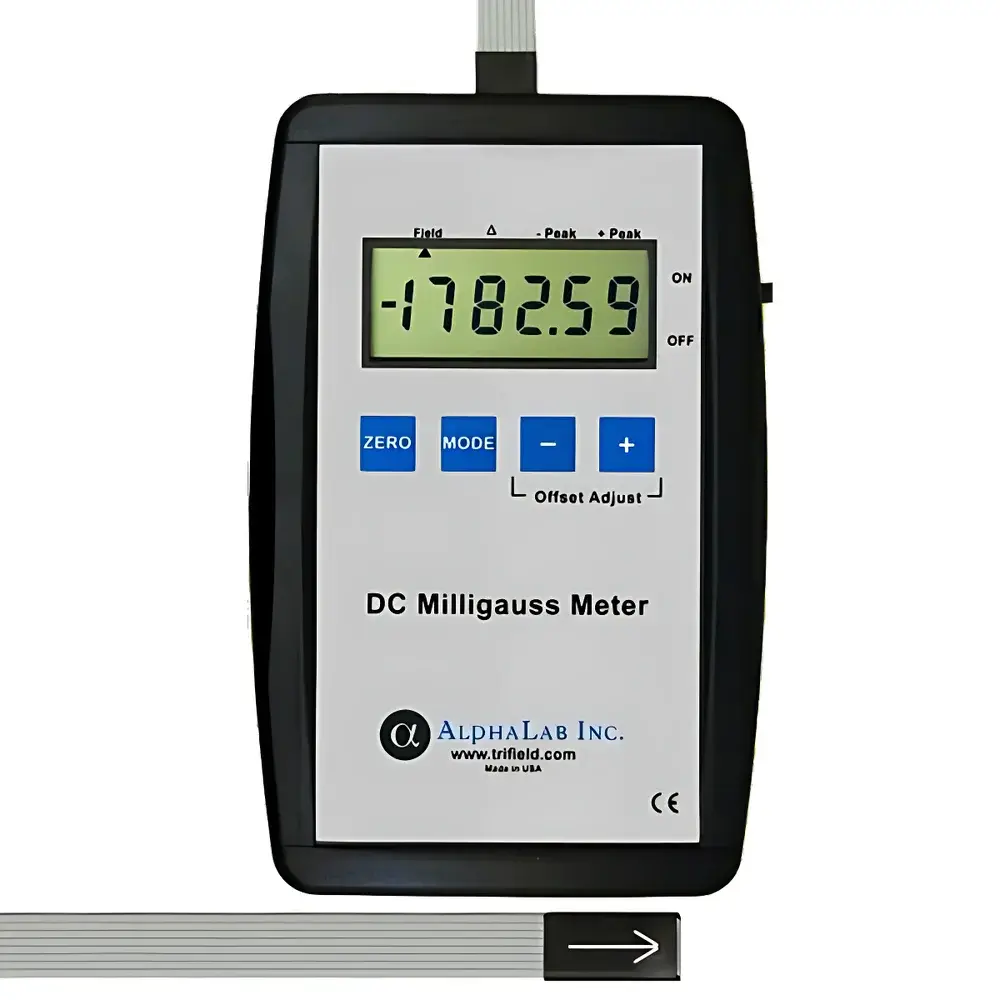
AlphaLab MGM DC Gaussmeter / Magnetometer
| Brand | AlphaLab |
|---|---|
| Origin | USA |
| Model | MGM |
| Measurement Range | ±2000 mG (±200 µT) |
| Resolution | 0.01 mG (1 nT) |
| Display | 5½-digit, -1999.99 to +1999.99 mG |
| Update Rate | 3 Hz |
| Analog Output | ±2 V = ±2 G (±2000 mG), ±0.5% accuracy |
| Bandwidth | DC–3 Hz standard (optional DC–300 Hz) |
| Sensor Type | Axial anisotropic magnetoresistive (AMR) |
| Active Sensor Area | 1 mm × 0.2 mm |
| Temperature Stability | Offset TC < 0.01 mG/°C |
| Accuracy (Gain) | ±0.5% FS |
| Offset Error | ±0.5 mG |
| Operating Temp | 0–45°C |
| Dimensions | 18 × 9 × 5 cm |
| Weight | 325 g (incl. battery) |
Overview
The AlphaLab MGM DC Gaussmeter is a precision axial-field magnetometer engineered for high-stability, low-noise measurement of static and quasi-static magnetic flux density (B-field) in laboratory, industrial, and research environments. Unlike traditional fluxgate or Hall-effect sensors, the MGM employs a miniaturized anisotropic magnetoresistive (AMR) sensing element—offering superior temperature stability, compact active area (1 mm × 0.2 mm), and exceptional resolution of 0.01 mG (1 nT). Its design targets applications requiring detection of minute field variations against strong background fields—such as characterizing thin-film magnets, mapping fringe fields near permanent magnets, verifying magnetic shielding integrity, or calibrating reference field coils. The instrument operates on the principle of AMR resistance modulation under applied magnetic fields, with signal conditioning optimized for DC-to-low-frequency response (standard 3 Hz bandwidth, extendable to 300 Hz upon request). With a full-scale range of ±2000 mG (±200 µT), it covers Earth’s geomagnetic field (~500 mG) by a factor of four—making it suitable for both geophysical baseline studies and engineering-grade magnetic QA/QC.
Key Features
- Ultra-high resolution: 0.01 mG (1 nT) across full ±2000 mG range, enabled by 5½-digit LCD display (−1999.99 to +1999.99 mG)
- Miniaturized axial AMR sensor: 1 mm × 0.2 mm active area enables spatially resolved measurements in high-gradient regions and thin-film characterization
- Exceptional thermal stability: Offset temperature coefficient < 0.01 mG/°C; gain temperature coefficient < 0.0015%/°C—performance approaching that of proton precession magnetometers without cryogenic or RF complexity
- Factory-calibrated accuracy: ±0.5% full-scale gain error and ±0.5 mG offset error, traceable to NIST-traceable standards
- Analog voltage output (1 V = 1 G, ±0.5%): ±2 V range compatible with standard DAQ systems; bandwidth configurable up to DC–300 Hz at −3 dB
- Robust mechanical design: Rugged handheld enclosure (18 × 9 × 5 cm), rubber boot protection, and 4-ft integrated 8-conductor shielded cable (custom lengths available)
- High reproducibility: ±0.01 mG (1 nT) repeatability under constant-temperature conditions
Sample Compatibility & Compliance
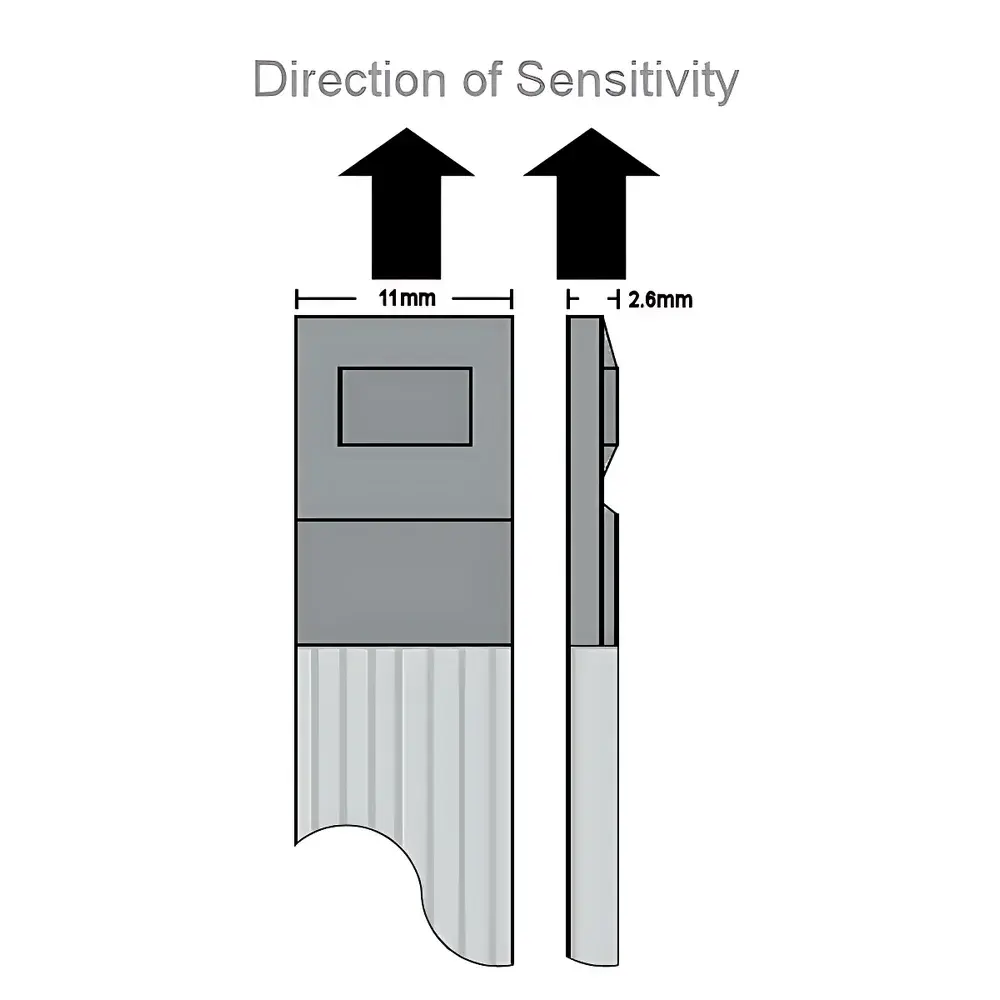
The MGM is designed for non-contact, non-destructive measurement of static and slowly varying magnetic fields in air, vacuum, or non-magnetic enclosures. Its axial sensor geometry requires alignment parallel to the field component of interest—ideal for mapping dipole fields, solenoid interiors, or surface fields of sintered NdFeB or AlNiCo magnets. It complies with general electromagnetic compatibility (EMC) requirements per IEC 61326-1 for laboratory use. While not certified for medical or aerospace safety-critical applications, its performance meets typical metrological requirements for ISO/IEC 17025-accredited calibration labs performing magnetic field verification per ASTM A977/A977M (Standard Test Method for Magnetic Properties of High-Coercivity Permanent Magnet Materials) and IEC 60404-5 (Permanent magnet materials — Part 5: Methods of measurement of magnetic properties). Data logging workflows support GLP/GMP-aligned audit trails when paired with compliant DAQ software.
Software & Data Management
The MGM does not include proprietary software but delivers analog output fully compatible with industry-standard data acquisition platforms—including National Instruments LabVIEW, MATLAB Data Acquisition Toolbox, Keysight PathWave, and Python-based PyVISA implementations. The ±2 V analog signal (linear, ratiometric, and low-drift) enables direct integration into automated test systems requiring time-synchronized B-field monitoring. Users may configure sampling rates up to 1 kHz when using optional high-bandwidth variants (DC–300 Hz). For traceable calibration records, AlphaLab provides NIST-traceable certificate documentation with each unit, including individual sensor sensitivity, offset, and temperature coefficients measured at multiple points across 0–45°C. All firmware and calibration parameters are stored in non-volatile memory and require no user intervention.
Applications
- Quality control of permanent magnets: Verifying Br, HcJ, and uniformity in production lines for automotive sensors and consumer electronics actuators
- Thin-film and MEMS magnetic characterization: Quantifying remanence and domain structure in sputtered CoPt or FeNi layers
- Magnetic shielding validation: Mapping leakage fields inside mu-metal enclosures used in electron microscopy or quantum sensing setups
- Geophysical instrumentation support: Establishing local geomagnetic baselines and monitoring diurnal variation in observatory-grade installations
- Educational laboratories: Teaching core concepts of magnetic vector fields, sensor physics, and SI unit conversions (1 G = 100 µT = 10⁵ nT)
- Calibration of Helmholtz coils and current sources: Providing feedback for closed-loop field generation systems operating up to 200 µT
FAQ
What is the difference between gauss and tesla units, and how does the MGM display them?
The MGM displays readings exclusively in milligauss (mG); 1 mG = 100 nT = 0.1 µT. Conversion is embedded in the analog output scaling (1 V = 1 G = 100 µT), enabling seamless integration with SI-unit-based DAQ systems.
Can the MGM measure alternating magnetic fields?
The standard configuration supports DC to 3 Hz (quasi-static fields). An optional high-bandwidth version extends usable frequency response to DC–300 Hz at −3 dB, suitable for low-frequency AC field monitoring such as power-line harmonics or PWM-driven actuator fields.
Is the sensor probe interchangeable or repairable?
The AMR sensor is permanently integrated into the probe tip and not user-replaceable. However, AlphaLab offers factory recalibration and probe replacement services under extended service agreements.
Does the MGM meet FDA 21 CFR Part 11 requirements for electronic records?
The standalone instrument does not include audit trail, electronic signature, or system validation features. When integrated into validated systems (e.g., LabVIEW with Part 11-compliant add-ons), compliance depends on the host platform’s qualification—not the MGM itself.
How is temperature compensation implemented?
Temperature coefficients for offset (< 0.01 mG/°C) and gain (< 0.0015%/°C) are characterized during factory calibration and applied via internal compensation algorithms; no user adjustment is required across 0–45°C.



