
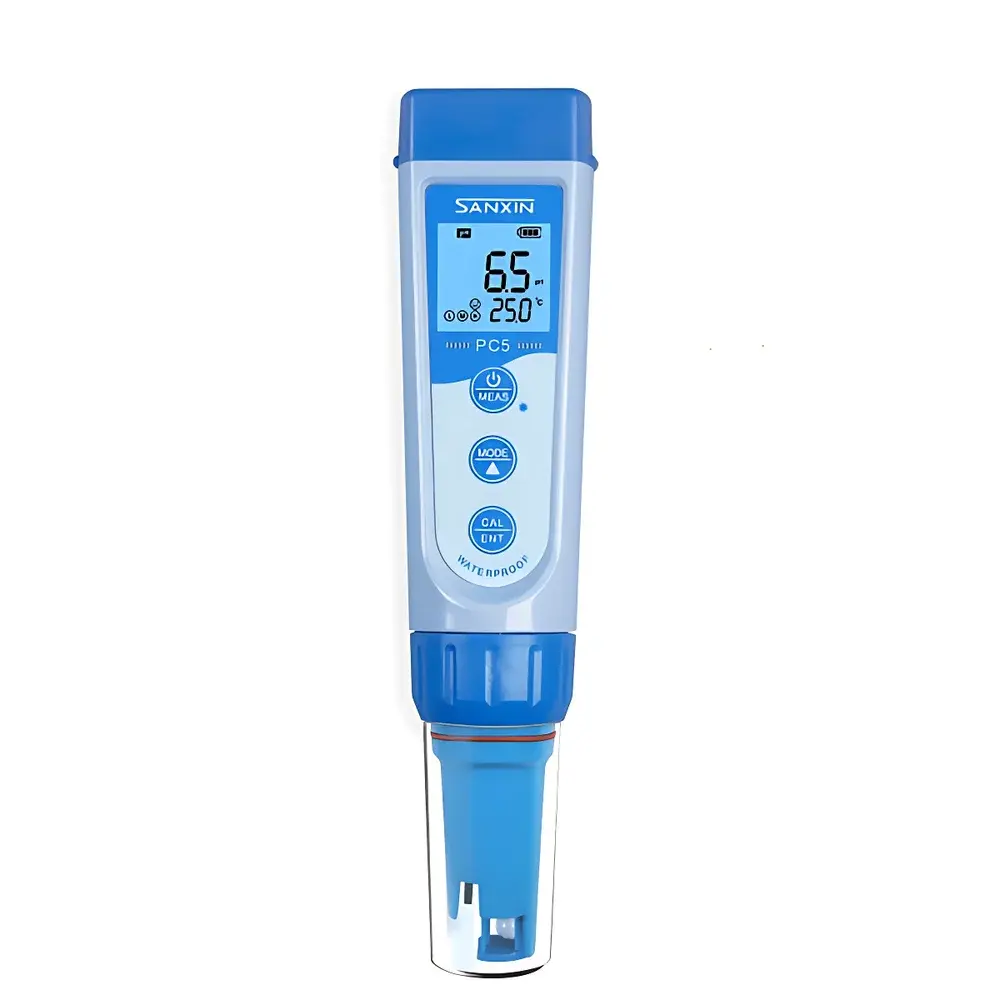
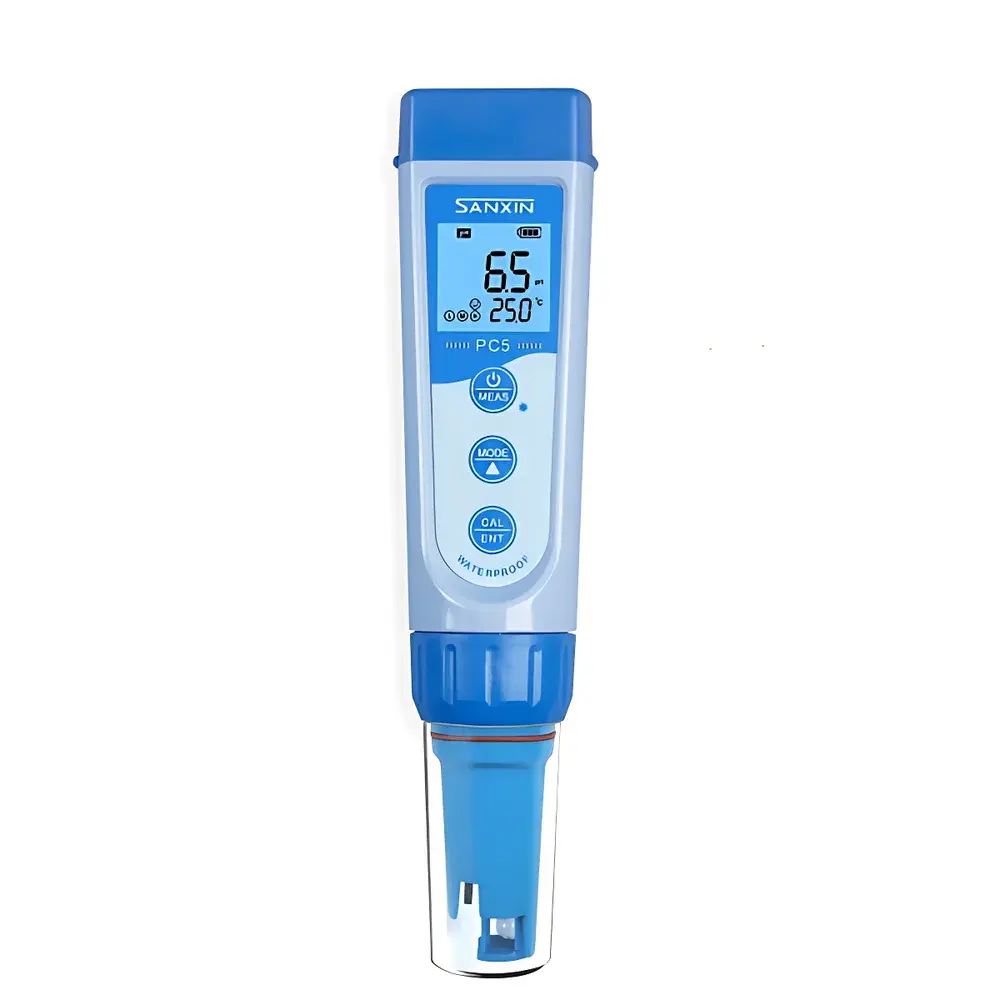
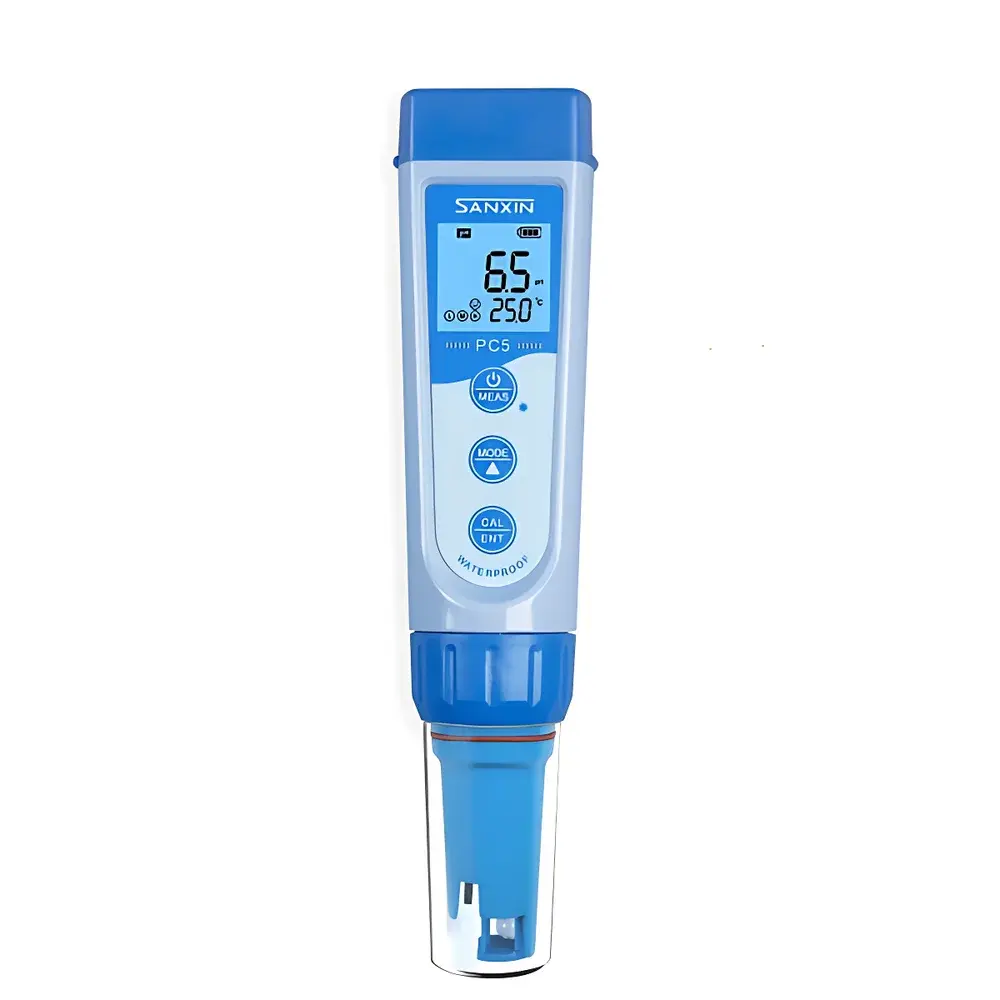
SANXIN PC5 Portable pH/Conductivity Pen Tester
| Brand | SANXIN Peri |
|---|---|
| Origin | Shanghai, China |
| Manufacturer Type | Authorized Distributor |
| Region of Manufacture | Domestic (China) |
| Model | PC5 |
| Pricing | Upon Request |
| Measurement Parameters | Single-Parameter (pH + Conductivity/TDS/Salinity/Resistivity) |
| Form Factor | Pen-Style Portable |
| Intended Use | Field & On-Site Applications |
| Conductivity Range | 0–2000 µS/cm |
| TDS Range | 0–100 g/L |
| Resistivity Range | 0–100 MΩ·cm |
| Salinity Range | 0–100 ppt |
| Temperature Range | 0–50 °C |
| Accuracy | ±1% FS |
| Minimum Resolution | 0.001 µS/cm |
| pH Range | –2.00 to 16.00 pH |
| pH Accuracy | ±0.01 pH |
| Temperature Compensation | Automatic (0–50 °C) |
| Calibration | 1–3 Point Auto-Calibration (pH), Conductivity Auto-Calibration |
| Display | Dual-Color Backlit LCD with Auto-Off Setting |
| Power Source | AAA Batteries |
| Enclosure Rating | IP67 |
| Accessories Included | Rugged Carrying Case, Calibration Solutions (pH 4.01/7.00/10.01, 1413 µS/cm KCl), Sample Vials, Electrode Cap |
Overview
The SANXIN PC5 Portable pH/Conductivity Pen Tester is an integrated electrochemical field instrument engineered for rapid, reliable measurement of pH, conductivity, total dissolved solids (TDS), salinity, and resistivity in aqueous solutions. Based on potentiometric pH detection and four-electrode (or two-electrode, depending on configuration) conductometric principles, the PC5 delivers laboratory-grade functionality in a compact, rugged pen format. Its design prioritizes operational robustness in non-laboratory environments—such as aquaculture ponds, hydroponic nutrient tanks, swimming pool maintenance zones, thermal cooling towers, and municipal water distribution points—where environmental exposure, portability constraints, and real-time decision-making are critical. The device implements automatic temperature compensation (ATC) across its full operating range (0–50 °C), ensuring thermally corrected readings without manual intervention. Built-in self-diagnostic routines continuously monitor electrode status, battery voltage, calibration validity, and sensor integrity—reducing operator error and supporting consistent data quality under variable field conditions.
Key Features
- Replaceable combination pH/conductivity sensor cartridge—enabling modular maintenance and extended service life
- Dual-color backlit LCD display with user-configurable auto-off timer (1–30 minutes) to optimize battery longevity
- Intelligent microcontroller architecture supporting 1–3 point pH auto-calibration and single-point conductivity auto-calibration against certified KCl standards (e.g., 1413 µS/cm)
- Integrated ATC using a built-in NTC thermistor (±0.5 °C accuracy), eliminating manual correction tables or external probes
- Auto-hold and manual hold functions for stable reading capture in turbulent or low-volume samples
- IP67-rated housing—fully dust-tight and submersible up to 1 m for 30 minutes—validated per IEC 60529
- Low-power operation via two standard AAA alkaline batteries (typical service life: >200 hours continuous use)
- On-device calibration prompts, error alerts (e.g., “CAL ERROR”, “ELECTRODE DRY”), and low-battery indicator
Sample Compatibility & Compliance
The PC5 is validated for use with clean to moderately turbid aqueous media, including freshwater, brackish water, nutrient solutions, chlorinated recreational water, and low-viscosity industrial process streams. It is not intended for highly viscous, suspended-solid-laden, or strongly oxidizing/reducing matrices without prior filtration or dilution. While not certified to ISO/IEC 17025 or accredited for regulatory reporting, the instrument adheres to foundational metrological practices aligned with ASTM D1125 (Standard Test Methods for Electrical Conductivity and Resistivity of Water) and ISO 7888 (Water Quality — Determination of Electrical Conductivity). Its calibration traceability relies on NIST-traceable reference solutions included in the kit (pH 4.01, 7.00, 10.01 buffers; 1413 µS/cm KCl). The device supports GLP-aligned workflows through timestamped calibration logs (stored internally) and clear visual feedback during calibration sequences.
Software & Data Management
The PC5 operates as a standalone field instrument with no Bluetooth, USB, or PC connectivity. All measurement data remain on-device only and are not exportable—consistent with its role as a rapid verification tool rather than a data-logging platform. However, its internal memory retains the last calibration date, buffer values used, and sensor identification status, accessible via diagnostic mode. For laboratories requiring audit trails or electronic records, users are advised to manually transcribe readings into LIMS or ELN systems. The absence of digital interfaces simplifies compliance with environments where electromagnetic interference (EMI) or cybersecurity restrictions prohibit wireless transmission—such as certain pharmaceutical cleanrooms or utility infrastructure sites.
Applications
- Aquaculture monitoring: Real-time tracking of pond pH stability and conductivity shifts linked to feed decomposition or algal bloom onset
- Hydroponics and vertical farming: Verification of nutrient solution ionic strength (via conductivity) and acid/base balance (pH) prior to irrigation cycles
- Recreational water management: On-site validation of sanitizer efficacy correlates (e.g., pH 7.2–7.8, conductivity <1500 µS/cm for balanced chlorine demand)
- Industrial cooling water systems: Trend analysis of conductivity drift indicating scaling potential or microbial fouling
- Environmental field surveys: Preliminary screening of surface water bodies for anthropogenic contamination indicators
- Educational labs: Introductory electrochemistry demonstrations emphasizing sensor response time, calibration logic, and temperature dependency
FAQ
Can the PC5 measure ORP?
Yes—the instrument supports optional ORP measurement when equipped with a dedicated ORP electrode (sold separately). The firmware automatically detects electrode type upon insertion and switches measurement mode accordingly.
Is the pH electrode refillable or gel-filled?
The standard pH sensor is a sealed, gel-filled combination electrode with integrated reference junction—designed for field durability and minimal maintenance. Refillable liquid-filled electrodes are not supported.
What is the recommended recalibration frequency?
For routine field use, recalibrate before each measurement session. In high-precision applications or after exposure to extreme pH/conductivity ranges, calibrate prior to every sample group.
Does the device comply with FDA 21 CFR Part 11?
No—the PC5 lacks electronic signature capability, audit trail generation, or user access controls required for Part 11 compliance. It is suitable for non-GxP preliminary assessments only.
How do I verify calibration integrity between sessions?
Use the built-in diagnostic mode to review stored calibration parameters and confirm slope (% recovery) and offset (mV) values fall within acceptable limits (pH slope: 95–105%; offset: ±30 mV).




