
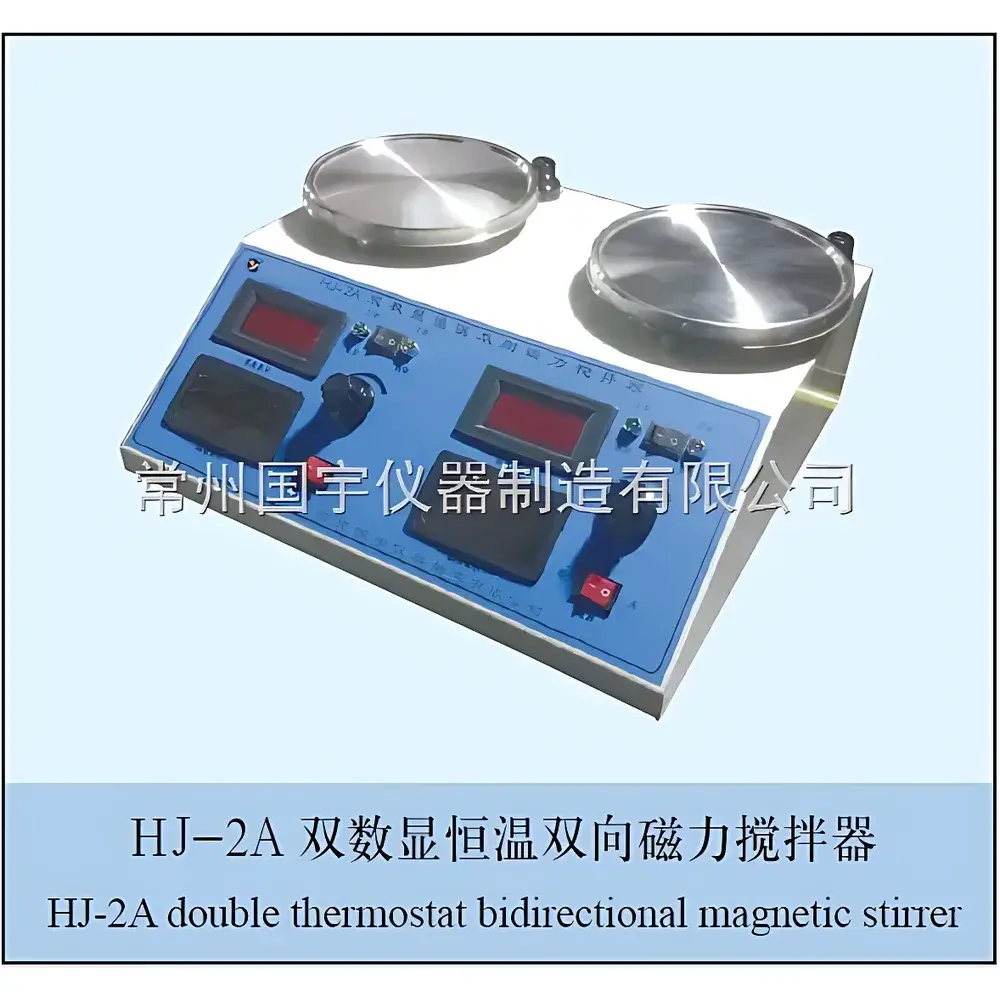
CZGY HJ-2A Upgraded Dual Digital Display Constant-Temperature Bidirectional Magnetic Stirrer
| Brand | CZGY |
|---|---|
| Origin | Jiangsu, China |
| Manufacturer Type | Direct Manufacturer |
| Instrument Type | Magnetic Stirrer |
| Max Stirring Volume | 2 × 2000 mL |
| Speed Range | 0–1600 rpm |
| Temperature Control Range | Ambient +10°C to 300°C |
| Heating Power | 300 W per plate |
| Motor Power | 30 W |
| Plate Diameter | Ø145 mm × 2 |
| Bidirectional Interval | 30 s |
| Temp. Accuracy | ±0.5°C |
| Power Supply | AC 220 V ±10 V, 50 Hz |
Overview
The CZGY HJ-2A Upgraded Dual Digital Display Constant-Temperature Bidirectional Magnetic Stirrer is an engineered laboratory platform designed for simultaneous, independent thermal and mechanical control of two samples under identical or differentiated operational parameters. It operates on the principle of magnetic coupling—where rotating permanent magnets beneath a thermally conductive ceramic or stainless-steel heating plate induce rotational motion in PTFE- or glass-coated magnetic stir bars immersed in liquid media. This non-contact drive mechanism eliminates mechanical shaft penetration, ensuring seal integrity, reduced contamination risk, and maintenance-free operation. Unlike single-station units, the dual-channel architecture enables comparative experiments—such as parallel reaction kinetics, buffer equilibration under matched conditions, or controlled temperature ramping across replicate samples—without cross-interference. Its integrated PID temperature regulation and microprocessor-based speed control deliver stable thermal profiles and precise rotational dynamics essential for reproducible solubilization, dissolution testing, catalyst activation, and homogeneous reagent dispersion in analytical, pharmaceutical, and materials synthesis workflows.
Key Features
- Dual independent digital displays: Separate LED readouts for real-time speed (rpm) and temperature (°C) on each station—enabling immediate visual verification without mode switching.
- Bidirectional stirring sequence: Programmable 30-second alternating rotation direction per station minimizes vortex asymmetry and improves mixing uniformity in viscous or heterogeneous systems.
- Wide operational envelope: 0–1600 rpm continuous speed range with smooth analog-style adjustment; temperature control from ambient +10°C up to 300°C with ±0.5°C accuracy over full range.
- Robust thermal design: Twin 145 mm diameter heating plates with 300 W power rating each ensure rapid heat-up and stable plateau maintenance—even during prolonged high-temperature operation (e.g., reflux, solvent evaporation, or polymerization).
- Safety-integrated architecture: Grounded chassis, auto-shutoff on overheating, and interlocked heating logic (heating disabled when stir bar is stationary) comply with IEC 61010-1 safety requirements for laboratory electrical equipment.
- Low-noise, low-vibration motor assembly: Brushless DC drive system eliminates commutator wear and acoustic emission—critical for vibration-sensitive applications such as optical cell preparation or microfluidic interface conditioning.
Sample Compatibility & Compliance
The HJ-2A accommodates standard laboratory glassware including borosilicate beakers (up to 2000 mL capacity per station), Erlenmeyer flasks, and jacketed reactors with compatible stir bar geometry (cylindrical or flea-type, 20–40 mm length). Its ceramic-coated aluminum heating surface resists chemical etching from common solvents (e.g., ethanol, acetone, dilute acids/bases) and withstands repeated thermal cycling. From a regulatory standpoint, the instrument’s fixed-setpoint temperature control and non-programmable logic align with GLP-compliant environments where audit-trail simplicity and operational transparency are prioritized. While not FDA 21 CFR Part 11 validated out-of-the-box, its deterministic behavior—no stored method files, no user-editable firmware—supports straightforward IQ/OQ documentation for QC labs operating under ISO/IEC 17025 or ASTM E2656 (Standard Guide for Validation of Laboratory Equipment).
Software & Data Management
This is a standalone, hardware-controlled instrument with no embedded software stack, network interface, or data logging capability. All operational parameters are set and monitored via front-panel tactile buttons and dual-digit LED displays. The absence of firmware or connectivity eliminates cybersecurity exposure, firmware version drift, and calibration traceability complications associated with digitally managed instruments. For laboratories requiring electronic recordkeeping, external USB or RS-232 data loggers (e.g., Omega OM-DAQPRO-5300 series) may be interfaced using optional analog output modules—though such integration falls outside factory specification and requires user validation per ALCOA+ principles.
Applications
- Pharmaceutical development: Dissolution testing per USP , buffer preparation for HPLC mobile phase conditioning, and excipient wet granulation studies.
- Materials science: Nanoparticle dispersion in polymer matrices, precursor solution homogenization for sol-gel synthesis, and graphene oxide suspension stabilization.
- Environmental analysis: Digestion of soil/water samples prior to ICP-MS or AAS quantification; COD (Chemical Oxygen Demand) reagent mixing at elevated temperatures.
- Academic research: Teaching laboratories performing Arrhenius kinetic experiments, enzyme activity assays requiring strict thermal control, and undergraduate physical chemistry labs studying viscosity–temperature relationships.
- Quality control: Routine pH electrode calibration solutions, standard reference material reconstitution, and cleaning solution activation in GMP cleanrooms.
FAQ
Is the HJ-2A suitable for use with corrosive solvents such as concentrated HCl or HF?
The heating plate surface is chemically resistant to mild-to-moderate organic and aqueous reagents, but direct contact with hydrofluoric acid or fuming sulfuric acid is not recommended. Always use secondary containment (e.g., silicone mats or ceramic trays) and verify compatibility with your specific solvent system.
Can both stations operate at different speeds and temperatures simultaneously?
Yes—each station features fully independent speed and temperature controls, allowing differential settings without mutual interference.
What stir bar size is optimal for the 2000 mL maximum volume?
For optimal torque transfer and vortex formation in tall-form beakers, use cylindrical stir bars measuring 35–40 mm in length and 8–10 mm in diameter; avoid oversized bars that exceed the magnetic coupling depth of the drive system.
Does the unit support external temperature probe input for jacketed vessel control?
No—the built-in sensor measures plate surface temperature only. External probe integration requires third-party PID controllers and is not supported by factory firmware.
What is the expected service life under continuous 8-hour daily operation at 1200 rpm and 180°C?
Rated for >10,000 hours of cumulative operation when operated within specified duty cycles (e.g., ≤4 hours at ≥1400 rpm; ≤8 hours at ≤1000 rpm), assuming proper ventilation and periodic cleaning of vent pathways.



