
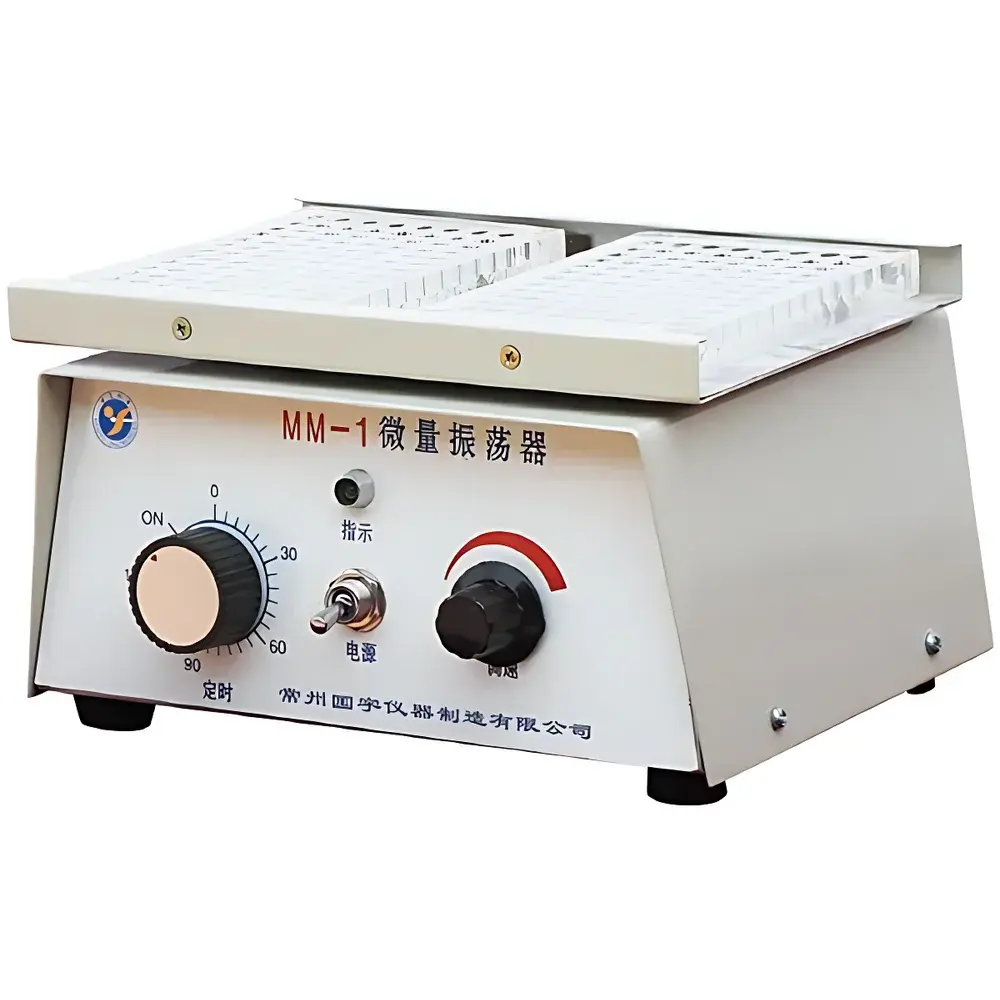
CZGY MM-1 Microplate Vibrator
| Brand | CZGY |
|---|---|
| Origin | Jiangsu, China |
| Manufacturer Type | Direct Manufacturer |
| Product Category | Domestic |
| Models | MM-1, ZW-A |
| Instrument Type | Microplate Vibrator / Non-incubated Shaker |
| Timer Range | 0–120 min |
| Oscillation Frequency | 0–2500 rpm |
| Amplitude | ≥6 mm |
| Temperature Control | None |
| Platform Quantity | 1 |
Overview
The CZGY MM-1 Microplate Vibrator is a compact, benchtop orbital shaker engineered for precise and reproducible mixing of micro-volume samples in standard 96-well plates—primarily blood coagulation assays, ELISA workflows, immunoassays, and other diagnostic applications requiring uniform agitation without thermal regulation. Unlike incubated shakers or temperature-controlled orbital mixers, the MM-1 operates at ambient conditions and leverages a robust electromagnetic drive system to deliver consistent sinusoidal motion across the entire platform. Its design adheres to fundamental mechanical vibration principles: oscillation is generated via an eccentric mass rotated by a brushless AC motor, translating rotational energy into controlled lateral displacement (≥6 mm amplitude) with adjustable frequency (0–2500 rpm). This enables rapid homogenization of viscous biological fluids—including whole blood, serum, plasma, and reagent-bound antigen–antibody complexes—while minimizing bubble formation and plate edge effects. The unit complies with IEC 61000-6-3 (EMC emissions) and IEC 61000-6-2 (immunity), and its electrical safety conforms to GB 4793.1–2019 (equivalent to IEC 61010-1), making it suitable for routine use in clinical laboratories operating under GLP-aligned quality frameworks.
Key Features
- Single-platform configuration optimized for 96-well microplates (dual-position capacity: up to two 96-well plates simultaneously)
- Stepless speed control via analog rotary dial, enabling fine-tuned adjustment from standstill to 2500 rpm for protocol-specific mixing intensity
- Stable amplitude output (≥6 mm peak-to-peak displacement) maintained across full speed range, verified per ISO 20816-1 vibration assessment guidelines
- Integrated 0–120 minute mechanical timer with audible end-of-cycle alert; auto-shutoff prevents over-mixing and sample degradation
- Low-power consumption (25 W nominal), compliant with ENERGY STAR®-aligned standby efficiency benchmarks for lab equipment
- Spring-suspended platform assembly with hardened steel suspension wires ensures long-term mechanical stability and resistance to fatigue-induced drift
- IP20-rated enclosure with grounded AC input (220 V, 50 Hz) and reinforced insulation barrier to prevent ingress of conductive liquids
Sample Compatibility & Compliance
The MM-1 accommodates standard ANSI/SBS-compliant 96-well plates—including flat-bottom, U-bottom, and V-bottom formats—as well as compatible assay strips and PCR plate adapters. It supports common diagnostic consumables used in coagulation testing (e.g., PT, APTT, fibrinogen assays), serology panels, and rapid antigen detection kits. While not certified for ISO 13485 manufacturing environments, the device meets essential performance criteria outlined in CLSI EP15-A3 for repeatability of mixing parameters in clinical laboratory instrumentation. Its non-sterile, non-ventilated construction excludes use in ISO Class 5 cleanrooms or GMP aseptic processing areas. Users must observe strict liquid containment protocols: no direct exposure to aqueous splashes or condensate, as internal components lack conformal coating or ingress protection beyond IP20.
Software & Data Management
The MM-1 operates as a standalone analog instrument with no embedded firmware, network interface, or digital data logging capability. All operational parameters—including runtime and speed setting—are manually configured and unrecorded. Consequently, it does not support FDA 21 CFR Part 11 electronic record/electronic signature compliance, nor does it generate audit trails. However, its simplicity ensures full traceability through manual logbook entries per ISO/IEC 17025:2017 Clause 7.10.2 (recording of equipment usage). Laboratories implementing paper-based or LIMS-integrated QC workflows may assign unique asset IDs and document calibration intervals (recommended annually per manufacturer guidance) alongside operator initials and batch identifiers.
Applications
- Blood coagulation analysis: uniform mixing of citrated whole blood in coagulation tubes prior to centrifugation or direct plate loading
- Immunoassay preparation: resuspension of dried-down antibody conjugates and antigen standards in ELISA and lateral flow assay development
- Quality control of diagnostic reagents: verification of homogeneity and solubility prior to lot release
- Research-scale cell lysate clarification: gentle agitation during protease inhibitor equilibration pre-centrifugation
- Pharmaceutical stability testing: auxiliary mixing step in forced degradation studies involving buffered protein solutions
FAQ
Is the MM-1 compatible with deep-well plates or 384-well formats?
No—the platform geometry and amplitude profile are validated exclusively for ANSI/SBS-standard 96-well plates (127.76 × 85.48 mm footprint). Use with non-standard plates may result in uneven motion distribution or mechanical interference.
Does the device include a calibration certificate or factory verification report?
CZGY provides a出厂检验报告 (Factory Inspection Report) verifying timer accuracy (±2% tolerance) and speed linearity (±3% deviation at 1000 rpm), but no NIST-traceable calibration certificate is included by default.
Can the MM-1 be operated continuously beyond 120 minutes?
No—the mechanical timer has a hard stop at 120 minutes. For extended operation, users must manually reset the timer after each cycle; continuous unattended operation is not supported.
What maintenance is required to ensure long-term performance?
Biannual inspection of suspension wire integrity and cleaning of ventilation grilles with dry compressed air is recommended. Lubrication is not required; the motor contains sealed-for-life bearings.
Is the unit suitable for use in biosafety cabinets?
Yes—its low electromagnetic emission profile and absence of heat-generating components allow safe placement inside Class II A2 cabinets, provided airflow balance is verified post-installation per NSF/ANSI 49 requirements.




