
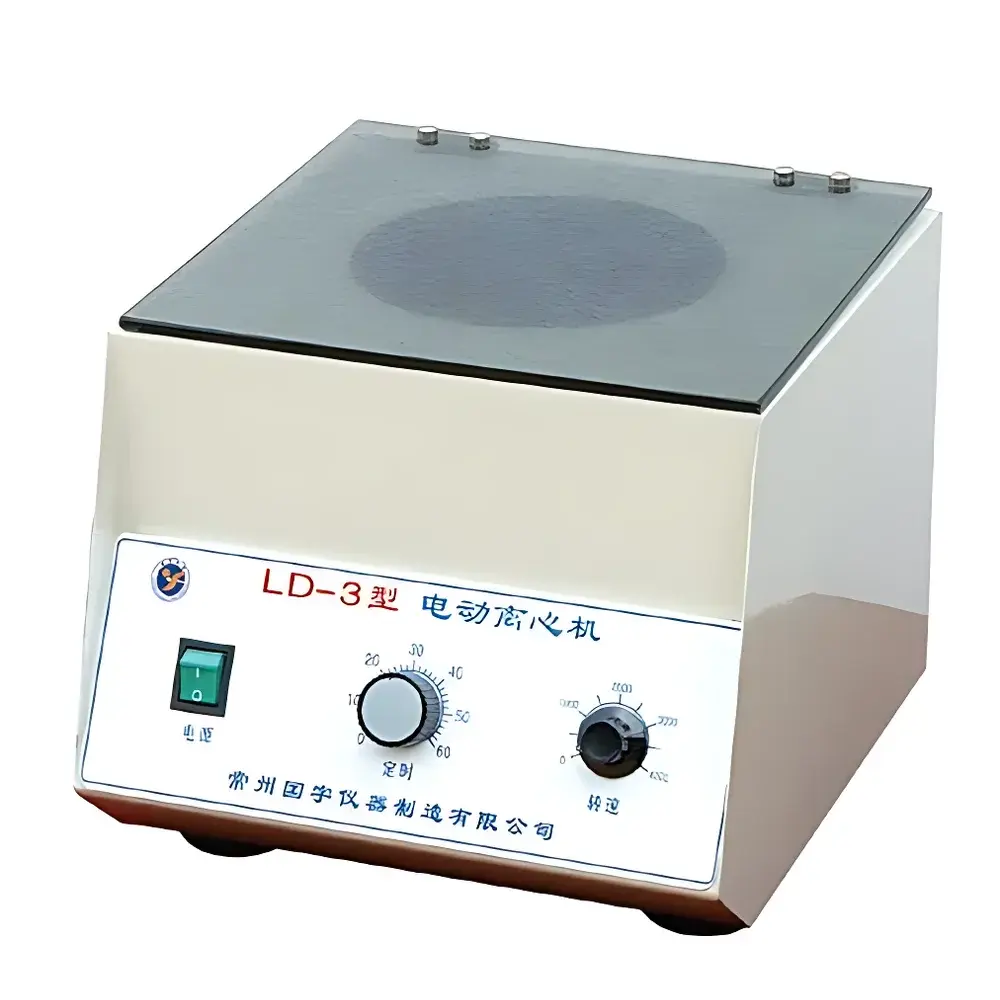
CZGY LD-3 Benchtop Electric Centrifuge
| Brand | CZGY |
|---|---|
| Origin | Jiangsu, China |
| Manufacturer Type | Direct Manufacturer |
| Model | LD-3 |
| Max Capacity | 6 × 50 mL |
| Max Speed | 4000 rpm |
| Dimensions | 290 × 330 × 260 mm |
| Power Supply | 220 V, 50 Hz |
| Motor Power | 40 W |
| RCF (Relative Centrifugal Force) at Max Speed | 1960 × g |
| Timer Function | Yes |
| Digital Speed Display | Yes |
| Safety Cover | Transparent Acrylic Lid |
| Grounding Requirement | Mandatory |
| Tube Balance Tolerance | ≤ 3 g per position |
Overview
The CZGY LD-3 Benchtop Electric Centrifuge is a compact, high-reliability centrifugation system engineered for routine separation tasks in clinical diagnostics, biomedical research, and quality control laboratories. It operates on the principle of sedimentation under controlled centrifugal force—generating radial acceleration to separate components of heterogeneous mixtures based on differences in density, size, and shape. With a maximum rotational speed of 4000 rpm and a corresponding relative centrifugal force (RCF) of 1960 × g, the LD-3 delivers sufficient resolution for plasma/serum separation, cellular pelleting, urine sediment analysis, and preliminary vaccine formulation workflows. Its benchtop footprint (290 × 330 × 260 mm) and lightweight construction make it suitable for space-constrained environments such as hospital satellite labs, teaching facilities, and field-deployable diagnostic units.
Key Features
- Compact, ergonomic design optimized for limited bench space without compromising structural rigidity or vibration damping.
- Digital RPM display with real-time speed monitoring—enabling precise method reproducibility across operators and shifts.
- Integrated mechanical timer (0–99 minutes) with automatic rotor deceleration and audible end-of-run signal.
- Transparent acrylic safety lid with interlock mechanism—prevents operation unless fully closed and ensures compliance with IEC 61010-2-020 safety standards for laboratory centrifuges.
- Brushed DC motor with 40 W nominal power output—designed for low thermal load, extended service life, and stable torque delivery across the full 0–4000 rpm range.
- Fixed-angle rotor configuration accommodating six 50 mL conical tubes (e.g., Falcon-style), with pre-balanced positioning to minimize manual correction during loading.
- Mandatory grounding terminal included—ensuring operator safety and electromagnetic compatibility (EMC) in shared lab infrastructure.
Sample Compatibility & Compliance
The LD-3 supports standard polypropylene and polycarbonate centrifuge tubes (up to 50 mL volume) used in clinical and bioscience applications. Tube balancing is required per ISO 21501-4 and CLSI EP17-A2 guidelines; imbalance tolerance is strictly limited to ≤ 3 g between opposing positions to prevent bearing wear and rotor deformation. The instrument meets CE marking requirements under the Low Voltage Directive (2014/35/EU) and Electromagnetic Compatibility Directive (2014/30/EU). While not certified for Class II biological safety containment, it is routinely deployed in BSL-2 compliant workflows when paired with sealed tube caps and appropriate PPE. Routine maintenance—such as rotor inspection, lid hinge lubrication, and motor brush assessment—is recommended every 500 operating hours per manufacturer service protocol.
Software & Data Management
The LD-3 is a standalone electromechanical device with no embedded microprocessor-based data logging or network connectivity. All operational parameters—including set speed, elapsed time, and run status—are monitored via front-panel indicators only. For GLP/GMP traceability, users are advised to document runs manually or integrate the centrifuge into external electronic lab notebook (ELN) systems using standardized SOP templates. No firmware updates or software validation packages are provided; however, the absence of digital control logic simplifies 21 CFR Part 11 compliance for audit trails when paired with paper-based or validated ELN-based recordkeeping.
Applications
- Routine serum and plasma separation from whole blood specimens in clinical pathology labs.
- Pelleting mammalian and microbial cells for downstream nucleic acid extraction or protein isolation.
- Sediment concentration in urinalysis workflows per CLIA and CAP accreditation requirements.
- Clarification of crude antigen preparations during early-stage vaccine development.
- Phase separation in immunoassay reagent preparation and buffer exchange protocols.
- Teaching laboratory use for demonstrating sedimentation kinetics and RCF–rpm relationships.
FAQ
What is the maximum relative centrifugal force (RCF) achievable with the LD-3?
The LD-3 achieves a maximum RCF of 1960 × g at 4000 rpm with its standard 6 × 50 mL fixed-angle rotor.
Does the LD-3 support variable-speed ramping or programmable acceleration/deceleration profiles?
No—the LD-3 features manual analog speed control with continuous adjustment from 0 to 4000 rpm; it does not include programmable ramp rates.
Is rotor calibration or certification available from the manufacturer?
CZGY provides factory-tested rotors with documented balance verification but does not offer NIST-traceable calibration certificates; third-party metrology services may be engaged for ISO/IEC 17025-compliant verification.
Can the LD-3 be used for centrifuging hazardous or infectious samples?
Only with fully sealed, leak-proof tubes and secondary containment; the unit itself lacks aerosol-tight sealing or biosafety certification.
What maintenance intervals are recommended for sustained performance?
Inspect rotor for cracks or corrosion every 100 runs; clean chamber and lid gasket weekly; verify grounding continuity before each daily use.



