
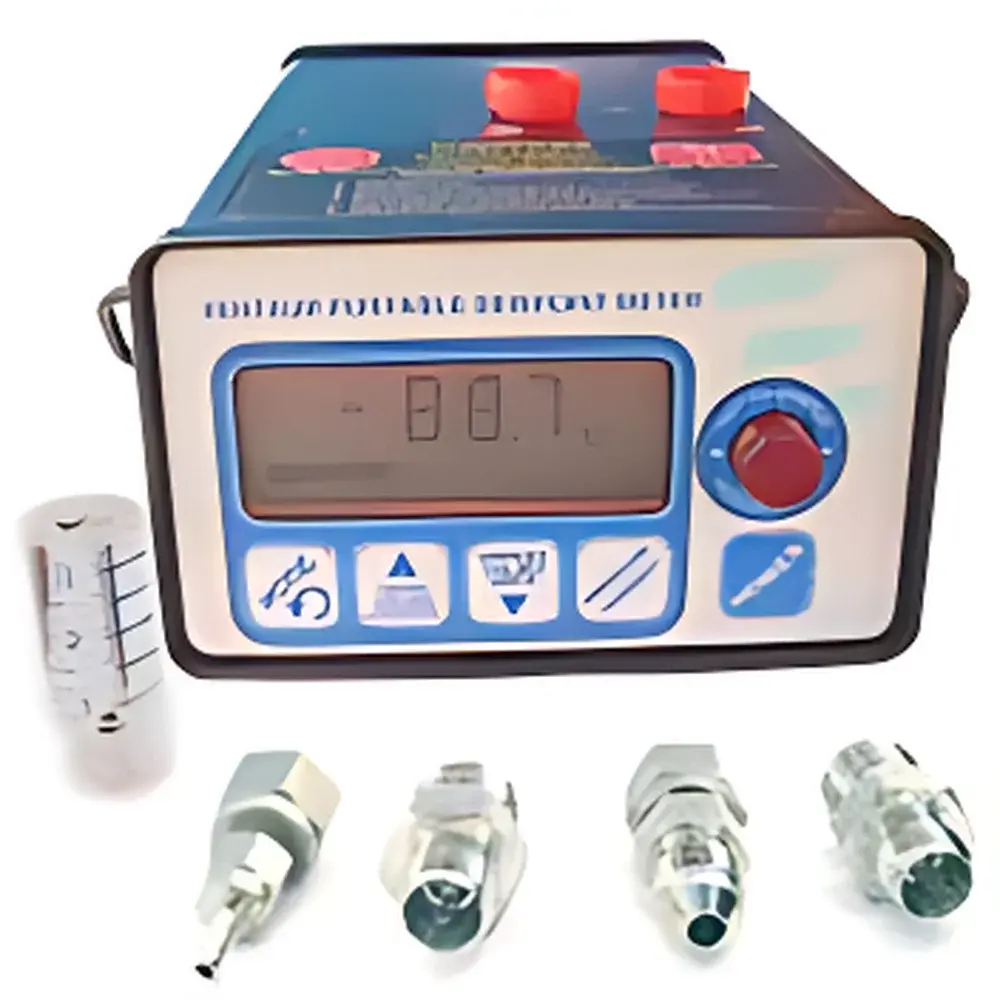
XPDM Series Portable Dew Point Meter
| (在此处输出精准翻译� | �纯英文产品名称。极其重要:仅输出一行名称,严禁输出备选名、严禁换行重复、严禁包含任何中文字符) |
|---|---|
| [Origin | USA |
| Manufacturer Type | Authorized Distributor |
| Origin Category | Imported |
| Model | XPDM |
| Pricing | Available Upon Request] |
Overview
The XPDM Series Portable Dew Point Meter is a field-deployable, battery-operated analytical instrument engineered for high-accuracy dew point measurement across an exceptionally wide range of −100 °C to +20 °C. It employs the well-established aluminum oxide (Al2O3) capacitive sensing principle: a high-purity aluminum rod is anodized to form a stable, microporous aluminum oxide dielectric layer; a porous gold electrode is sputtered onto this layer, forming a capacitor whose capacitance varies predictably with water vapor adsorption. This physical adsorption-based transduction mechanism ensures long-term stability, minimal hysteresis, and immunity to common interferents such as hydrocarbons or CO2. Designed for real-time monitoring in demanding industrial environments—including natural gas transmission, refinery process streams, SF6 insulation gas in high-voltage switchgear, hydrogen cooling systems in power generators, medical oxygen supply lines, and compressed air networks—the XPDM delivers trace moisture quantification without requiring external calibration gases or laboratory infrastructure.
Key Features
- True portability: Compact housing (63.5 × 108 × 190 mm), lightweight design (< 1.2 kg), and dual-power operation (9 V alkaline battery or 15–25 V DC input) enable extended field use without mains dependency.
- Extended measurement range: Certified performance from −100 °C to +20 °C dew point, supporting applications from ultra-dry semiconductor purge gases to moderately humid process air.
- Rapid thermal and adsorption equilibrium: 90% response time ≤ 450 s; 63% response time ≤ 90 s—optimized for dynamic sampling conditions and frequent point-of-use verification.
- Integrated temperature sensing: Onboard Pt100-grade thermistor measures sample gas temperature simultaneously with dew point, enabling real-time thermodynamic correction.
- Multi-parameter display: Simultaneous readout of dew point (°C), ppmv, g/m³, lb/MMSCF, and absolute humidity—configurable via intuitive 5-button interface.
- Modular sensor architecture: Field-replaceable sensor cartridges ensure interchangeability and minimize downtime during maintenance or recalibration.
- Programmable pressure compensation: Built-in pressure correction algorithm accepts user-input or optional external pressure transducer data to normalize dew point values to standard reference conditions (e.g., 101.325 kPa).
- Galvanic isolation: Sensor element, enclosure, and signal outputs (4–20 mA analog & RS-232) are electrically isolated to prevent ground loops and ensure EMC compliance in electrically noisy plant environments.
Sample Compatibility & Compliance
The XPDM is compatible with non-corrosive, non-condensing gases including nitrogen, argon, helium, hydrogen, oxygen, compressed air, natural gas (dry), SF6, and CO2. It operates safely within a maximum working pressure of 690 kPa absolute and a recommended flow rate of 100 mL/min (not m/s—corrected per industry convention). The electro-polished stainless steel sample chamber meets ASTM D2045 and ISO 8573-1 Class 1 requirements for trace moisture analysis in compressed air systems. While not intrinsically safe certified, it complies with IEC 61000-6-2/6-3 for electromagnetic compatibility and UL 61010-1 for electrical safety. Sensor storage at ≤ −80 °C dew point preserves baseline capacitance integrity between measurements, ensuring long-term repeatability (±0.5 °C) and accuracy (±3 °C typical over full range).
Software & Data Management
Data logging and configuration are supported via RS-232 serial interface using ASCII protocol (baud rate configurable up to 115.2 kbps). Optional PC software enables timestamped data export (CSV), sensor health diagnostics, firmware updates, and audit-trail-enabled calibration event logging—supporting GLP/GMP documentation requirements. The 3.5-digit backlit LCD provides local visualization without external hardware. Analog output (4–20 mA, HART-compatible option available) permits direct integration into DCS/PLC systems with linear scaling to user-defined dew point spans. All calibration events—including automatic self-calibration using ambient saturated vapor above +20 °C—are recorded with date/time stamps and retained in non-volatile memory.
Applications
- Quality assurance of insulating gases in power transformers and GIS (gas-insulated switchgear) per IEEE C37.122 and IEC 60480.
- Moisture verification in hydrogen-cooled turbine generators to prevent rotor winding corrosion (per NEMA MG-1 and EPRI guidelines).
- In-line monitoring of dried instrument air for pneumatic control systems (ISO 8573-1 Class 2 or better).
- Compliance testing of medical oxygen per USP and ISO 8573-3.
- Pre-commissioning drying validation of LNG pipelines and cryogenic equipment.
- Field verification of desiccant dryer performance in petrochemical and pharmaceutical manufacturing.
FAQ
What is the recommended calibration frequency for the XPDM in routine industrial use?
Annual calibration is recommended for general applications; however, critical processes (e.g., SF6 handling in substations) may require semi-annual verification per utility-specific maintenance protocols.
Can the XPDM measure dew point in corrosive gas streams such as wet H2S or chlorine?
No. The aluminum oxide sensor is chemically incompatible with acidic, oxidizing, or halogenated gases. Use only with clean, dry, non-reactive carrier gases.
Does the instrument support pressure correction for variable line pressures?
Yes—pressure correction is programmable via front-panel menu or host software, and supports both manual entry and live input from an optional external pressure sensor.
How does the automatic calibration function work?
It utilizes ambient atmospheric moisture above +20 °C as a known reference point (saturation vapor pressure ≈ 23.4 mbar), triggering internal capacitance normalization without external standards.
Is the sensor protected against condensation during transient exposure to high humidity?
The sensor’s design includes a protective diffusion barrier and rapid thermal stabilization; however, prolonged exposure to saturated vapor below its operational lower limit may require extended recovery time and is not recommended.





