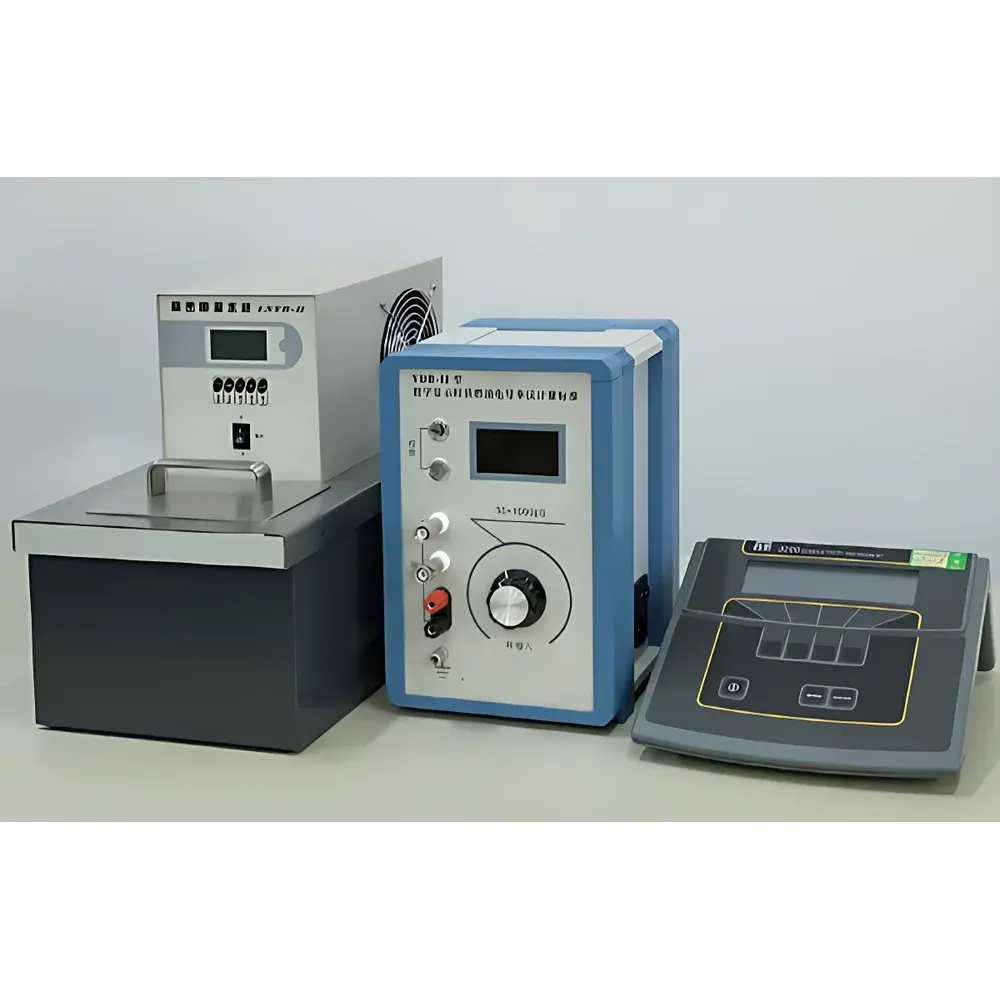
Shanghai Biaozhuo YCM-T Oil Conductivity Meter Calibration Standard Set
| Brand | Biaozhuo |
|---|---|
| Origin | Shanghai, China |
| Model | YCM-T |
| Measurement Range | 0–2000 pS |
| Expanded Uncertainty | ≤1% (k=2) |
| Dimensions (L×W×H) | ≤250 mm × 170 mm × 180 mm |
| Weight | ≤2.5 kg |
| Interface | BNC + Terminal Block |
| Insulation Resistance (between terminals) | ≥1×10¹³ Ω·m |
Overview
The Shanghai Biaozhuo YCM-T Oil Conductivity Meter Calibration Standard Set is a primary metrological reference instrument designed specifically for the verification and calibration of electrical conductivity meters used in the measurement of light petroleum products—such as aviation fuel, gasoline, kerosene, and diesel. It functions as a traceable, high-stability resistive standard, engineered to replicate defined conductance values across the 0–2000 pS range via precision high-value resistor networks. Unlike general-purpose resistance standards, the YCM-T is purpose-built to emulate the low-conductance behavior of hydrocarbon-based fuels under controlled environmental conditions. Its design complies fully with GJB/J 3049–97, the Chinese military standard for the verification of light oil conductivity meters, ensuring metrological validity for laboratories operating under MIL-STD, ISO/IEC 17025, or national defense quality assurance frameworks. The unit serves as a critical link in the calibration chain—from national metrology institutes to field service labs—supporting regulatory compliance in fuel quality control, static electricity hazard mitigation, and safety-critical handling procedures in aviation refueling, petrochemical storage, and military logistics.
Key Features
- Traceable calibration standard with expanded uncertainty ≤1% (k=2), validated against national reference standards;
- Compact, portable enclosure (≤250 × 170 × 180 mm; ≤2.5 kg) optimized for lab bench use and mobile calibration teams;
- Dual-interface output: BNC coaxial connector for shielded signal integrity + screw-type terminal block for flexible grounding and auxiliary connections;
- High insulation resistance (>1×10¹³ Ω·m between terminals), minimizing leakage current and ensuring stable low-pS output fidelity;
- Integrated desiccant chamber with replaceable silica gel cartridges, enabling humidity resilience in non-climate-controlled environments;
- Designed for operation at (22 ± 2)°C ambient temperature—compatible with standard metrology lab thermal stabilization protocols.
Sample Compatibility & Compliance
The YCM-T is exclusively intended for calibrating the electronic meter section (i.e., the conductance-to-digital converter and readout circuitry) of portable and benchtop oil conductivity analyzers—not the sensor cells themselves. It is compatible with all commercially available light-oil conductivity meters conforming to GJB/J 3049–97 input impedance and excitation voltage specifications. The device meets the physical and electrical requirements for use in GLP-compliant fuel testing laboratories and supports audit readiness for ISO/IEC 17025 accreditation. While not certified to IEC 61000 or ATEX, its construction adheres to Class II insulation principles and is suitable for use in non-hazardous zone laboratory environments. Documentation includes a calibration certificate with traceability to NIM (National Institute of Metrology, China) through accredited secondary standards.
Software & Data Management
The YCM-T is a hardware-only metrological standard with no embedded firmware, display, or data logging capability—ensuring long-term stability, zero drift from software aging, and full compatibility with legacy and modern conductivity meters alike. All calibration records—including date, operator ID, environmental conditions (temperature, RH), selected test points, observed readings, and calculated error per GJB/J 3049–97 Section 5.1.2.3—are maintained externally in laboratory information management systems (LIMS) or paper-based calibration logs. For digital recordkeeping, the device supports integration with electronic calibration management platforms compliant with FDA 21 CFR Part 11 (audit trail, electronic signature, and record retention) when paired with validated data acquisition software and calibrated multimeters.
Applications
- Periodic verification of aviation fuel conductivity meters prior to aircraft refueling operations;
- Factory acceptance testing (FAT) and in-process calibration of conductivity analyzers during OEM production;
- Supporting static charge dissipation assessments in fuel blending, pipeline transfer, and tank farm operations;
- Reference standard for third-party calibration service providers serving defense, civil aviation, and refinery clients;
- Training and proficiency testing for metrologists and QC technicians in petroleum product testing laboratories.
FAQ
What is the recommended preconditioning procedure before first use or after prolonged storage?
Dry the internal desiccant cartridge at 105°C for 2–3 hours, reinsert it into the instrument, and allow the unit to equilibrate for ≥8 hours in a (22 ± 2)°C environment prior to calibration.
Can the YCM-T be used to calibrate conductivity sensors directly?
No—it is designed only for verifying the electronic meter section (conductance readout electronics). Sensor cell calibration requires separate traceable cell standards and solution-based methods.
Is the uncertainty value of ≤1% (k=2) valid across the entire 0–2000 pS range?
Yes—the expanded uncertainty is specified over the full operational range and verified at minimum three points (e.g., 10 pS, 500 pS, 1800 pS) per GJB/J 3049–97 Annex B.
How often should the desiccant be replaced?
Replace silica gel when color indicator shifts from blue to pink, or at least every 12 months under typical lab storage conditions.
Does the YCM-T require periodic recalibration by an accredited lab?
Yes—recommended recalibration interval is 12 months, or after any physical shock, exposure to >80% RH, or suspected performance deviation.