
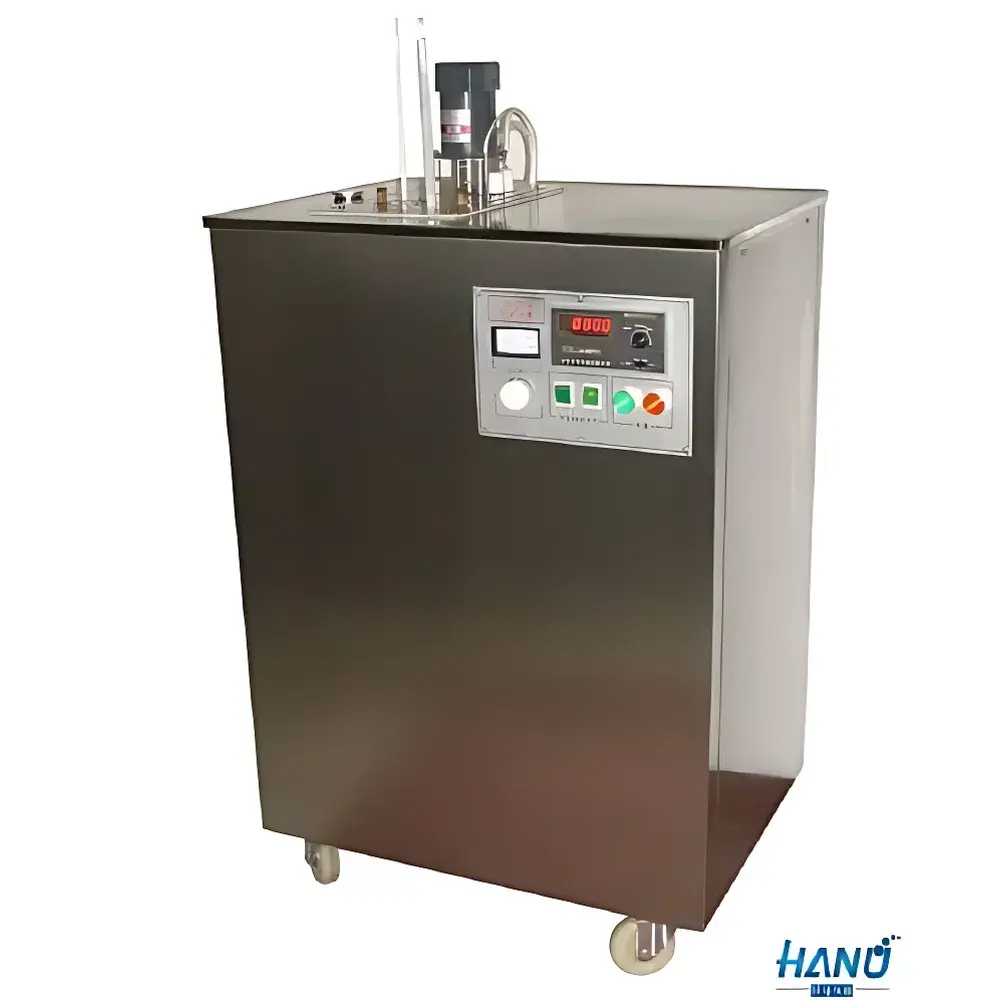
Hanuo HN20M Compact Precision Circulating Bath
| Brand | Hanuo |
|---|---|
| Origin | Shanghai, China |
| Model | HN20M |
| Instrument Type | Precision Circulating Bath |
| Circulation Mode | Internal Circulation |
| Temperature Control | Refrigeration & Heating |
| Bath Volume | 6.5 L |
| Temperature Range | −20 °C to 95 °C |
| Temperature Stability | ±0.01 °C per 10 min |
| Temperature Uniformity | ≤0.01 °C |
| Settling Time | ≤10 min |
| Working Chamber Dimensions | Ø100 × 300 mm |
| Medium | Anhydrous Ethanol (for <30 °C), Deionized Water (for ≥30 °C) |
| Ambient Operating Temperature | <30 °C |
| Power Consumption | 750 W |
| Voltage/Frequency | 220 V / 50 Hz |
| External Dimensions (H × W × D) | 420 × 360 × 650 mm |
| Construction | Stainless Steel (Brushed Finish) Inner Tank and Outer Casing |
Overview
The Hanuo HN20M Compact Precision Circulating Bath is a laboratory-grade temperature-controlled immersion system engineered for metrological calibration and high-fidelity thermal process support. It operates on the principle of active refrigeration-heating thermoregulation using dual-mode Peltier-assisted compression cooling and resistive heating, coupled with PID-based closed-loop feedback control. Designed specifically to meet the stringent thermal stability requirements of national metrology institutes and accredited calibration laboratories, the HN20M delivers exceptional short-term stability (±0.01 °C over 10 minutes) and spatial uniformity (≤0.01 °C across its cylindrical working zone), making it suitable for primary and secondary calibration of liquid-in-glass thermometers (e.g., standard mercury and Beckmann types), industrial platinum resistance thermometers (PRTs), and Cu–Constantan thermocouples per ISO/IEC 17025 and JJG 161–2018 guidelines.
Key Features
- Compact footprint (420 × 360 × 650 mm) optimized for benchtop deployment in space-constrained metrology labs and QC environments.
- Stainless steel brushed-finish construction—both inner tank and outer casing—for corrosion resistance, mechanical durability, and compliance with cleanroom-compatible surface standards.
- High-precision digital PID temperature controller with real-time deviation monitoring, auto-tuning capability, and programmable ramp/soak profiles.
- Dual-mode thermal regulation: integrated vapor-compression refrigeration circuit for sub-ambient operation (down to −20 °C) and high-efficiency tubular heating elements for rapid warm-up to 95 °C.
- Internal circulation pump ensures consistent thermal homogeneity without external plumbing; flow rate optimized to minimize turbulence-induced thermal gradients.
- Thermal medium compatibility: anhydrous ethanol for low-temperature operation (−20 °C to 29 °C); deionized water recommended above 30 °C to prevent scaling and ensure long-term bath fluid integrity.
Sample Compatibility & Compliance
The HN20M accommodates standard calibration probes up to Ø100 mm in diameter and 300 mm in immersion depth, supporting common reference sensor geometries including stem-type thermometers, sheathed RTDs, and miniature thermocouple junctions. Its thermal performance complies with key international metrological requirements: temperature stability and uniformity meet or exceed the specifications outlined in ISO 5725 (accuracy of measurement methods), ASTM E74-22 (calibration of force-measuring instruments), and JJG 229–2010 (verification procedures for precision thermostatic baths). The unit’s design supports traceable calibration workflows under GLP and ISO/IEC 17025-accredited quality systems, with documented thermal validation protocols available upon request.
Software & Data Management
While the HN20M operates as a standalone analog/digital hybrid instrument, its RS-232 interface enables integration with external data acquisition systems (e.g., LabVIEW, MATLAB, or custom SCADA platforms) for time-stamped temperature logging, alarm event capture, and audit trail generation. When used in regulated environments (e.g., pharmaceutical QC or medical device testing), the bath can be operated within a validated configuration that satisfies FDA 21 CFR Part 11 requirements for electronic records—provided the host software implements appropriate user access controls, electronic signatures, and immutable audit logs. Optional firmware upgrades support Modbus RTU protocol for centralized facility monitoring networks.
Applications
- Primary and secondary calibration of temperature standards in national metrology institutes and third-party calibration labs.
- Thermal validation of temperature-sensitive analytical instrumentation—including HPLC column ovens, viscometer thermostats, and differential scanning calorimeters (DSC).
- Stability testing of reference materials and certified reference substances (CRMs) per ISO Guide 35.
- Controlled-temperature conditioning of samples prior to rheological, spectroscopic, or electrochemical analysis.
- Process simulation in R&D settings requiring precise thermal boundary conditions (e.g., polymer crystallization studies, enzyme activity assays, battery electrolyte characterization).
FAQ
What temperature media are compatible with the HN20M bath?
Anhydrous ethanol is required for operation below 30 °C; deionized or softened water is recommended for temperatures between 30 °C and 95 °C. Oil-based media are not supported.
Is external circulation possible with this model?
No—the HN20M features internal-only circulation. For external recirculation applications, consider the HN20MX variant with dual-port manifold and pressure-rated pump.
Does the unit include NIST-traceable calibration documentation?
Factory calibration certificates (with as-found/as-left data) are provided; NIST-traceable certification requires optional on-site verification by an ISO/IEC 17025-accredited provider.
Can the HN20M maintain stability during extended overnight operation?
Yes—its thermal architecture and redundant safety cutoffs (over-temp, low-level, dry-run) enable unattended 24-hour operation when used with appropriate bath fluid maintenance protocols.
What is the maximum allowable ambient temperature for reliable performance?
The specified operating ambient must remain below 30 °C with adequate ventilation; exceeding this limit may degrade refrigeration efficiency and compromise stability specifications.
Related Products



