
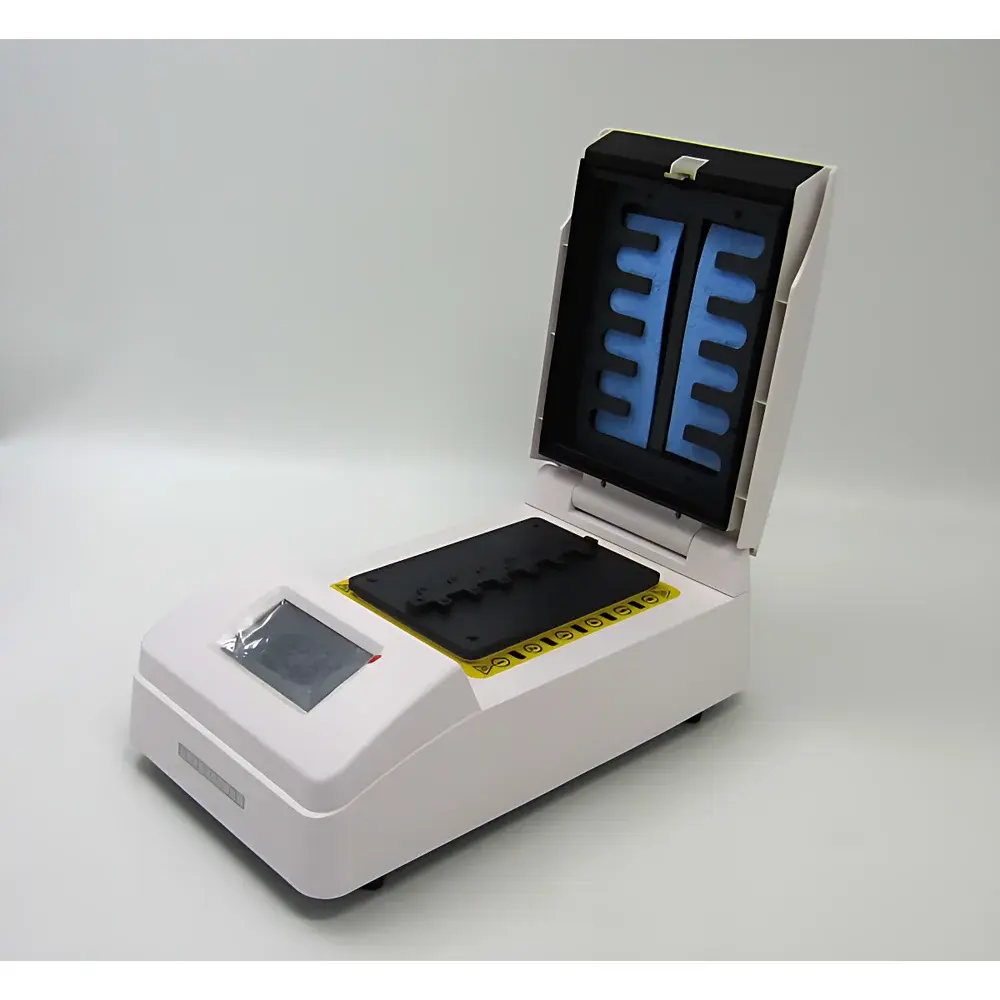
Hanuo LF-2000 In Situ Hybridization (ISH) Instrument
| Brand | Hanuo |
|---|---|
| Model | LF-2000 |
| Origin | Shanghai, China |
| Temperature Range | Ambient +5°C to 100°C |
| Temperature Uniformity | ±0.5°C |
| Rotation Speed | 20 rpm |
| Slide Capacity | 12 standard microscope slides |
| Humidity Control | Integrated |
| Heating Rate | ≤3 min (37°C → 95°C) |
| Cooling Rate | ≤5 min (95°C → 45°C) |
| Temperature Resolution | 0.1°C |
| Timer Range | 1 min – 99 h 59 min |
| Power | 330 W |
| Dimensions | 440 × 220 × 120 mm |
| Weight | 4.5 kg |
| Programmable Protocols | 105 user-defined methods |
| Operating Modes | Denaturation & Hybridization, Hybridization-only, Multi-step sequential run |
Overview
The Hanuo LF-2000 In Situ Hybridization (ISH) Instrument is a benchtop, microprocessor-controlled platform engineered for reproducible and standardized nucleic acid hybridization directly on solid substrates—primarily formalin-fixed paraffin-embedded (FFPE) tissue sections and cytological smears mounted on glass microscope slides. It operates on the principle of controlled thermal denaturation and subsequent annealing of labeled DNA or RNA probes to complementary target sequences within preserved cellular architecture. Unlike manual water bath or oven-based protocols, the LF-2000 delivers precise spatiotemporal control over temperature, rotation, humidity, and timing—critical parameters governing probe accessibility, hybridization kinetics, and signal specificity. Its design eliminates inter-operator variability, reduces exposure to hazardous reagents (e.g., formamide, SSC buffers), and supports compliance with laboratory quality management frameworks including ISO 15189 and CLIA pre-analytical standardization requirements.
Key Features
- Full-touch 7-inch LCD interface with switchable English/Chinese menu navigation and real-time graphical display of setpoints and actual values (temperature, time remaining, humidity level)
- Integrated humidity regulation system maintaining >85% relative humidity during hybridization to prevent slide desiccation and preserve morphological integrity
- Uniform thermal field across all 12 slide positions, validated at ±0.5°C deviation under load; stable operation achievable even when fewer than 12 slides are loaded
- Ergonomic single-hand slide insertion via spring-loaded, indexed slide carriers—designed to minimize mechanical stress on fragile FFPE sections
- Three operational modes: simultaneous denaturation/hybridization (optimized for FISH workflows), hybridization-only (for pre-denatured samples), and multi-step sequential runs (e.g., protease digestion → denaturation → hybridization → wash cycles)
- Automated pre-heating and post-run cooling functions ensure rapid thermal equilibration and safe handling after high-temperature steps
- 105 programmable protocol slots support full customization of ramp rates, dwell times, rotational speed (fixed at 20 rpm), and humidity setpoints per step
- Robust aluminum-alloy chassis and low-noise DC motor drive ensure long-term mechanical stability and minimal vibration-induced probe displacement
Sample Compatibility & Compliance
The LF-2000 accommodates standard 25 × 75 mm glass microscope slides (including charged, poly-L-lysine, or silanized variants) and is compatible with common ISH/FISH probe chemistries—including digoxigenin-, biotin-, and fluorescently labeled DNA/RNA probes—as well as enzymatic detection systems (e.g., alkaline phosphatase or horseradish peroxidase conjugates). It meets general safety standards per IEC 61010-1 for laboratory electrical equipment and includes thermal cut-off protection and door-open interlock logic. While not certified for clinical diagnostic use under FDA 510(k) or CE-IVD, its operational repeatability aligns with GLP-aligned validation practices for research-grade molecular pathology labs. Protocol documentation supports audit readiness for internal QA reviews and method transfer between sites.
Software & Data Management
The instrument features embedded firmware with non-volatile memory for secure storage of all 105 protocols, including timestamps of last execution and operator ID fields (via optional external USB keyboard input). No proprietary PC software is required; however, exported log files (CSV format via USB port) contain complete thermal profiles, humidity traces, and cycle completion status—enabling retrospective analysis in Excel or LIMS-integrated platforms. Audit trail functionality records critical events (e.g., parameter changes, door openings, error codes) with date/time stamps, satisfying basic data integrity expectations under ALCOA+ principles for non-regulated research environments.
Applications
- Fluorescence in situ hybridization (FISH) for chromosomal aberrations (e.g., HER2, EGFR, ALK amplifications; BCR-ABL translocations)
- Chromogenic in situ hybridization (CISH) and silver-enhanced ISH (SISH) in routine histopathology laboratories
- RNA ISH for spatial gene expression profiling in developmental biology and oncology tissue microarrays
- Microbial identification via rRNA-targeted probes in infectious disease diagnostics research
- Method development and optimization studies requiring strict thermal and temporal control across multiple hybridization conditions
FAQ
Does the LF-2000 support integration with LIS or LIMS systems?
No native HL7 or ASTM interface is provided; however, exported CSV logs can be parsed and imported into third-party laboratory information systems via batch scripting.
Can the instrument perform overnight hybridizations at 37°C?
Yes—the timer supports up to 99 hours 59 minutes, and the humidity control system remains active throughout extended low-temperature incubations.
Is calibration traceable to national standards?
The unit includes factory calibration certificates for temperature and time; users may perform periodic verification using NIST-traceable digital thermometers and stopwatch validation per internal SOPs.
What maintenance is required?
Routine cleaning of the slide chamber and humidity reservoir with deionized water every 50 runs; no scheduled lubrication or sensor recalibration is specified by the manufacturer.
Are consumables or accessories included?
Standard slide carriers for 12 slides are supplied; optional accessories include custom slide racks for alternative formats (e.g., 1” × 3” slides) and humidity sensor calibration kits (sold separately).



