
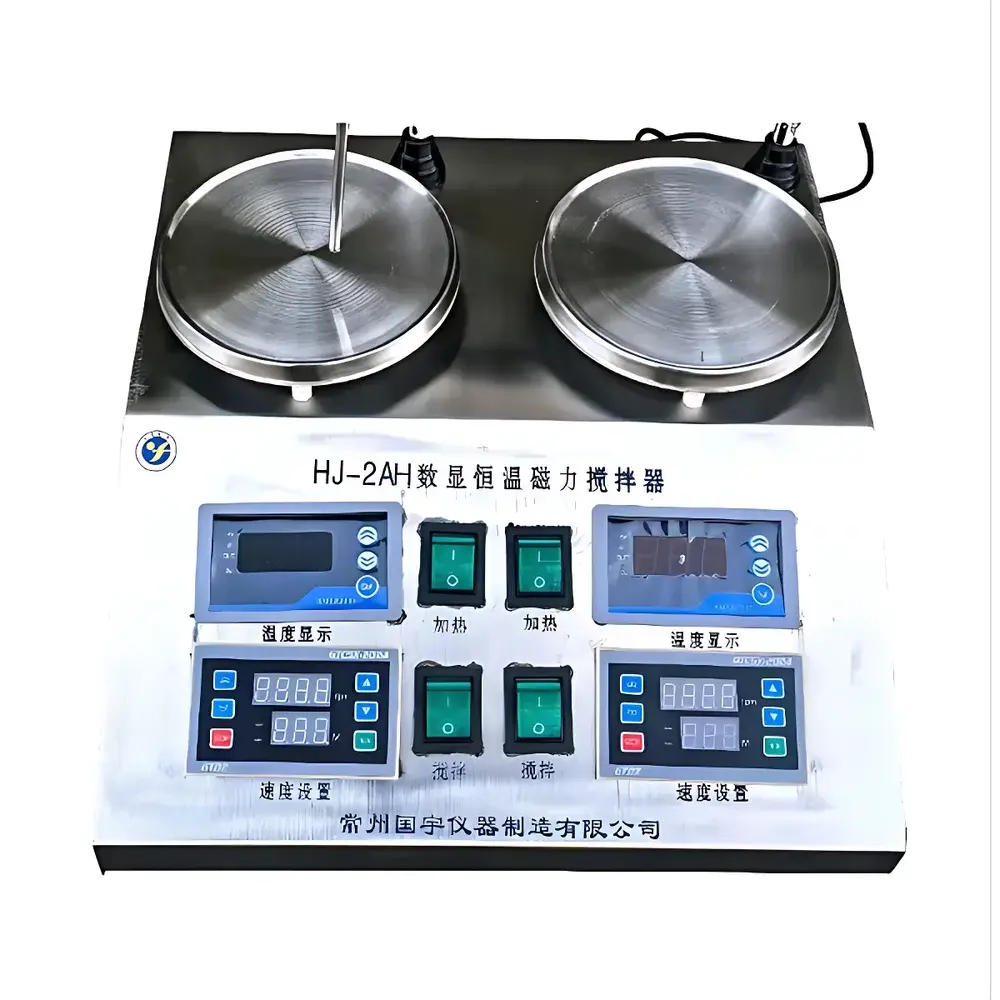
CZGY HJ-2AH Dual-Station Digital Temperature-Controlled Magnetic Stirrer
| Brand | CZGY |
|---|---|
| Origin | Jiangsu, China |
| Manufacturer Type | Direct Manufacturer |
| Instrument Type | Magnetic Stirrer |
| Model | HJ-2AH |
| Maximum Stirring Volume | 1 L per station |
| Speed Range | 200–2000 rpm |
| Temperature Control Range | RT + 5°C to 100°C |
| Heating Power | 200 W × 2 |
| Stirring Plate Material | Stainless Steel (12 cm diameter × 2) |
| Speed Accuracy | ±1 rpm |
| Display | Dual Independent LED Digital Displays (speed & temperature) |
| Timer Range | 0–999 min |
| Power Supply | 220 V ±10%, 50 Hz |
Overview
The CZGY HJ-2AH is a dual-station digital magnetic stirrer engineered for precision mixing and temperature-controlled sample preparation in analytical, quality control, and research laboratories. It operates on the principle of magnetic coupling—rotating a PTFE-coated stir bar within a vessel via a rotating magnetic field generated beneath a non-magnetic, thermally conductive stainless-steel heating plate. Each station functions independently, enabling simultaneous yet distinct speed and temperature setpoints across two samples—ideal for comparative experiments, calibration protocols, or parallel reaction monitoring. Unlike single-axis hotplates or analog stirrers, the HJ-2AH integrates closed-loop PID temperature regulation with high-resolution digital speed feedback, delivering consistent thermal and rotational energy input essential for reproducible dissolution testing, buffer equilibration, reagent synthesis, and viscosity pre-conditioning prior to rheological analysis.
Key Features
- Dual independent control channels: Separate digital displays and adjustment dials for speed and temperature on each station—eliminating cross-talk or shared parameter interference.
- High-stability DC brushless motor: Delivers smooth torque delivery from 200 to 2000 rpm with ±1 rpm speed accuracy, minimizing mechanical vibration and ensuring long-term operational consistency.
- Stainless-steel heating plates (12 cm diameter × 2): Corrosion-resistant, flat-surface platforms optimized for uniform heat distribution and compatibility with glass, borosilicate, and low-profile labware (e.g., beakers, flasks, crystallization dishes).
- PID temperature regulation: Maintains setpoint stability within ±1.5°C across the full 25–100°C operating range (RT + 5°C minimum), with overheat protection and automatic cut-off at 110°C.
- Programmable timer (0–999 min): Supports unattended operation with audible end-of-cycle alert; timer resets independently per station upon parameter change.
- Compact benchtop footprint (280 × 160 × 120 mm): Designed for space-constrained fume hoods, laminar flow cabinets, or multi-instrument workstations without sacrificing accessibility or thermal isolation.
Sample Compatibility & Compliance
The HJ-2AH accommodates standard laboratory vessels up to 1 L capacity per station—including round-bottom flasks (50–1000 mL), tall-form beakers (100–1000 mL), and shallow crystallization dishes—provided stir bars are appropriately sized (e.g., 30–40 mm cross-shaped or oval bars for optimal vortex formation). Its stainless-steel surface resists common solvents (ethanol, acetone, dilute acids/bases) and withstands routine cleaning with mild detergents or 70% isopropanol. While not certified to IEC 61010-1 for hazardous-area use, the unit complies with general-purpose electrical safety requirements for Class I laboratory equipment. It supports GLP-aligned workflows through deterministic parameter logging (when paired with external data acquisition systems) and is routinely deployed in environments adhering to ISO/IEC 17025 and USP auxiliary equipment validation guidelines.
Software & Data Management
The HJ-2AH operates as a standalone instrument with no embedded microcontroller-based data logging or USB/RS-232 interfaces. All operational parameters—speed, temperature, and timer—are manually entered and retained locally via non-volatile digital display circuitry. For traceable recordkeeping, users integrate the device into validated laboratory information management systems (LIMS) or electronic lab notebooks (ELN) by documenting setpoints, duration, and observed outcomes per batch or experiment ID. Where regulatory compliance (e.g., FDA 21 CFR Part 11) mandates audit trails, external hardware loggers (e.g., calibrated thermocouple + tachometer data loggers) may be employed to capture time-stamped speed and temperature profiles during critical process steps.
Applications
- Buffer and reagent preparation requiring precise thermal homogenization (e.g., PBS, Tris-HCl, cell culture media).
- Accelerated stability studies involving temperature-dependent solubility or degradation kinetics.
- Pre-heating and agitation of samples prior to HPLC injection, UV-Vis spectroscopy, or titration.
- Dissolution testing support for pharmaceutical formulations under USP Apparatus II conditions (with appropriate vessel adaptation).
- Simultaneous optimization of two reaction variables—e.g., comparing catalyst activation at 60°C vs. 85°C while maintaining identical stirring intensity.
- QC lab workflows where parallel processing of reference standards and test samples reduces turnaround time without compromising parameter fidelity.
FAQ
Is the HJ-2AH compatible with corrosive or organic solvents?
Yes—the stainless-steel heating plates and sealed electronics housing resist exposure to common lab solvents; however, direct spillage of strong oxidizers (e.g., concentrated HNO₃) or halogenated hydrocarbons should be avoided.
Can both stations operate at different speeds and temperatures simultaneously?
Yes—each station has fully independent speed and temperature controls, with dedicated LED displays and adjustment knobs.
What is the maximum recommended vessel height for stable operation?
Vessels should not exceed 18 cm in total height to ensure adequate magnetic coupling and thermal contact; taller containers require longer stir bars and may reduce speed stability above 1500 rpm.
Does the unit include a built-in temperature probe port?
No—the HJ-2AH uses integrated surface-mounted sensors for plate temperature feedback; external PT100 or thermocouple probes must be connected to separate monitoring equipment.
Is calibration documentation provided with shipment?
Factory calibration certificates for speed and temperature accuracy are available upon request and may be included in IQ/OQ validation packages for regulated environments.



