
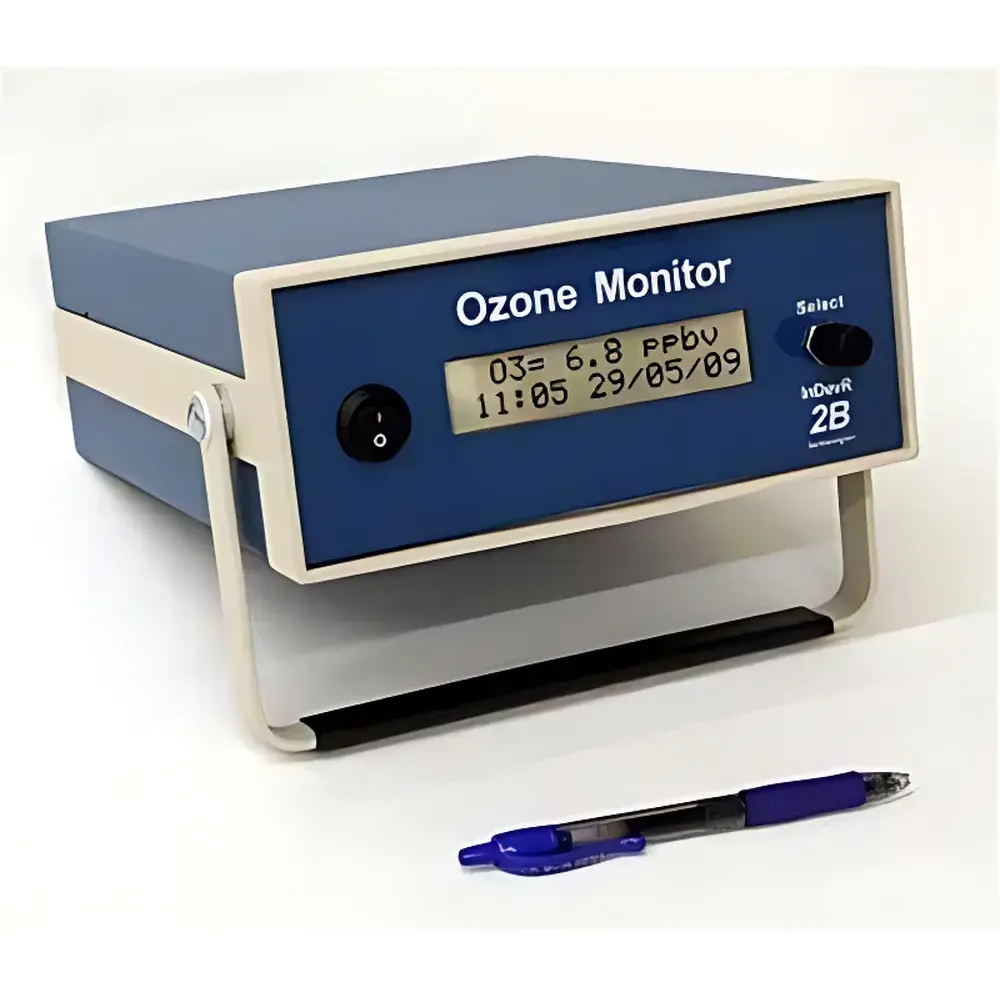
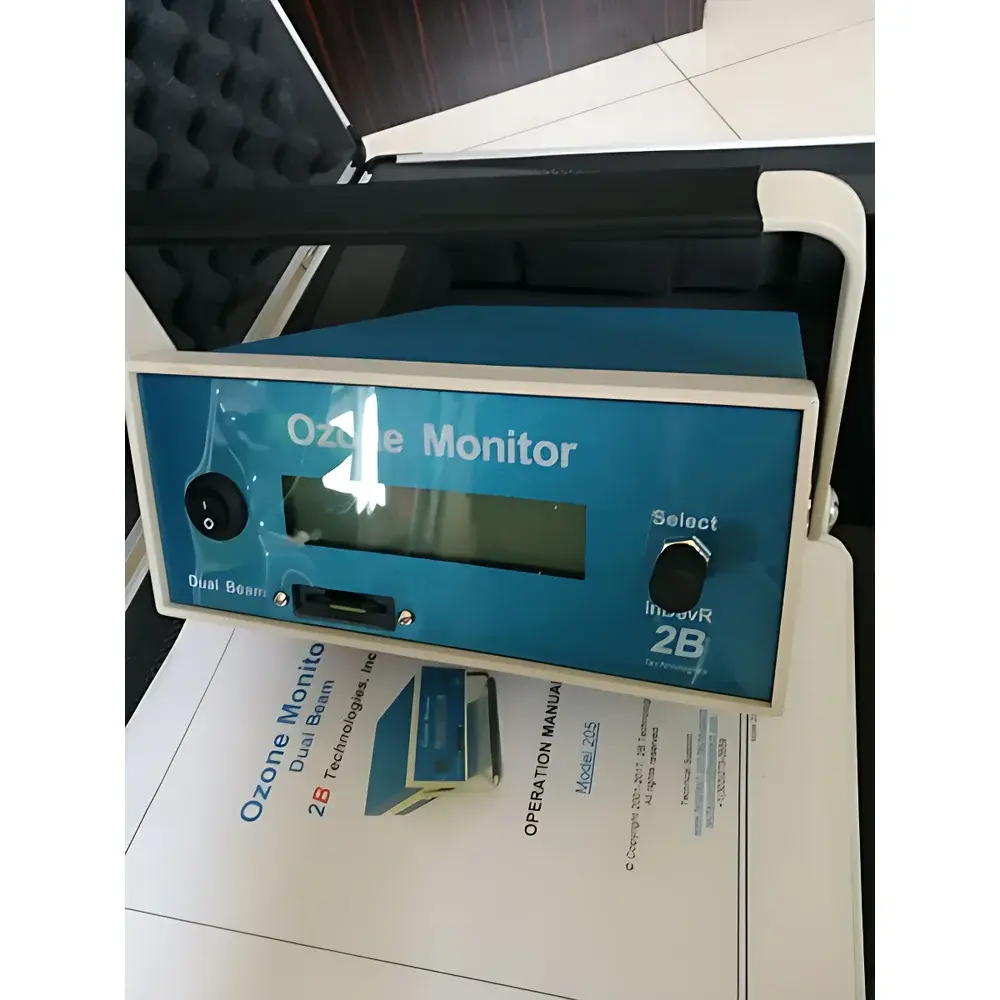
2B Technologies Model 202 Ozone Analyzer
| Origin | USA |
|---|---|
| Manufacturer Type | Authorized Distributor |
| Origin Category | Imported |
| Model | Model 202 |
| Price | Upon Request |
Overview
The 2B Technologies Model 202 Ozone Analyzer is a compact, high-precision ultraviolet (UV) absorption instrument engineered for regulatory-grade ambient and personal ozone monitoring. It operates on the well-established principle of differential UV photometry at 254 nm — a method validated by the U.S. Environmental Protection Agency (EPA) as a Federal Equivalent Method (FEM: EQOA-0410-190) under 40 CFR Part 58. The dual-beam optical architecture compensates for lamp intensity drift and window fouling, ensuring long-term measurement stability without manual zero/span adjustments during routine operation. Designed for deployment across diverse environmental regimes — from ground-level urban networks to stratospheric balloon payloads — the analyzer delivers trace-level sensitivity (detection limit: 3.0 ppb at 2σ) with NIST-traceable calibration certified at time of shipment. Its lightweight construction (2.1 kg), low power consumption (4.0 W nominal; 2.9 W in low-power mode), and wide operational envelope (0–50 °C standard; –20–50 °C with optional cold-weather package) make it uniquely suited for field-intensive applications where size, weight, and energy constraints govern instrument selection.
Key Features
- Dual-beam UV absorption photometry at 254 nm, minimizing baseline drift and enhancing signal-to-noise ratio
- Measurement range: 1.5 ppb to 250 ppm with 0.1 ppb resolution and accuracy ≤1.5 ppb or 2% (whichever is greater)
- Internal flow control system maintaining ~1.0 L/min sample flow; minimum required flow >0.6 L/min
- Onboard data logging capacity: 14,336 records (configurable averaging intervals: 10 s, 1 min, 5 min, or 1 hr)
- Integrated temperature and pressure compensation per ISO 7183 and EPA Reference Method 5A requirements
- Real-time analog outputs (0–2.5 V) and RS232 digital interface; optional USB adapter and 4–20 mA current loop output
- Three auxiliary analog inputs (0–2.5 V) for concurrent recording of external parameters (e.g., RH, barometric pressure, ambient temperature)
- Modular design supporting field-upgradeability to the Model 205 dual-beam platform
Sample Compatibility & Compliance
The Model 202 is designed for continuous analysis of ambient air, indoor air, and controlled laboratory atmospheres. It complies with U.S. EPA requirements for ozone monitoring under 40 CFR Part 58 Appendix A, Subpart C (Ambient Air Quality Monitoring Requirements), and meets performance specifications outlined in ASTM D5012–21 (Standard Practice for Determining Ozone Concentration in Ambient Air). All factory calibrations are traceable to NIST Standard Reference Materials (SRMs) and documented in the included Certificate of Calibration. The instrument supports GLP-compliant data integrity through timestamped, non-volatile internal memory and optional GPS-synchronized georeferencing. For regulated environments requiring audit trails, firmware versions v3.2+ support metadata tagging and user-accessible log export via serial interface.
Software & Data Management
Data acquisition and configuration are managed via the proprietary 2B Technologies Ozone Logger software (included on CD-ROM), compatible with Windows-based systems. The software enables real-time visualization, remote parameter adjustment (e.g., averaging period, units, alarm thresholds), and batch export to CSV or Excel formats. Internal memory stores up to 14,336 rows with automatic rollover; optional removable flash memory card extends storage indefinitely and enables portable data transfer without host PC dependency. Timestamps include UTC synchronization capability when paired with the GPS accessory. Firmware updates preserve calibration coefficients and user settings, ensuring continuity during maintenance cycles. All stored datasets retain embedded metadata: instrument ID, firmware version, calibration date, and environmental correction flags.
Applications
- Ambient air quality monitoring networks (urban, rural, background stations)
- Personal exposure assessment studies investigating ozone-related respiratory health outcomes
- Mobile platforms: UAV-mounted atmospheric profiling, aircraft-based vertical sounding, and vehicle-integrated mobile labs
- Remote off-grid monitoring sites powered by solar-charged battery systems (e.g., mountain-top observatories, Arctic research stations)
- Indoor air quality audits in healthcare facilities, schools, and occupational environments
- Material degradation testing — quantifying ozone-induced oxidation kinetics on polymers, textiles, and biological tissues
- Method validation and intercomparison studies against reference-grade chemiluminescence analyzers
FAQ
Is the Model 202 compliant with U.S. EPA FEM requirements?
Yes — it is designated as an EPA Federal Equivalent Method (FEM: EQOA-0410-190) for ozone measurement under 40 CFR Part 58.
Does the instrument require daily zero/span calibration?
No — its dual-beam design and stable mercury lamp minimize drift; baseline shift is <2 ppb/day and <5 ppb/year, enabling unattended operation for extended periods.
Can the Model 202 be operated on battery power alone?
Yes — it accepts 12 V DC input and ships with a rechargeable metal hydride battery pack rated for 12 hours of continuous operation.
What is the lowest detectable ozone concentration?
The method detection limit is 3.0 ppb (2σ), with RMS noise <1.5 ppb or 2% of reading, whichever is greater.
Is temperature and pressure correction applied automatically?
Yes — internal sensors provide real-time T&P compensation per ISO 7183 and EPA guidance, with user-selectable units (°C/K, mbar/torr).
Can external sensors be integrated for co-located measurements?
Yes — three 0–2.5 V analog inputs allow simultaneous logging of external temperature, humidity, or pressure signals alongside ozone data.
Related Products







