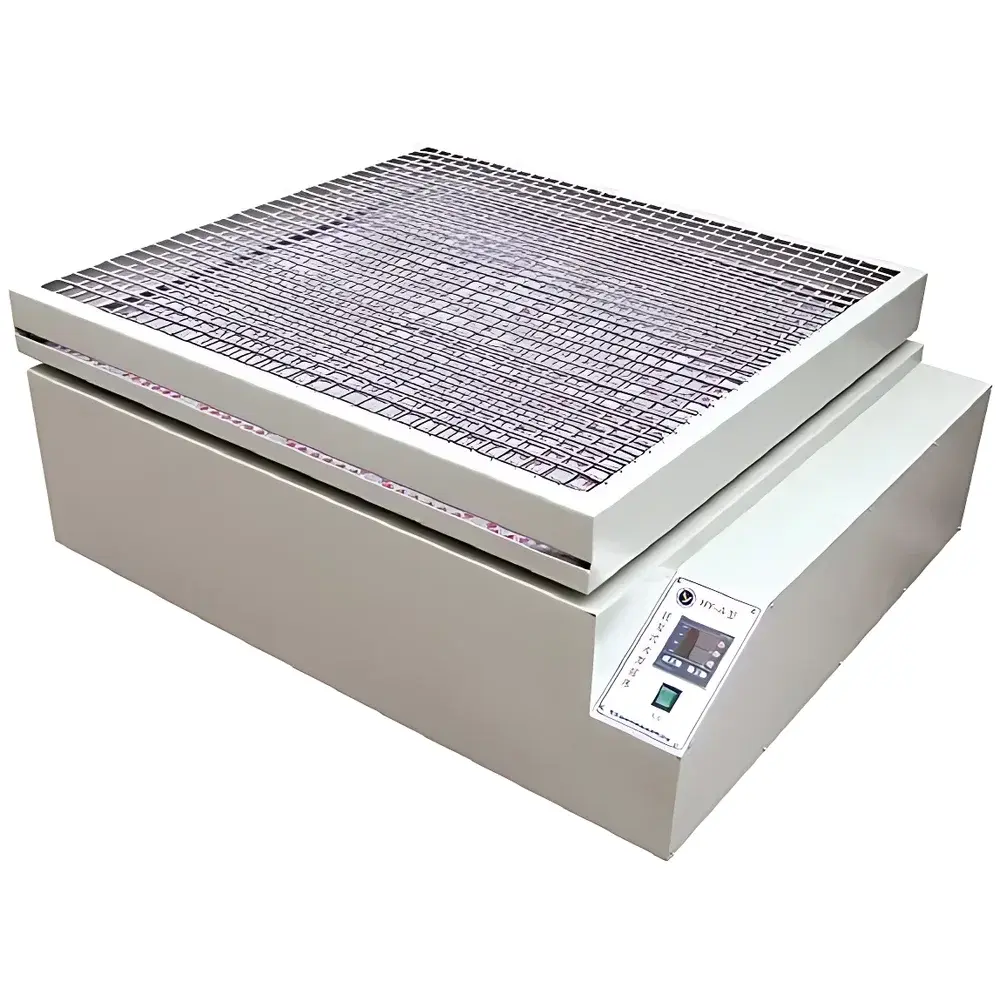
CZGY HY-B Orbital Large-Capacity Laboratory Shaker
| Brand | CZGY |
|---|---|
| Origin | Jiangsu, China |
| Manufacturer Type | Direct Manufacturer |
| Instrument Category | Domestic |
| Model | HY-B |
| Pricing | USD 1,250 (est.) |
| Instrument Type | Orbital Shaker |
| Timer Range | 0–9999 min |
| Oscillation Frequency | 60–280 rpm |
| Orbit Diameter | 30 mm |
| Temperature Control | None |
| Platform Quantity | 1 |
Overview
The CZGY HY-B Orbital Large-Capacity Laboratory Shaker is an engineered platform for high-throughput, low-shear mixing of biological, chemical, and environmental samples under non-temperature-controlled conditions. It operates on the principle of orbital motion—where the platform rotates in a horizontal circular path with a fixed 30 mm orbit diameter—generating gentle yet effective homogenization ideal for cell suspension, microbial culture propagation, reagent blending, and immunoassay plate preparation. Designed for continuous operation up to 8 hours per cycle and rated for a maximum load of 40 kg, the shaker features a robust steel frame, reinforced aluminum alloy platform (1000 × 940 mm), and precision-balanced drive mechanism to minimize vibration transmission and ensure long-term mechanical stability. Its microprocessor-based control system delivers consistent rotational speed across the full 60–280 rpm range, incorporating dynamic power compensation to maintain constant angular velocity regardless of load variation—a critical requirement for reproducible culture growth and assay consistency.
Key Features
- Large-format platform (1000 × 940 mm) accommodates multiple flasks, bottles, Petri dishes, or deep-well plates simultaneously—optimized for academic labs, QC facilities, and public health laboratories handling high-volume sample processing.
- Orbital motion with 30 mm nominal orbit diameter ensures uniform, low-turbulence mixing—minimizing shear stress on sensitive cells and microbial cultures compared to reciprocating or vortex agitation.
- Dual-parameter digital controller with independent adjustment of speed (60–280 rpm, resolution: 1 rpm) and timer (0–9999 minutes, resolution: 1 minute); both parameters retained after power cycling.
- Manual mode enables direct voltage output control (0–99% duty cycle) for fine-tuned empirical optimization; auto mode executes pre-set speed/time protocols with electronic start/stop confirmation.
- Integrated safety design includes grounded 3-pin AC input (220 V, 50 Hz), thermal-overload protection, and non-corrosive surface treatment to resist incidental exposure to mild aqueous or buffered solutions.
- 200 W brushless motor provides high torque at low speeds and stable operation at upper-range frequencies—validated for ≥10,000 operational hours under standard laboratory ambient conditions (15–30 °C, <80% RH).
Sample Compatibility & Compliance
The HY-B supports universal clamping via optional stainless-steel mesh trays, rubber-coated universal clamps, and custom-fit flask holders (e.g., for 1 L, 2 L, or 5 L Erlenmeyer flasks). It is routinely deployed in applications aligned with ISO 17025-accredited testing workflows—including water quality analysis (APHA Standard Methods), clinical microbiology media preparation (CLSI M07-A10), and food safety enrichment protocols (ISO 6579-1). While the unit itself does not incorporate temperature regulation, its mechanical design complies with IEC 61000-6-3 (EMC emissions) and IEC 61010-1 (safety requirements for laboratory equipment). No integrated data logging or audit trail functionality is provided; users requiring GLP/GMP-compliant documentation must interface with external PC-based acquisition systems.
Software & Data Management
The HY-B operates as a standalone instrument with no embedded software, network interface, or USB/RS-232 connectivity. All parameter settings are stored in non-volatile memory and recalled upon power-up. For traceable operation in regulated environments, users may integrate the shaker into broader lab automation ecosystems using dry-contact relay outputs (optional accessory) or manual timestamped logbook entries. The controller’s real-time display shows current speed (rpm), elapsed time, and remaining runtime—enabling visual verification without external instrumentation. Firmware updates are not supported; hardware calibration is performed at factory level and requires certified service technician intervention if drift exceeds ±2 rpm over 100-hour validation cycles.
Applications
- Microbial culture expansion for bioprocess development, antibiotic susceptibility testing, and vaccine production support.
- Homogenization of soil/water extracts in environmental monitoring labs performing EPA Method 1664 or ISO 11348-based toxicity assays.
- Preparation of standardized suspensions for particle size distribution analysis, ELISA plate coating, and antigen-antibody binding kinetics studies.
- Supporting ASTM D2510 (standard practice for shaking apparatus in petroleum testing) and USP <711> dissolution apparatus qualification when used as auxiliary mixing equipment.
- High-capacity buffer equilibration, reagent dilution series preparation, and cryovial rack agitation in biobanking and biorepository operations.
FAQ
What is the maximum recommended load capacity for sustained operation?
The platform is rated for continuous operation at 40 kg total mass—including containers, closures, and internal contents—provided weight distribution remains within ±10% of center symmetry.
Can this shaker be mounted on a benchtop without anchoring?
Yes, but anchoring is strongly advised when operating above 200 rpm or with asymmetric loads exceeding 25 kg, due to centrifugal inertia effects on large-area platforms.
Is the controller compatible with external timing or data acquisition systems?
No native interface exists; however, the RUN/STOP signal line can be accessed via rear-panel terminals for integration with programmable logic controllers (PLCs) or custom DAQ hardware.
Does the unit meet FDA 21 CFR Part 11 requirements?
No—it lacks electronic signature capability, audit trail generation, and user-accessible configuration logs required for Part 11 compliance.
What maintenance is required to ensure long-term performance?
Biannual inspection of belt tension (if belt-driven variant), cleaning of ventilation grilles, and verification of platform levelness using a machinist’s level; no lubrication of the drive assembly is required.
Related Products