
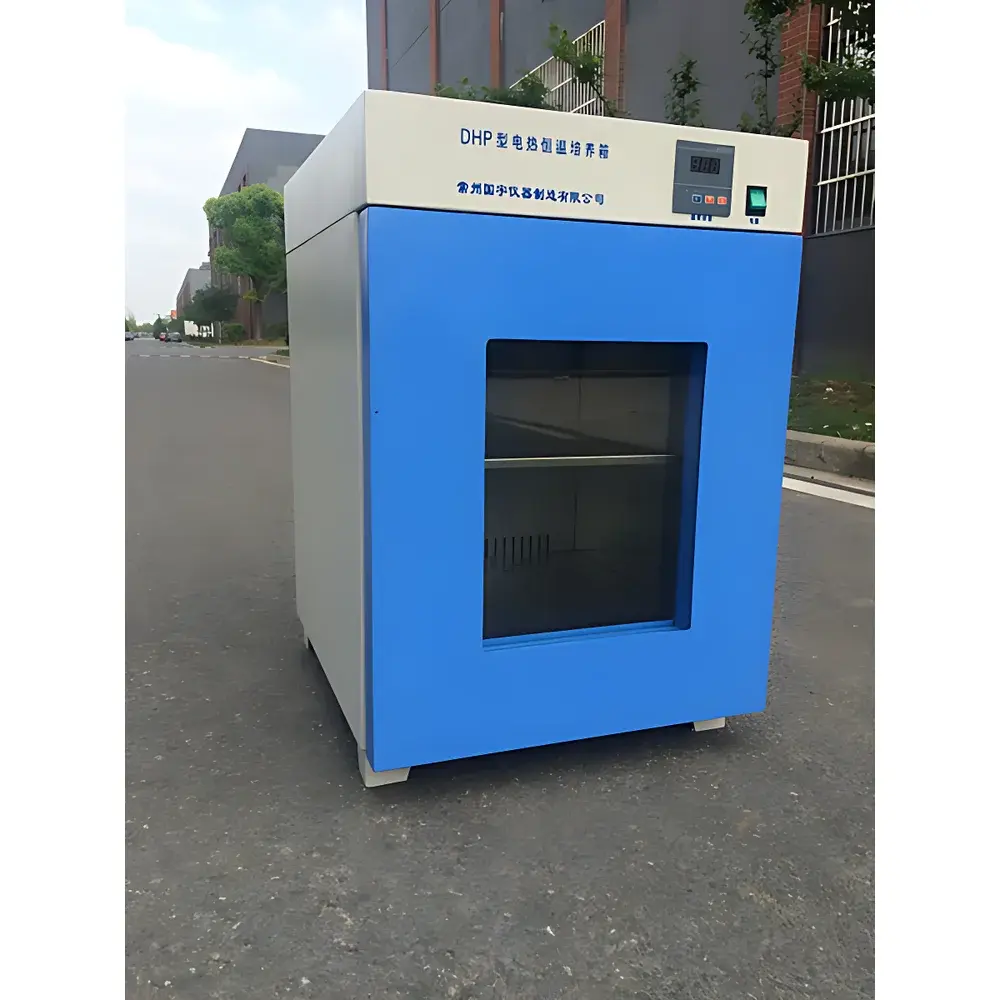
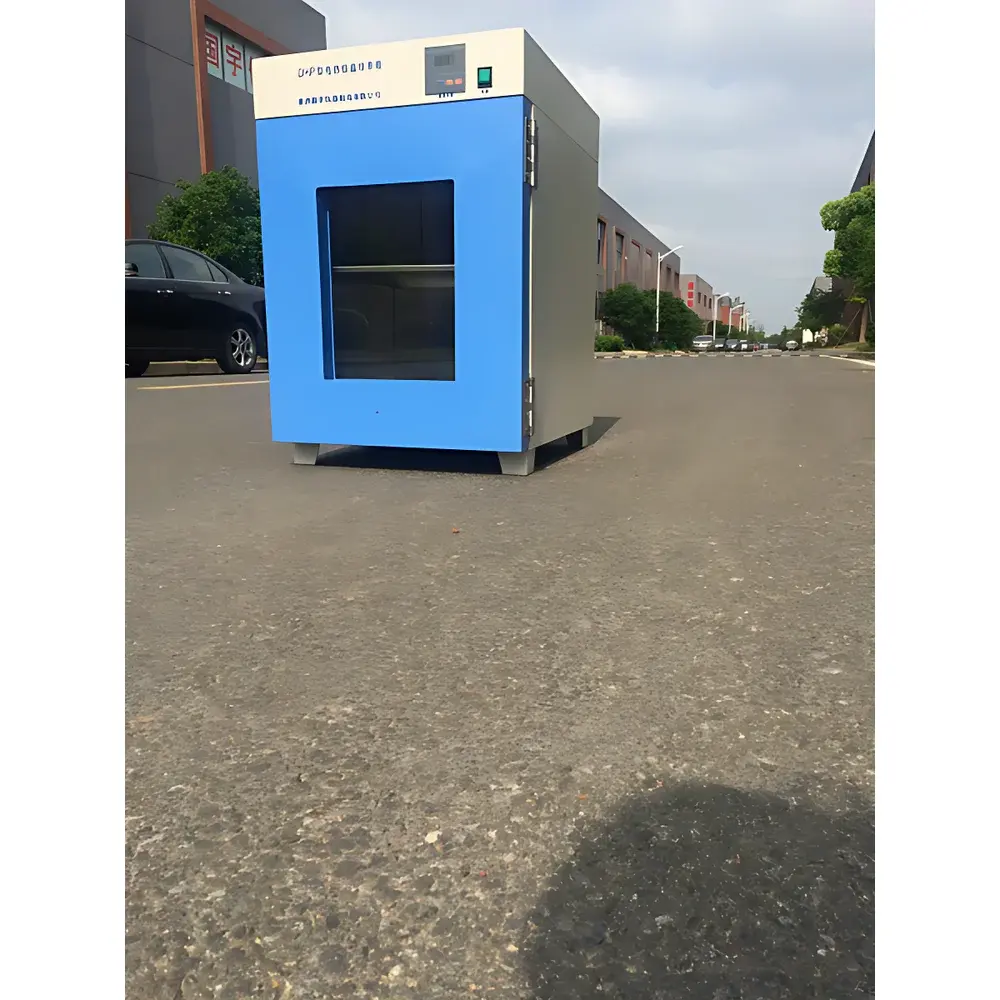
CZGY DHP-420 Electrically Heated Constant-Temperature Incubator
| Brand | CZGY |
|---|---|
| Origin | Jiangsu, China |
| Manufacturer Type | Direct Manufacturer |
| Country of Origin | China |
| Model | DHP-420 |
| Price | USD 395 (FOB) |
| Temperature Range | Ambient +5 °C to 65 °C |
| Temperature Uniformity | ±1 °C |
| Humidity Control | Not Available |
| Internal Chamber Dimensions | 420 × 420 × 500 mm (L×W×H) |
| Power Supply | 220 V / 50 Hz |
| Rated Power | 300 W |
| Shelf Load Capacity | 15 kg |
| Temperature Stability | ≤ ±0.5 °C |
| Construction | Cold-rolled steel exterior with electrostatic powder coating |
Overview
The CZGY DHP-420 Electrically Heated Constant-Temperature Incubator is a precision-engineered, convection-driven thermal environment system designed for stable, repeatable temperature control in life science laboratories. It operates on resistive heating with forced-air circulation—employing an internal axial fan and optimized duct geometry—to ensure uniform heat distribution across the entire working chamber. Unlike humidity-controlled or CO₂-incorporated incubators, the DHP-420 is purpose-built for applications requiring strictly regulated dry-heat conditions, such as microbial culture maintenance, enzyme activity assays, cell line passaging at non-physiological temperatures, and stability testing of reagents or diagnostic kits under accelerated thermal stress. Its microprocessor-based PID temperature controller delivers high reproducibility and long-term drift stability, making it suitable for GLP-compliant workflows where documented thermal consistency is essential.
Key Features
- Stainless steel interior chamber (grade 304) with seamless, radius-cornered construction for easy decontamination and resistance to corrosion from routine cleaning agents.
- Cold-rolled steel outer casing finished with durable electrostatic powder coating—enhancing mechanical robustness and environmental resistance in shared lab spaces.
- High-efficiency thermal insulation using ultra-fine glass wool (density ≥ 48 kg/m³) between chamber walls—minimizing external heat leakage and reducing ambient thermal load.
- Dual-layer tempered glass observation door with anti-fog treatment and integrated LED lighting—enabling continuous visual monitoring without compromising thermal integrity.
- Intelligent digital PID controller with real-time display of setpoint and actual temperature, adjustable proportional band (P), integral time (I), derivative time (D), and hysteresis (HY) parameters for fine-tuned thermal response tuning.
- Over-temperature alarm function (AL parameter) with audible/visual alert and automatic cut-off activation when chamber temperature exceeds user-defined threshold—meeting basic IEC 61010-1 safety requirements for laboratory equipment.
- Parameter lock mode (LCK=1 or 2) prevents accidental modification of operational settings during multi-user deployment—supporting audit-ready configuration management.
Sample Compatibility & Compliance
The DHP-420 accommodates standard microbiological and biochemical sample formats, including Petri dishes (up to 150 mm diameter), test tubes (16–25 mm OD), multi-well plates (6–96-well), and flasks (Erlenmeyer up to 2 L). Its dry-heat environment excludes moisture-sensitive protocols but aligns with ASTM E2927-22 (Standard Practice for Calibration of Dry-Heat Sterilizers) and ISO 8573-1 (compressed air purity classes, relevant for optional external air filtration integration). While not certified to UL 61010-1 or CE-EMC by default, the unit complies with fundamental electrical safety principles per GB 4793.1–2019 (Chinese national equivalent of IEC 61010-1). For regulatory submissions, users may document validation protocols—including IQ/OQ/PQ—using built-in temperature logging capability via optional RS485 interface (MODBUS RTU protocol support).
Software & Data Management
The DHP-420 operates autonomously via its embedded microcontroller and does not require proprietary software for basic operation. However, it supports optional serial communication (RS485) for integration into centralized lab monitoring systems. When paired with third-party SCADA or LIMS platforms, temperature setpoints, real-time readings, alarm events, and runtime logs can be archived with timestamped metadata. The controller retains user-adjustable calibration offset (SC parameter, ±50 °C range), enabling traceable sensor correction against NIST-traceable reference thermometers—critical for FDA 21 CFR Part 11–aligned environments where electronic records must demonstrate integrity and accountability. No onboard data storage or cloud connectivity is provided; all data persistence relies on external acquisition infrastructure.
Applications
- Maintenance of bacterial and fungal stock cultures (e.g., E. coli, S. cerevisiae) at sub-physiological temperatures (30–37 °C).
- Thermal denaturation studies of purified proteins or nucleic acids under controlled dry-heat exposure.
- Accelerated stability testing of pharmaceutical excipients, lyophilized diagnostics, or polymer-based assay components per ICH Q1A(R2).
- Pre-incubation of enzymatic reaction mixtures prior to kinetic measurement (e.g., alkaline phosphatase, horseradish peroxidase).
- Conditioning of sterile packaging materials (Tyvek®, medical-grade paper) prior to peel strength or microbial barrier validation.
- Environmental simulation for electronics reliability testing—particularly for passive component aging under sustained thermal load.
FAQ
Does the DHP-420 support humidity control?
No. This model is a dry-heat incubator only; no humidification system or water reservoir is integrated.
Can the temperature sensor be calibrated externally?
Yes—the SC parameter allows manual offset adjustment (±50 °C) using a certified reference thermometer, supporting traceable calibration procedures.
What is the maximum shelf loading capacity per level?
Each stainless steel shelf supports up to 15 kg distributed evenly; overloading may impede airflow and compromise temperature uniformity.
Is the unit compatible with 110 V / 60 Hz power supplies?
No. The DHP-420 is configured exclusively for 220 V / 50 Hz input; voltage conversion requires an external isolation transformer rated for continuous 300 W operation.
How often should preventive maintenance be performed?
We recommend quarterly inspection of fan operation, door gasket integrity, and heating element continuity—especially in high-usage academic or QC labs.




