
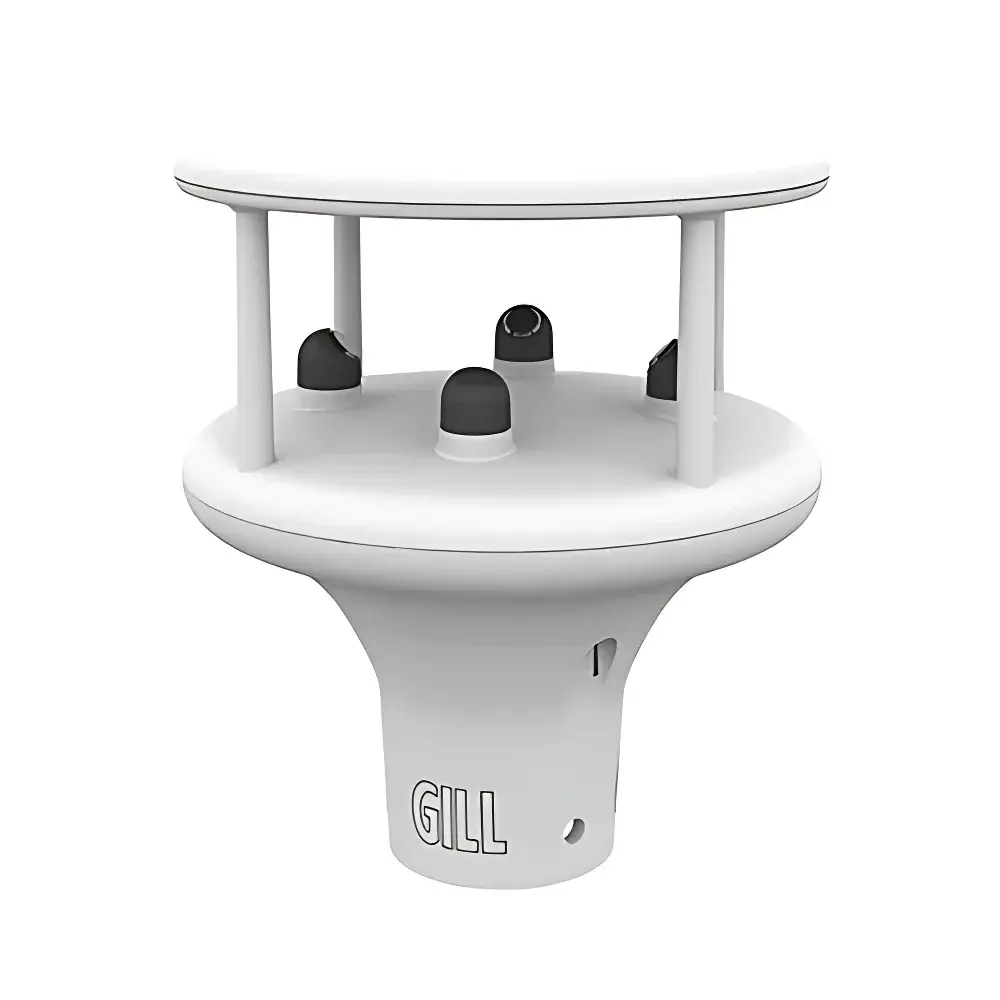
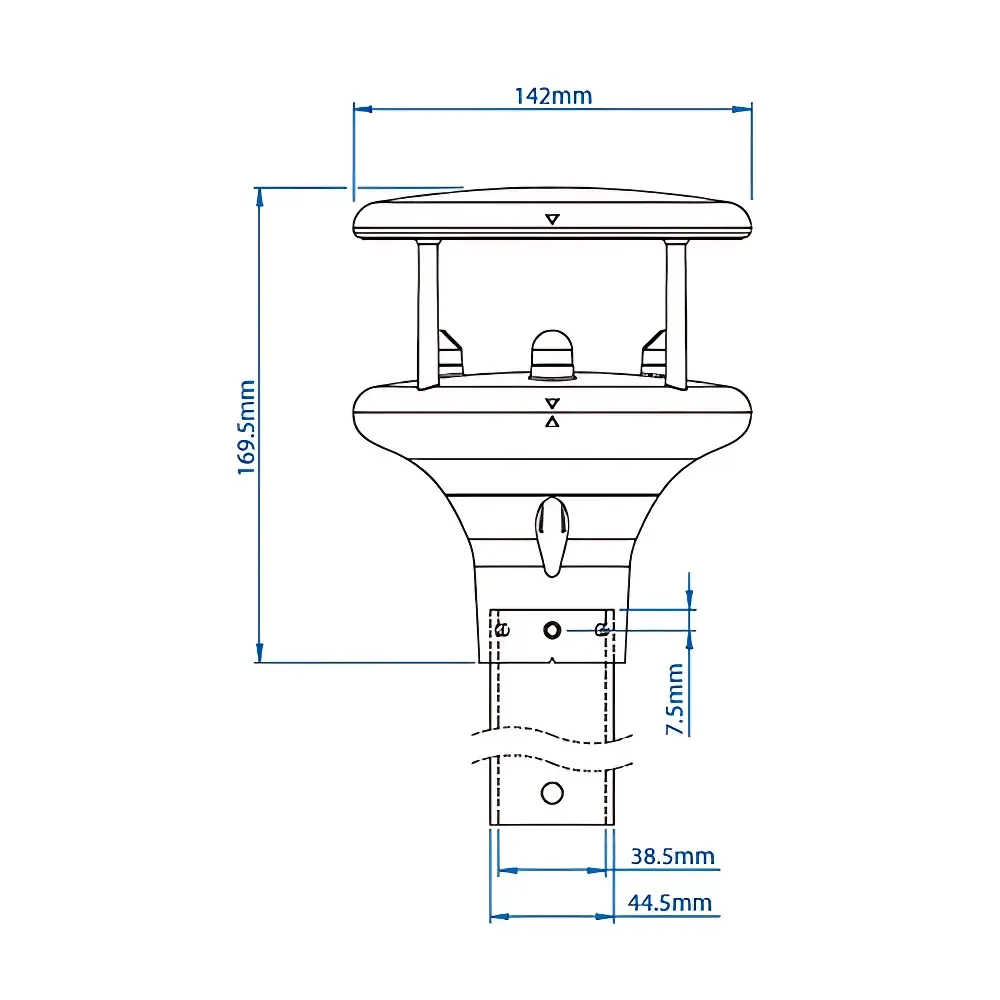
Gill GMX200 Ultrasonic Anemometer
| Brand | Gill |
|---|---|
| Origin | United Kingdom |
| Model | GMX200 |
| Instrument Type | Ultrasonic Anemometer |
| Resolution | 0.01 m/s |
| Measurement Range | 0–60 m/s |
| Accuracy | ±3% |
| Operating Temperature | −35 to +70 °C |
| Operating Humidity | 0–100% RH |
| Output Interfaces | RS-232, RS-422, RS-485 (ASCII), SDI-12, NMEA 0183, Modbus RTU, Analog (optional) |
| Optional GPS Module | Altitude (m), MSL Pressure, Sunrise/Sunset, Solar Position, Twilight, Solar Noon |
| Wind Data Outputs | Apparent/True Wind Speed & Direction, WMO-Averaged Wind, Gusts, Tilt Angle |
Overview
The Gill GMX200 Ultrasonic Anemometer is a compact, high-reliability wind sensing instrument engineered for continuous, maintenance-free operation in demanding environmental monitoring applications. Based on time-of-flight ultrasonic transit-time principle, the GMX200 measures horizontal wind speed and direction by calculating the differential propagation time of ultrasonic pulses across three orthogonal acoustic paths. This solid-state, moving-part-free architecture eliminates mechanical wear, ensures long-term stability, and delivers high reproducibility under variable thermal and turbulent conditions. Designed as part of Gill Instruments’ MaxiMet family of integrated meteorological sensors, the GMX200 is optimized for deployment in unattended field sites—ranging from coastal observatories and wind farm SCADA systems to urban air quality networks and academic research stations. Its robust aluminum housing, IP66-rated enclosure, and wide operating temperature range (−35 to +70 °C) support deployment across arctic, desert, and tropical environments without recalibration.
Key Features
- Ultrasonic wind measurement with no moving parts—zero mechanical hysteresis and minimal drift over time
- Simultaneous real-time output of apparent wind speed/direction, WMO-standard 2-, 10-, and 60-second averaged wind vectors, and gust parameters (peak 3-second wind)
- Integrated 3-axis electronic compass for heading-compensated wind vector calculation; supports tilt compensation up to ±30°
- Optional GPS module enables true wind computation (corrected for platform motion), georeferenced timestamping, altitude above MSL, and solar geometry outputs (sunrise/sunset, solar noon, twilight phases)
- Multi-protocol digital interface suite: ASCII serial (RS-232/422/485), SDI-12, NMEA 0183 (for GPS-integrated units), Modbus RTU, and analog voltage/current outputs (0–5 V, 4–20 mA) configurable per user requirement
- Field-configurable output units: wind speed in m/s, km/h, mph, knots, or ft/min; wind direction in degrees true/magnetic; pressure in hPa or inHg
Sample Compatibility & Compliance
The GMX200 is designed for open-air atmospheric sampling and requires unobstructed 360° hemispherical exposure above ground level. It complies with IEC 61000-6-2 (immunity) and IEC 61000-6-4 (emissions) for industrial environments. While not certified to specific meteorological standards (e.g., WMO Guide to Instruments and Methods of Observation), its measurement methodology aligns with WMO-recommended ultrasonic anemometry practices for synoptic and mesoscale observation networks. The device meets CE marking requirements and conforms to RoHS 2011/65/EU directives. For regulated applications requiring audit trails or data integrity assurance (e.g., EPA ambient air monitoring or ISO 17025-accredited labs), optional firmware logging and secure configuration lockout are available upon request.
Software & Data Management
Gill provides the free MaxiMet Configuration Utility (Windows/macOS) for local setup, calibration verification, and firmware updates via USB-to-serial adapter. Raw sensor data streams are protocol-agnostic and integrate natively with industry-standard SCADA platforms (e.g., Ignition, Wonderware), environmental data loggers (Campbell Scientific CR series, Onset HOBO), and cloud-based telemetry services (AWS IoT Core, Azure IoT Hub). All digital protocols support ASCII-readable metadata headers and time-synchronized packet framing. When deployed with GPS, NMEA GGA and RMC sentences provide traceable UTC timestamps synchronized to GNSS time—critical for time-series correlation in multi-sensor networks. Audit-ready data exports (CSV, JSON) include embedded sensor ID, firmware version, and diagnostic flags (e.g., signal-to-noise ratio, transducer fault status).
Applications
- Renewable energy: Turbine site assessment, yaw error correction, and power curve validation in wind farms
- Transport infrastructure: Real-time crosswind alerts for aviation (airports, helipads), rail signaling, and highway safety systems
- Environmental compliance: Emission dispersion modeling input, fugitive dust monitoring, and boundary air quality network nodes
- Marine & coastal operations: Port weather stations, offshore platform safety monitoring, and tidal current correlation studies
- Agricultural microclimate networks: Frost prediction, pesticide drift modeling, and irrigation scheduling support
- Academic research: Boundary layer turbulence studies, urban heat island investigations, and eddy covariance flux tower auxiliary sensing
FAQ
Does the GMX200 require periodic recalibration?
No—ultrasonic transducers are factory-calibrated using NPL-traceable wind tunnel procedures. Long-term drift is typically <0.5% per year; field verification against a reference cup anemometer is recommended annually for metrologically critical applications.
Can the GMX200 operate without GPS?
Yes—GPS is fully optional. Without GPS, the unit outputs apparent wind only; true wind computation and geospatial metadata require the GPS module and valid satellite lock.
Is analog output available as standard or only optional?
Analog output (0–5 V or 4–20 mA) is optional and must be specified at time of order; it is not field-upgradable.
What mounting hardware is included?
Standard delivery includes a universal U-bolt mounting kit (M8 stainless steel) compatible with 50–76 mm diameter masts; custom brackets and pole clamps are available separately.
How does the GMX200 handle precipitation or icing?
The transducer array features hydrophobic coating and self-heating capability (activated below 0 °C); ice accumulation mitigation is effective up to moderate freezing rain conditions but not intended for persistent glaze ice environments.







