
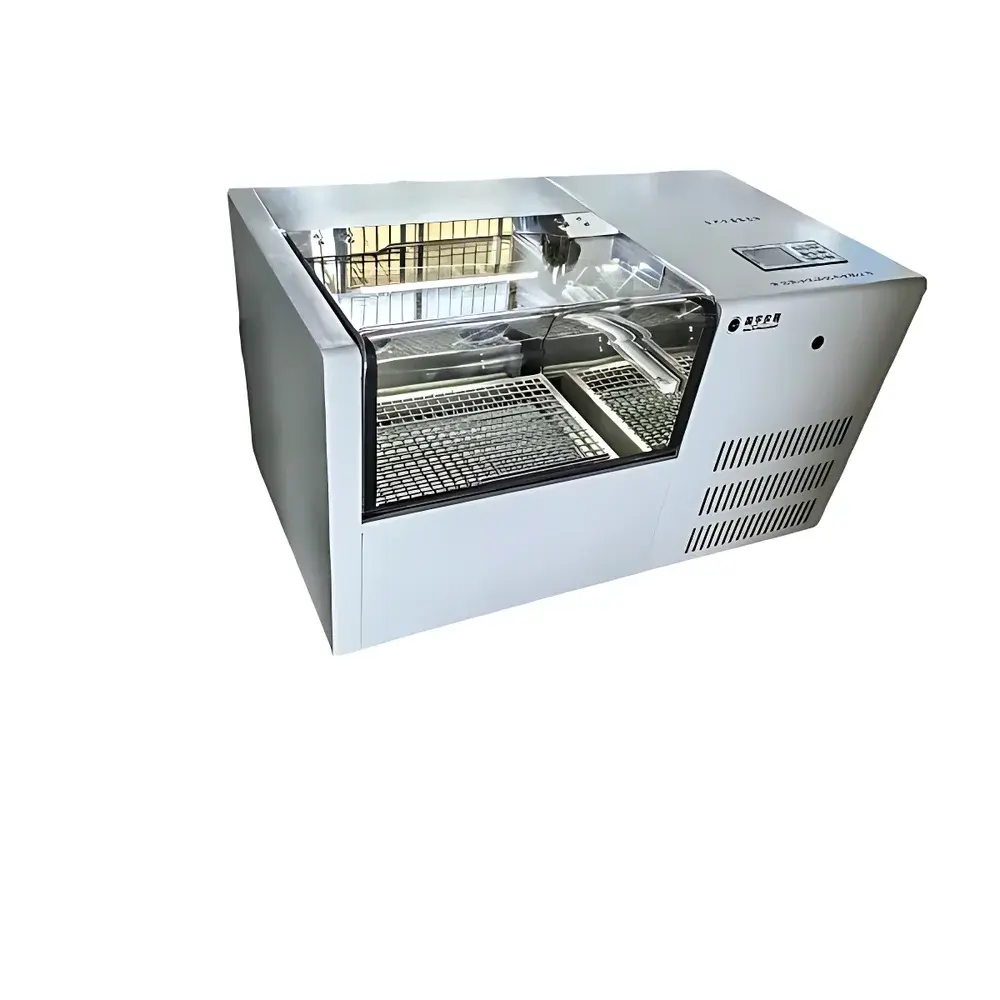
CZGY HNY-200B Benchtop Air-Bath Constant-Temperature Orbital Shaker
| Brand | CZGY |
|---|---|
| Origin | Jiangsu, China |
| Manufacturer Type | Direct Manufacturer |
| Instrument Type | Air-Bath Constant-Temperature Orbital Shaker |
| Timer Range | 0–9999 min/h |
| Oscillation Frequency | 20–400 rpm |
| Orbital Amplitude | 26 mm |
| Temperature Range | 4–65 °C |
| Shelf Quantity | 1 |
| Display | LCD with Simultaneous Temp/RPM/Time Readout |
| Control Algorithm | PID Feedback |
| Temperature Uniformity | ±0.5 °C (at 37 °C, working surface) |
| Temperature Stability | ≤0.1 °C (at 37 °C) |
| Tray Dimensions | 450 × 410 mm |
| Chamber Volume | 80 L |
| Power Supply | AC 220 V, 50 Hz |
| Rated Power | 650 W |
| External Dimensions (W×D×H) | 1000 × 710 × 630 mm |
| Environmental Operating Range | 5–30 °C |
| Data Logging | USB-based continuous recording (temp, rpm, time), auto-graphing & replay |
| Programmable Modes | Multi-segment temperature/rpm/time profiles |
| Safety Features | Over-temperature alarm, motor overheat protection, door-open stop, auto-restart after power failure, speed失控 lockout, slow-start ramp control |
| Drive System | High-precision servo motor with EMI filter ring |
| Cooling | Intelligent frost-free refrigeration (auto-on/off based on ambient & setpoint) |
| Oscillation Mode | Orbital (bidirectional programmable) |
| Construction | Mirror-finish stainless steel interior, cold-rolled steel exterior with epoxy coating |
| Compliance | Designed for GLP-compliant environments |
Overview
The CZGY HNY-200B Benchtop Air-Bath Constant-Temperature Orbital Shaker integrates precise temperature regulation with controlled orbital agitation in a single compact platform. It operates on the principle of forced-air convection heating and cooling, coupled with a high-fidelity servo-driven orbital motion system—enabling reproducible suspension culture, microbial growth, enzymatic assays, hybridization reactions, and cell-based studies under tightly regulated thermal and mechanical conditions. Unlike water-bath shakers, its air-bath architecture eliminates fluid contamination risks and simplifies maintenance while delivering uniform thermal distribution across the 450 × 410 mm stainless steel tray. Engineered for long-term reliability in academic, clinical, and industrial life science laboratories, the HNY-200B meets the operational rigor required for ISO/IEC 17025-accredited testing environments and supports traceable workflows aligned with Good Laboratory Practice (GLP) and current Good Manufacturing Practice (cGMP) frameworks.
Key Features
- PID-controlled temperature regulation with ±0.1 °C accuracy in steady-state operation and ≤0.1 °C fluctuation at 37 °C—validated across the full 4–65 °C range.
- Orbital oscillation at 20–400 rpm with ±1 rpm repeatability; programmable bidirectional rotation (forward/reverse/alternating) for enhanced suspension homogeneity in viscous or particulate-laden media.
- 26 mm orbital diameter optimized for standard flask configurations (e.g., 250 mL × 15 positions included); compatible with microplates, tubes, and custom fixtures via optional clamping accessories.
- Integrated USB data logger capturing real-time temperature, rotational speed, and elapsed time—stored as timestamped CSV files; auto-conversion to publication-ready plots upon download.
- Multi-segment program mode allowing up to 10 user-defined phases combining independent temperature setpoints, rpm profiles, and duration—enabling complex kinetic experiments without manual intervention.
- Frost-free intelligent refrigeration system that dynamically engages/disengages based on ambient conditions and target setpoint—ensuring stable sub-ambient operation down to 4 °C without manual defrost cycles.
- Slow-ramp start function prevents splashing during initiation of low-viscosity cultures; motor overheat protection and speed-loss lockout safeguard sample integrity and instrument longevity.
- LCD interface displaying simultaneous readouts of setpoint/actual temperature, target/actual rpm, and remaining/elapsed time—supporting intuitive monitoring during unattended overnight runs.
Sample Compatibility & Compliance
The HNY-200B accommodates diverse biological and biochemical sample formats—including Erlenmeyer flasks (50–1000 mL), test tubes, deep-well plates, and custom vessels—secured via universal spring-loaded clamps or silicone matting. Its mirror-polished stainless-steel chamber resists corrosion from sterilants (e.g., 70% ethanol, hydrogen peroxide vapor) and facilitates decontamination between runs. The device complies with IEC 61010-1 safety standards for laboratory equipment and incorporates design elements supporting regulatory alignment: non-volatile parameter memory (retains settings after power loss), door-interlock shutdown, audible/visual alarms for out-of-spec conditions, and timestamped event logging. When operated with validated third-party software, raw USB log files meet FDA 21 CFR Part 11 requirements for electronic records and signatures—including audit trail generation, user access controls, and data immutability verification.
Software & Data Management
No proprietary software installation is required—the HNY-200B writes native CSV-formatted logs directly to any standard USB flash drive. Each file contains millisecond-accurate timestamps, interpolated temperature and rpm values, and phase-change markers corresponding to programmed segment transitions. Post-acquisition analysis is performed using common tools (Excel, Python pandas, GraphPad Prism), where data can be visualized as multi-axis time-series plots, exported to PDF/PNG, or imported into LIMS systems via automated scripts. The built-in controller supports firmware updates via USB, ensuring long-term compatibility with evolving data governance policies. For labs requiring formal validation, IQ/OQ documentation templates are available upon request, covering sensor calibration traceability (NIST-traceable reference thermistors), mechanical performance verification (laser tachometer + thermal mapping), and alarm response testing.
Applications
This shaker serves core functions across microbiology (E. coli, yeast, and mammalian cell expansion), molecular biology (DNA hybridization, library preparation, chromatin immunoprecipitation wash steps), biochemistry (enzyme kinetics, protein solubilization, ligand-binding assays), environmental testing (BOD incubation, microbial degradation studies), and pharmaceutical development (excipient compatibility screening, stability-indicating dissolution protocols). Its wide temperature span enables both mesophilic (30–37 °C) and psychrophilic (4–15 °C) cultivation, while the programmable bidirectional mode improves oxygen transfer efficiency in high-density fermentations. Educational labs benefit from its robust construction and intuitive interface—supporting student-led inquiry into growth rate modeling, Arrhenius-based reaction optimization, and statistical process control of culture parameters.
FAQ
What is the minimum controllable speed, and can it operate at 1 rpm?
Yes—the servo motor and PID feedback loop support stable operation down to 1 rpm, with factory calibration available upon request for ultra-low-shear applications such as fragile tissue dissociation or sedimentation studies.
Does the unit include refrigeration, and what is the lowest achievable temperature?
It features integrated compressor-based refrigeration with intelligent demand modulation, achieving and maintaining 4 °C reliably—even in ambient environments up to 30 °C—with automatic frost management.
How is temperature uniformity verified across the platform?
Uniformity is validated per ASTM E145-22 Annex A4 using nine calibrated thermocouples distributed across the tray surface at 37 °C; results consistently demonstrate ±0.5 °C deviation within the central 80% area.
Can multiple users assign distinct access levels or password-protect settings?
While the base controller does not support multi-user authentication, all parameter changes are logged with timestamps and require physical interaction—making it suitable for shared-core facilities operating under procedural SOPs rather than digital role-based access.
Is the USB data log compliant with 21 CFR Part 11 for regulated environments?
The raw CSV output satisfies technical requirements for electronic records; full Part 11 compliance requires implementation of complementary controls (e.g., validated analysis software, secure storage infrastructure, and documented change management)—all supported through CZGY’s GxP readiness package.




