
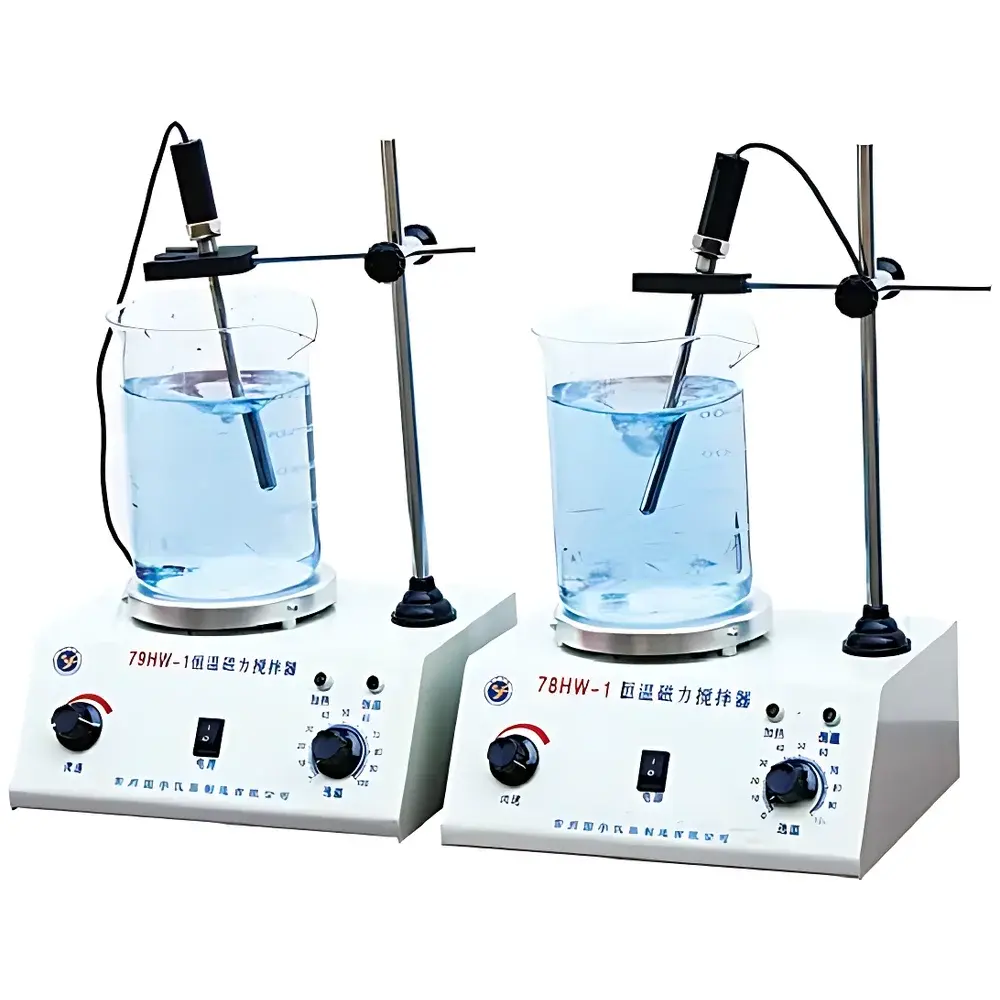
CZGY 79HW-1 Constant-Temperature Magnetic Stirrer
| Brand | CZGY |
|---|---|
| Origin | Jiangsu, China |
| Manufacturer Type | Direct Manufacturer |
| Instrument Type | Magnetic Stirrer |
| Model | 79HW-1 |
| Maximum Stirring Volume | 1000 mL |
| Speed Range | 0–1600 rpm |
| Temperature Control Range | Ambient to 100 °C |
| Plate Diameter | 120 mm |
| Motor Power | 25 W |
| Heating Power | 150 W |
| Voltage/Frequency | 220 V, 50 Hz |
| Temperature Accuracy | ±1 °C |
| Continuous Operation | 8 h at medium speed, 4 h at high speed |
Overview
The CZGY 79HW-1 Constant-Temperature Magnetic Stirrer is an entry-level, benchtop laboratory instrument engineered for simultaneous temperature-controlled heating and magnetic stirring of liquid samples in glass or stainless-steel vessels. It operates on the principle of electromagnetic induction: a rotating permanent magnet beneath the ceramic-coated aluminum heating plate generates a time-varying magnetic field that couples with a PTFE- or glass-coated stir bar immersed in the sample, inducing rotational motion without mechanical contact. Integrated resistive heating elements enable precise thermal regulation up to 100 °C, making it suitable for applications requiring gentle, uniform thermal input during mixing—such as reagent dissolution, buffer preparation, catalyst activation, and pre-analytical sample homogenization. Designed for reliability in teaching labs, QC environments, and routine R&D workflows, the unit features a compact footprint (220 × 160 × 110 mm), non-corrosive plate surface, and fail-safe thermal cutoff to prevent overheating under no-load or dry-run conditions.
Key Features
- Digitally adjustable speed control (0–1600 rpm) via rotary encoder, enabling smooth, stepless ramping for optimal vortex formation and particle suspension
- Independent analog temperature controller with ±1 °C accuracy across ambient to 100 °C range; calibrated against NIST-traceable reference thermometers
- 120 mm diameter heated plate with high-emissivity black ceramic coating for rapid thermal response and uniform heat distribution
- 25 W brushless DC motor ensures silent operation (<45 dB(A)) and long service life with minimal maintenance
- 150 W heating element with dual-stage thermal protection: bimetallic thermostat + electronic overtemperature limiter (110 °C cut-off)
- Grounded 3-pin IEC C14 power inlet compliant with IEC 61010-1 safety standards for laboratory electrical equipment
- IP20-rated enclosure suitable for indoor use in controlled environments (ISO 14644 Class 8 cleanrooms or standard lab spaces)
Sample Compatibility & Compliance
The 79HW-1 accommodates standard laboratory glassware including beakers (50–1000 mL), Erlenmeyer flasks, and round-bottom flasks placed directly on the heating plate. Stir bar compatibility includes common geometries (e.g., 20–40 mm cylindrical, cross-shaped, or octagonal bars) with PTFE, PTFE-glass, or Alnico cores. The device meets CE marking requirements per Directive 2014/30/EU (EMC) and 2014/35/EU (LVD). While not certified for GMP or GLP environments out-of-the-box, its stable thermal and rotational performance supports adherence to ASTM E2913-22 (Standard Guide for Selection and Use of Laboratory Stirring Equipment) and ISO 8573-7 (for compressed air–free mixing protocols). For regulated workflows, users may implement procedural controls—including daily verification of speed and temperature setpoints using external calibrators—to satisfy internal QA/QC documentation requirements.
Software & Data Management
As a standalone analog/digital hybrid instrument, the 79HW-1 does not feature embedded firmware, USB connectivity, or data logging capabilities. All operational parameters are set manually via front-panel controls and visually confirmed via dual-scale LED indicators (rpm and °C). This architecture eliminates cybersecurity vulnerabilities associated with networked devices and reduces validation burden in regulated settings where deterministic, human-verifiable operation is preferred. Users maintaining 21 CFR Part 11–compliant systems may record setpoints, duration, and observed outcomes manually in bound logbooks or LIMS-integrated electronic notebooks. Calibration records—performed annually or after impact events—should include verification of thermal stability (±1 °C deviation over 30 min at 80 °C) and speed linearity (±3% full-scale error across 100–1600 rpm).
Applications
- Preparation of aqueous and organic solutions in analytical chemistry labs (e.g., HPLC mobile phase blending, titrant standardization)
- Cell culture media warming and pH-adjustment steps prior to sterile filtration
- Homogenization of nanoparticle suspensions and colloidal dispersions in materials science research
- Accelerated solvent extraction (ASE) pre-heating stages in environmental testing laboratories
- Controlled hydrolysis reactions in pharmaceutical development (e.g., ester cleavage kinetics under isothermal conditions)
- Teaching demonstrations of heat transfer principles, viscosity–temperature relationships, and magnetic coupling efficiency
FAQ
What is the maximum recommended vessel diameter for stable operation?
A vessel base diameter ≤100 mm is advised to ensure full contact with the 120 mm plate and minimize stir bar wobble at speeds >1200 rpm.
Can the unit be used without heating while stirring?
Yes—the temperature control knob can be set to “OFF” or ambient mode while retaining full speed adjustability.
Is the heating plate resistant to chemical spills?
The ceramic-coated aluminum surface resists mild acids, bases, and solvents; however, prolonged exposure to strong oxidizers (e.g., concentrated HNO₃) or halogenated solvents requires immediate wipe-down to prevent etching.
Does the device support external temperature probe feedback?
No—it relies on built-in plate-sensor feedback only; integration with external Pt100 or thermocouple probes is not supported.
What maintenance is required for long-term reliability?
Monthly visual inspection of plate integrity, annual cleaning of ventilation grilles, and biannual verification of ground continuity (≤0.1 Ω) using a dedicated earth bond tester.



