
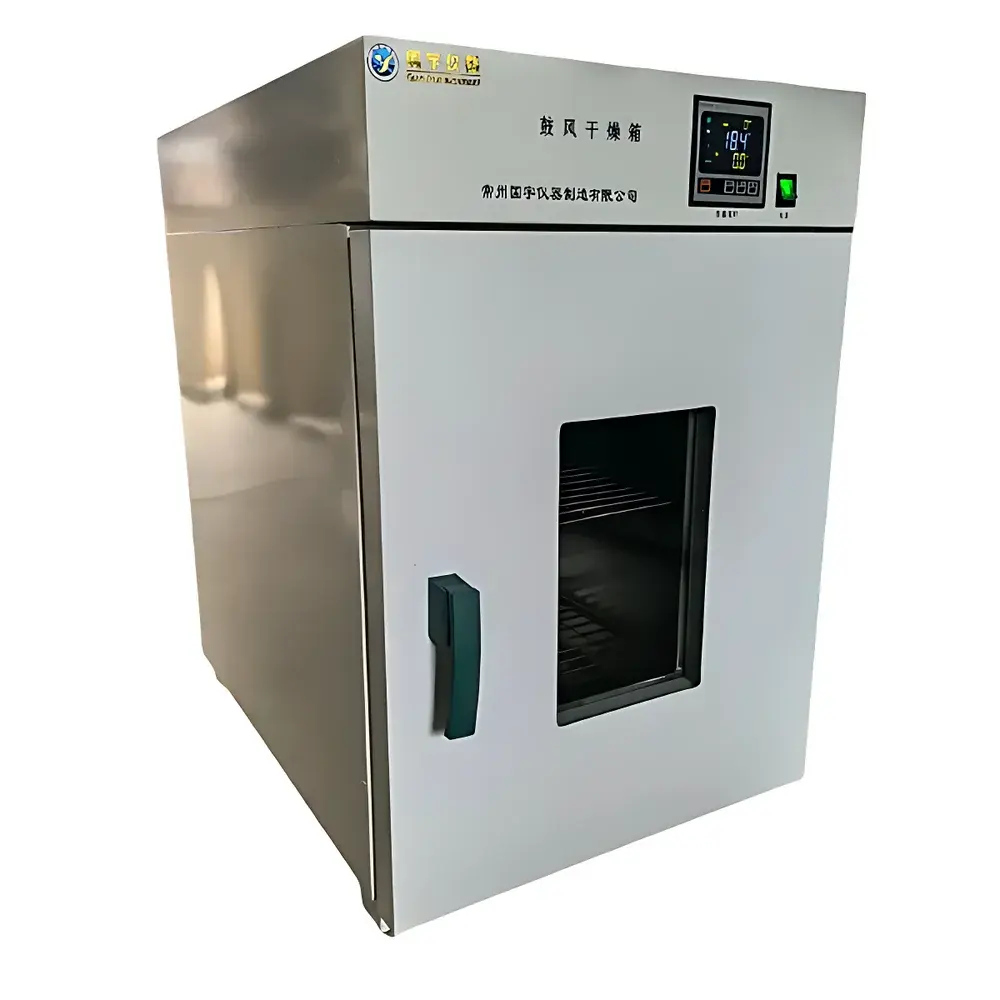
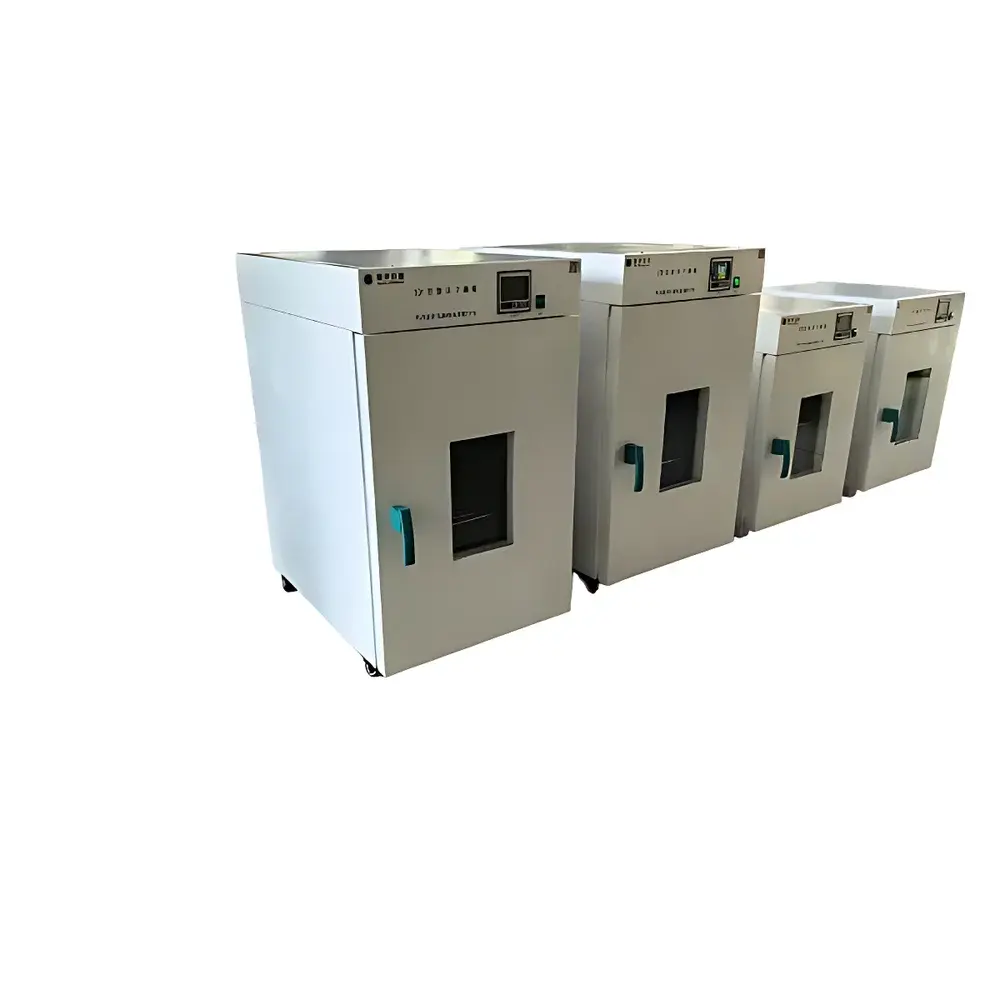
CZGY 101-2A Forced-Air Precision Drying Oven
| Brand | CZGY |
|---|---|
| Origin | Jiangsu, China |
| Manufacturer Type | Direct Manufacturer |
| Product Category | Domestic |
| Model | 101-2A |
| Instrument Type | Precision Forced-Air Oven |
| Temperature Range | RT+10 to 300 °C |
| Temperature Fluctuation | ±1 °C |
| External Dimensions | 570 × 650 × 850 mm |
| Internal Chamber Dimensions | 450 × 450 × 550 mm |
| Temperature Resolution | 0.1 °C |
| Operating Ambient Temperature | Ambient |
| Interior Material | Stainless Steel (SUS304) |
| Heating Method | Rear-Mounted Heaters with Forced-Air Circulation |
| Temperature Uniformity | ±1 °C |
| Control System | Segment LCD Display with Fuzzy PID Algorithm |
| Power Supply | 220 V AC |
| Rated Power | 2000 W |
| Timer Range | 0–9999 minutes/hours |
| Accuracy | ±0.5 °C |
Overview
The CZGY 101-2A Forced-Air Precision Drying Oven is an engineered solution for controlled thermal processing in research laboratories, quality control environments, and industrial testing facilities. Designed around a robust forced-convection architecture, this oven utilizes rear-mounted heating elements coupled with a high-efficiency axial fan and optimized airflow ducting to ensure rapid thermal equilibration and stable temperature maintenance across the entire working chamber. Unlike bottom-heated ovens—whose radiant heat distribution poses documented fire hazards and compromises sample integrity—the 101-2A’s rear-heating configuration eliminates direct contact between heating elements and chamber floor, significantly reducing ignition risk and improving long-term operational safety. Its operating range spans from ambient +10 °C to 300 °C, making it suitable for moisture loss determination, polymer curing, pharmaceutical stability studies, pre-weighing desiccation, and routine sterilization of glassware and metal tools.
Key Features
- Stainless steel interior chamber (SUS304) resistant to corrosion, oxidation, and repeated thermal cycling
- Cold-rolled steel outer casing with durable epoxy powder coating for mechanical and chemical resilience
- High-density rockwool insulation layer between inner and outer walls ensures low thermal loss and energy efficiency
- Tempered borosilicate glass observation window integrated into the door for real-time visual monitoring without compromising chamber integrity
- Fuzzy PID temperature control algorithm delivers high reproducibility and minimizes overshoot during ramp-up or setpoint changes
- Segment-type LCD display provides clear, at-a-glance readout of current temperature, setpoint, timer status, and system alerts
- Adjustable timer function supports both minute- and hour-based operation (0–9999 units), enabling unattended batch processing
- Independent over-temperature protection circuit with manual reset ensures fail-safe operation under abnormal conditions
Sample Compatibility & Compliance
The 101-2A accommodates standard laboratory ware including Petri dishes, weighing boats, crucibles, glass vials, and aluminum sample pans. Its uniform airflow design prevents localized hot spots and supports consistent drying kinetics across heterogeneous sample loads. The unit complies with general-purpose laboratory equipment safety standards per IEC 61010-1:2010 and meets structural requirements for Class II, Division 1 environments. While not certified for explosion-proof use, its rear-heater layout and grounded chassis conform to widely adopted best practices for non-hazardous area thermal instrumentation. For regulated applications—such as those governed by USP , ISO 17025, or GLP-compliant protocols—the oven supports traceable calibration via external reference thermometers and can be integrated into audit-ready documentation workflows when paired with validated calibration records.
Software & Data Management
The 101-2A operates as a standalone instrument with no embedded software or network interface. All control logic resides within the microcontroller-based PID module, ensuring deterministic response and immunity to firmware vulnerabilities. Temperature data logging requires external integration via RS-232 or analog output (optional add-on). When connected to third-party data acquisition systems—such as LabVIEW, MATLAB, or custom SCADA platforms—the oven supports time-stamped temperature recording at user-defined intervals. For FDA 21 CFR Part 11 compliance, users may implement electronic signatures and audit trails externally through validated software layers; the hardware itself provides timestamped event flags (e.g., door open/close, over-temp alarm, timer completion) accessible via serial command protocol.
Applications
- Determination of moisture content in pharmaceutical excipients, food powders, and soil samples per ASTM D2231 and ISO 712
- Pre-drying of filter papers and gravimetric vessels prior to ash content analysis (AOAC 920.110)
- Thermal conditioning of polymers and composites prior to tensile or rheological testing
- Accelerated aging studies for packaging materials and adhesives under controlled humidity-free conditions
- Dehydration of biological specimens before SEM sample preparation
- Post-cleaning drying of stainless steel and ceramic labware in ISO Class 5–8 cleanrooms
FAQ
What distinguishes the 101-2A’s rear-heating design from bottom-heated ovens?
Rear-mounted heating elements eliminate direct exposure of flammable residues or spilled solvents to the heat source, substantially lowering fire risk and simplifying heater replacement.
Can the oven be calibrated to meet ISO/IEC 17025 requirements?
Yes—calibration is performed using NIST-traceable reference thermometers at three points (100 °C, 150 °C, and 250 °C); full uncertainty budgets and certificate templates are available upon request.
Is the internal chamber volume sufficient for standard ISO drying trays?
With internal dimensions of 450 × 450 × 550 mm (111.4 L), the chamber accommodates up to four ISO 6507-1 standard drying trays (200 × 250 × 40 mm) simultaneously.
Does the unit support continuous operation at maximum temperature?
Yes—the thermal management system and insulation package are rated for uninterrupted operation at 300 °C, subject to periodic verification of fan performance and door gasket integrity.
What maintenance is required to sustain ±1 °C uniformity over time?
Biannual inspection of fan blade balance, duct seal integrity, and PID parameter drift is recommended; calibration verification should occur every six months in GLP environments.



