
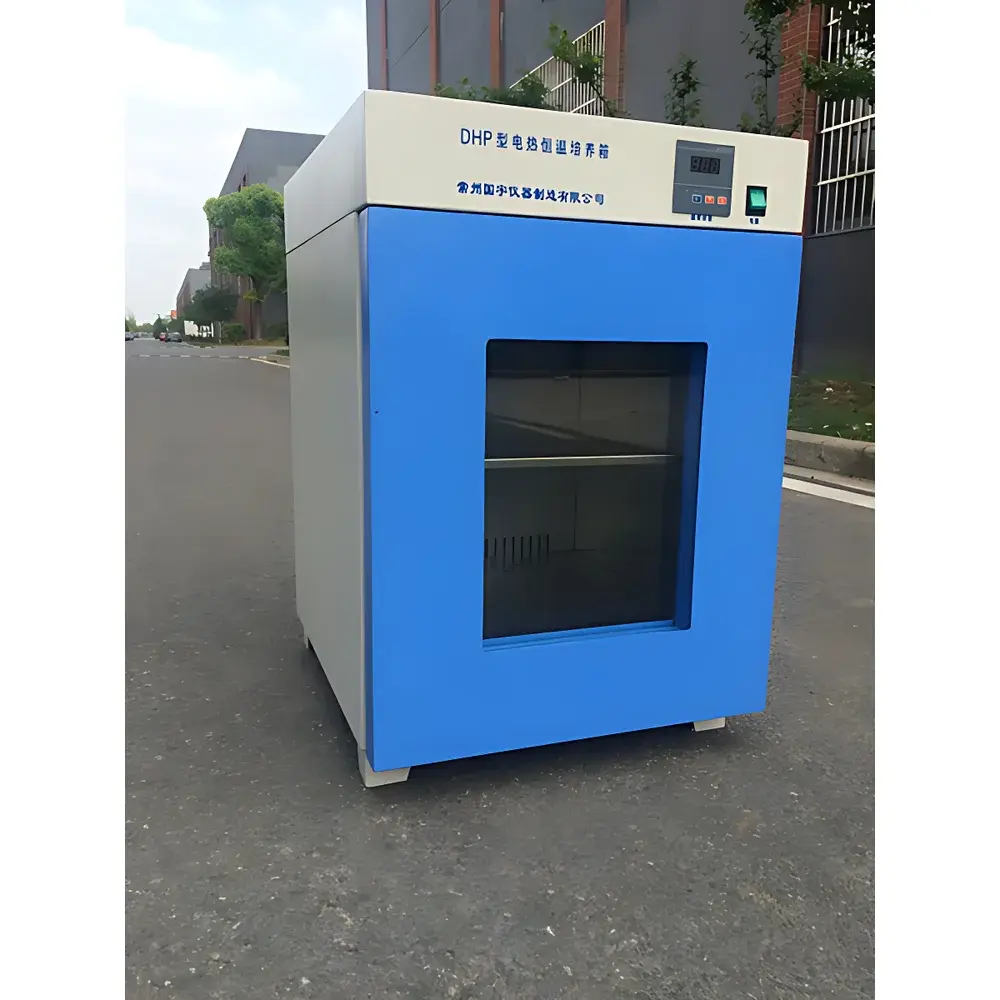
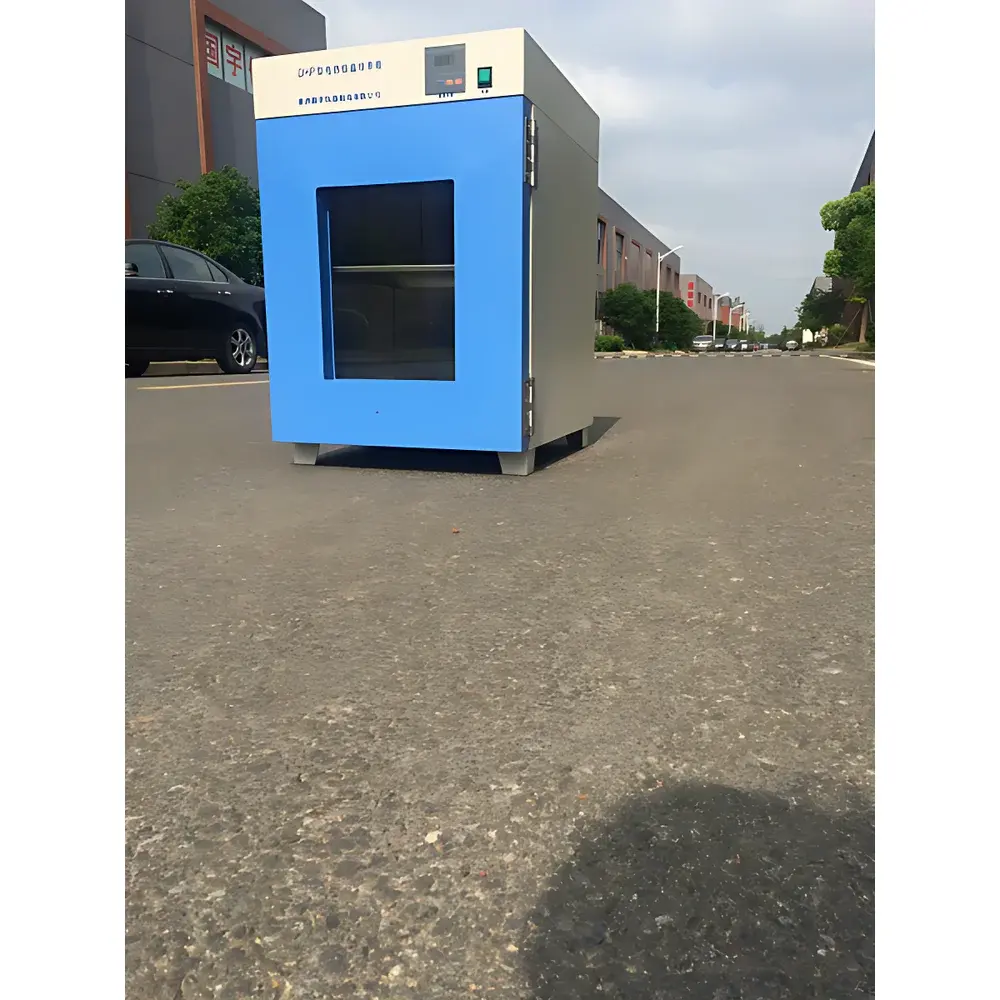
CZGY DHP-500 Electrically Heated Constant-Temperature Incubator
| Brand | CZGY |
|---|---|
| Origin | Jiangsu, China |
| Manufacturer Type | Direct Manufacturer |
| Country of Origin | China |
| Model | DHP-500 |
| Price | USD 560 (FOB) |
| Temperature Range | Ambient +5°C to 65°C |
| Temperature Uniformity | ±1°C |
| Humidity Control | Not Available |
| Internal Chamber Dimensions | 500 × 500 × 600 mm (L×W×H) |
| Rated Power | 400 W |
| Voltage/Frequency | 220 V / 50 Hz |
| Shelf Load Capacity | 35 kg |
| Temperature Stability | ≤ ±0.5°C |
| Construction | Cold-rolled steel exterior with electrostatic powder coating |
| Insulation | High-density ultra-fine glass fiber |
| Air Circulation | Forced-air convection with optimized duct design |
| Controller | Microprocessor-based digital PID temperature controller with dual-line LED display, parameter lock (LCK), and sensor offset calibration (SC: −50 to +50°C) |
Overview
The CZGY DHP-500 Electrically Heated Constant-Temperature Incubator is a precision-engineered laboratory incubation system designed for stable, repeatable thermal environments in microbiological culture, cell propagation, enzyme activity assays, and long-term sample storage applications. It operates on the principle of forced-air convection heating, where a low-noise centrifugal fan circulates heated air through a calibrated duct network to minimize thermal stratification and ensure uniform temperature distribution across the entire 150 L working volume (500 × 500 × 600 mm). Unlike humidity-controlled or CO₂-incorporated incubators, the DHP-500 is purpose-built as a dry, non-humidified thermal platform—making it ideal for applications requiring strict temperature fidelity without vapor-phase interference, such as bacterial colony expansion, media solidification, reagent pre-warming, and stability testing of temperature-sensitive compounds under ambient humidity conditions.
Key Features
- Robust structural architecture: 1.2 mm cold-rolled steel outer casing with epoxy-polyester powder coating ensures corrosion resistance and mechanical durability in shared lab environments.
- Hygienic stainless steel (AISI 304) inner chamber with seamless welded corners and polished finish—facilitates rapid decontamination and meets basic GLP-compliant cleaning protocols.
- High-efficiency thermal insulation: 70 mm thick ultra-fine glass fiber fill between double-wall construction reduces heat loss and improves energy efficiency while minimizing external surface temperature rise.
- PID-controlled microprocessor regulator with dual-line LED interface enables precise setpoint definition (0.1°C resolution), real-time monitoring, and programmable deviation correction (SC parameter).
- Configurable safety logic: Adjustable upper-limit alarm (AL), hysteresis setting (HY), and parameter lock (LCK levels 0–2) support SOP-driven operation and prevent unauthorized configuration changes.
- Optimized airflow path: Internally baffled convection channel directs laminar air movement from rear-mounted heater/fan assembly toward front-loading door plane—verified to maintain ≤ ±1°C uniformity per ISO 15270:2021 Annex B test methodology.
Sample Compatibility & Compliance
The DHP-500 accommodates standard microbiological vessels including Petri dishes (up to 150 mm diameter), culture flasks (T-75, T-175), multiwell plates, and glass/plastic sample racks. Its open-chamber design supports unrestricted access for manual handling and integration with auxiliary equipment (e.g., pipetting robots or barcode scanners mounted externally). While not certified to IEC 61010-1 or UL 61010B for hazardous location use, the unit complies with general electrical safety requirements for Class II laboratory appliances per GB 4793.1–2007 (equivalent to EN 61010-1:2010). It is suitable for ISO/IEC 17025-accredited laboratories performing routine QC tasks where temperature traceability is maintained via external NIST-traceable thermistor probes (e.g., Fluke 1523 or similar). No integrated data logging or 21 CFR Part 11 compliance features are included—users must implement third-party validation protocols for regulated workflows.
Software & Data Management
The DHP-500 operates exclusively via its embedded microcontroller with no onboard software stack, USB interface, or Ethernet connectivity. All operational parameters—including setpoint, alarm thresholds, PID coefficients (P, I, D), cycle time (t), and sensor offset—are configured manually using front-panel push-button navigation (SET, △, ▽). The controller retains settings during power interruption but does not record time-stamped temperature history. For audit-ready documentation, users are advised to pair the incubator with an independent validated data logger (e.g., Onset HOBO UX100-003 or Omega OM-DAQPRO-5300) installed inside the chamber at geometric center, with probe placement following ASTM E2875–22 Section 6.3 guidelines. Calibration intervals should align with institutional SOPs—typically every 6 months—and include verification at three points: 37°C (standard culture temp), 55°C (thermophile range), and 65°C (upper operational limit).
Applications
- Microbiological cultivation: Escherichia coli, Bacillus subtilis, Staphylococcus aureus, and other mesophilic organisms under standardized aerobic conditions (ASTM D5772–17).
- Enzyme kinetics studies requiring consistent thermal activation (e.g., Taq polymerase pre-incubation prior to PCR setup).
- Pharmaceutical excipient stability screening per ICH Q1A(R2) guidelines at intermediate storage temperatures (40°C/75% RH simulated via dry incubation + desiccant control).
- Educational labs: Student-based bacterial transformation experiments, fungal spore germination assays, and antibiotic susceptibility testing (Kirby-Bauer method).
- Industrial QA/QC: Pre-heating of viscosity standards, conditioning of polymer films prior to tensile testing, and thermal equilibration of reference materials before spectroscopic analysis.
FAQ
Does the DHP-500 support humidity control?
No. This model is a dry-heating incubator with no integrated humidification or water reservoir. For humidity-dependent applications, consider dedicated humidified incubators or external steam-generating accessories.
Can the unit be validated for GMP environments?
Yes—provided users perform IQ/OQ/PQ using third-party calibrated sensors and document procedures per Annex 15 of the EU GMP Guide. The device itself lacks electronic audit trails or user-access logs required for full Part 11 compliance.
What is the recommended calibration frequency?
Biannual calibration is advised for routine use; quarterly calibration is recommended in high-throughput or regulated settings. Verification should include at least three temperature points across the operating range.
Is over-temperature protection hardware-based or software-limited?
It includes both: a redundant bimetallic thermal cutoff (mechanical fail-safe at 75°C) and programmable AL alarm (user-defined threshold, default 70°C).
Can multiple shelves be installed without compromising uniformity?
Yes—the standard configuration includes two adjustable stainless steel shelves. Adding up to four shelves (sold separately) maintains ≤ ±1.2°C uniformity when loaded per manufacturer’s loading diagram (max 70% chamber volume occupancy).
Related Products





