
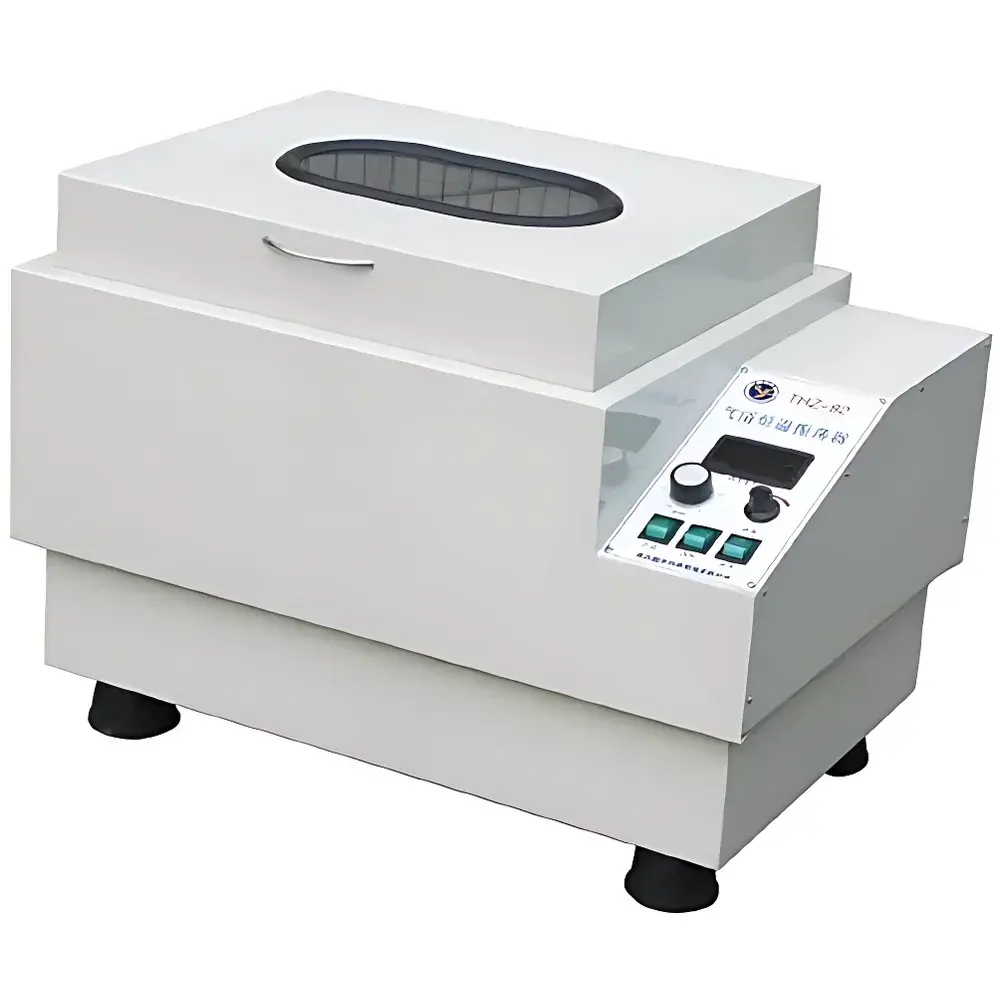
CZGY THZ-82 Air-Bath Constant-Temperature Orbital Shaker
| Brand | CZGY |
|---|---|
| Origin | Jiangsu, China |
| Manufacturer Type | Direct Manufacturer |
| Instrument Type | Air-bath Constant-Temperature Orbital Shaker |
| Timer Range | 0–120 min |
| Oscillation Frequency | 0–300 rpm (adjustable) |
| Oscillation Amplitude | 20 mm |
| Temperature Range | Ambient to 50 °C |
| Platform Quantity | 1 |
| Power Supply | 220 V, 50 Hz |
| Heating Power | 500 W |
| Temperature Accuracy | ±1 °C |
| Platform Dimensions | 470 × 420 mm |
| Overall Dimensions | 690 × 470 × 500 mm |
| Flask Capacity | 16 mL × 300, 100 mL × 24, or 200 mL × 15 |
Overview
The CZGY THZ-82 Air-Bath Constant-Temperature Orbital Shaker is an engineered platform for precise, reproducible cultivation of biological samples under controlled thermal and mechanical conditions. Unlike water-bath shakers, this air-bath design employs forced convection heating via integrated fan-assisted airflow and PID-regulated resistive heating elements—enabling rapid temperature equilibration, uniform chamber thermal distribution, and avoidance of water contamination risks in sensitive cell culture or reagent-based assays. Its orbital (circular) motion profile—distinct from reciprocating or linear agitation—generates gentle yet effective mixing ideal for suspension cultures, microbial growth, enzyme kinetics, and solubility studies where shear-sensitive cells or fragile aggregates require consistent, low-turbulence agitation. The unit operates across a biologically relevant temperature span (ambient to 50 °C), supporting standard incubation protocols for mesophilic bacteria, yeast, mammalian cell lines, and biochemical reaction optimization.
Key Features
- Orbital shaking mechanism with adjustable frequency (0–300 rpm) and fixed 20 mm diameter orbit—optimized for homogeneous suspension without foaming or excessive shear stress.
- Digital PID temperature controller with ±1 °C accuracy and real-time LED display—ensuring stable thermal setpoints critical for kinetic consistency across replicate experiments.
- Robust stainless-steel platform (470 × 420 mm) designed for long-term corrosion resistance and easy decontamination; compatible with standard laboratory glassware and plastic flasks.
- Mechanical timer (0–120 min) with “continuous run” mode—supporting both timed incubation cycles and unattended overnight operation under supervised lab conditions.
- 500 W high-efficiency heating system with overheat protection and thermal cutoff—maintaining safe operational envelope even during extended use at upper temperature limits.
- Low-noise brushless motor drive and precision-balanced eccentric drive assembly—ensuring vibration isolation, minimal cross-talk to adjacent instrumentation, and >10,000-hour service life.
Sample Compatibility & Compliance
The THZ-82 accommodates diverse vessel configurations without adapter modification: up to 300 × 16 mL test tubes, 24 × 100 mL Erlenmeyer flasks, or 15 × 200 mL bottles—enabling parallel processing for strain screening, media optimization, or dose-response assays. Its open-air chamber allows rapid flask exchange and visual monitoring while maintaining thermal integrity via insulated double-wall construction. The instrument complies with IEC 61010-1:2010 safety standards for laboratory electrical equipment and meets EMC Class B emission limits per CISPR 11. While not certified for ISO 13485 or FDA 21 CFR Part 11 out-of-box, its analog timer and non-networked control architecture permit straightforward integration into GLP-compliant workflows requiring audit-trail documentation via external loggers or LIMS linkage.
Software & Data Management
This model operates via standalone hardware controls—no embedded firmware, no USB/Bluetooth connectivity, and no proprietary software dependency. All operational parameters (temperature setpoint, timer duration, speed setting) are manually configured and visually confirmed on the front-panel LED display. This architecture eliminates cybersecurity vulnerabilities, reduces validation burden in regulated environments, and ensures deterministic behavior across power cycles. For laboratories requiring electronic recordkeeping, optional external temperature data loggers (e.g., compliant with ASTM E2810–19 for thermal mapping) may be deployed alongside the unit to capture time-stamped ambient and chamber temperature profiles. No password protection, user roles, or electronic signatures are implemented—consistent with Class I laboratory equipment per ISO/IEC 17025:2017 Annex A.2 guidance.
Applications
- Microbial culture expansion (E. coli, Bacillus spp., Pseudomonas) under aerobic, temperature-controlled conditions.
- Suspension-based mammalian cell passaging and transient transfection preparation where uniform nutrient dispersion is critical.
- Biochemical assay development—including ligand-binding kinetics, protein stability screening (thermal shift assays), and enzymatic activity profiling across temperature gradients.
- Environmental microbiology—soil extract enrichment, waterborne pathogen recovery, and biodegradation rate studies.
- Pharmaceutical QC support—dissolution testing of solid dosage forms, excipient compatibility trials, and buffer equilibration protocols.
- Academic teaching labs—introducing students to fundamental principles of microbial growth kinetics, oxygen transfer limitations, and temperature-dependent metabolic rates.
FAQ
What is the difference between orbital and reciprocating motion in shakers?
Orbital motion produces circular agitation ideal for suspension cultures and low-shear applications; reciprocating motion generates back-and-forth linear movement better suited for viscous samples or particle resuspension.
Can the THZ-82 be used for sterile applications?
While the stainless-steel platform and enclosed chamber support surface decontamination (e.g., 70% ethanol wipe-down), the unit lacks HEPA filtration or UV sterilization—sterile technique must be maintained externally via laminar flow hood transfer.
Is the temperature calibration traceable to NIST standards?
Factory calibration is performed using reference thermistors calibrated against NIST-traceable standards; users may perform field verification with a calibrated digital thermometer per ISO/IEC 17025 Clause 6.6.
Does the shaker include overload or imbalance detection?
No automatic imbalance shutdown is integrated; however, the mechanical design includes reinforced mounting brackets and dynamic balancing to minimize drift at maximum 300 rpm load.
What maintenance is required for long-term reliability?
Biannual inspection of fan intake filters, visual check of drive belt tension (if applicable), and verification of thermal cut-off functionality using a calibrated heat source—documented per manufacturer’s Maintenance Log Template (available upon request).
Related Products




