
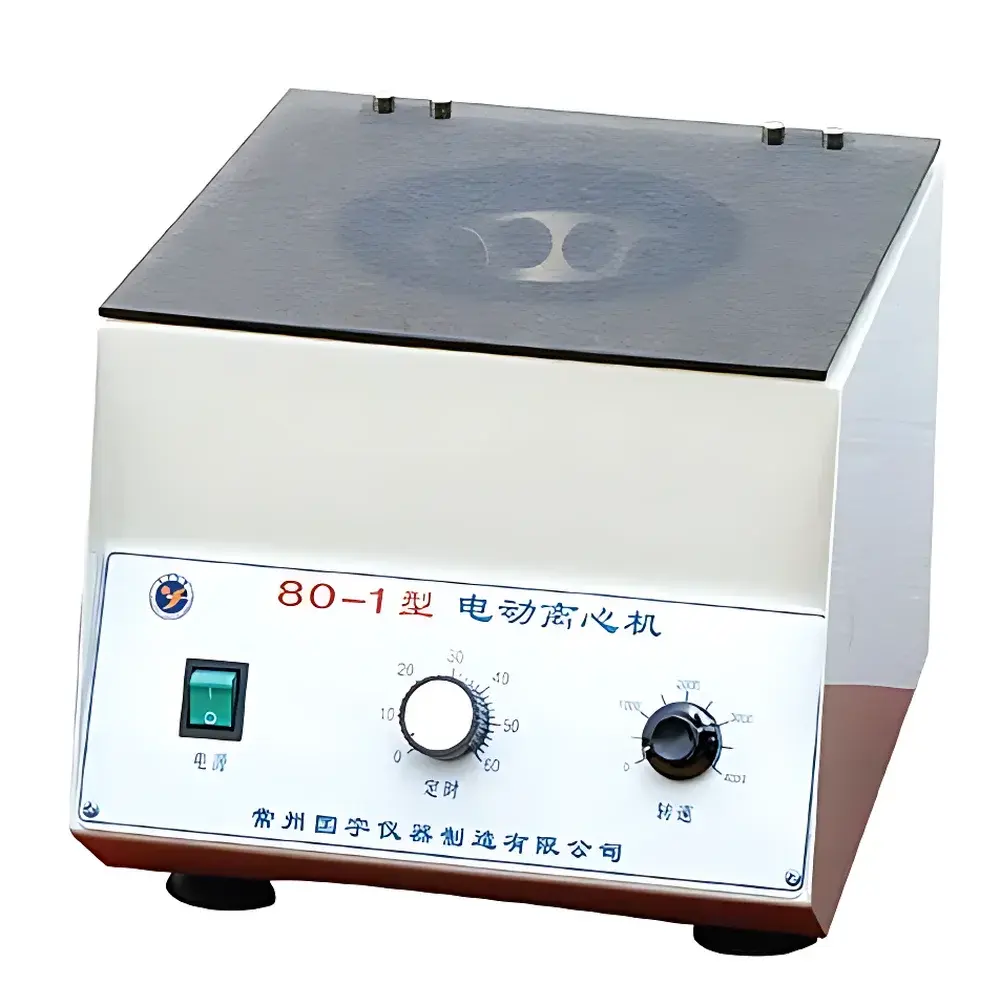
CZGY 80-1 Benchtop Electric Centrifuge
| Brand | CZGY |
|---|---|
| Origin | Jiangsu, China |
| Manufacturer Type | Direct Manufacturer |
| Model | 80-1 |
| Max Capacity | 12 × 20 mL |
| Max Speed | 4000 rpm |
| Dimensions | 290 × 330 × 260 mm |
| Power Supply | 220 V, 50 Hz |
| Timer Range | 0–60 min |
| Motor Rated Power | 40 W |
| RCF (Relative Centrifugal Force) at 4000 rpm | 1960 × g |
| Compliance | CE-marked design principles (IEC 61010-1), GLP-compatible operation |
Overview
The CZGY 80-1 Benchtop Electric Centrifuge is a compact, fixed-speed or stepwise variable-speed centrifugation system engineered for routine separation tasks in clinical diagnostics, biomedical research, and quality control laboratories. Operating on the principle of sedimentation under radial acceleration, it generates controlled relative centrifugal force (RCF) to separate components based on density differentials—such as blood plasma from erythrocytes, precipitated proteins from supernatants, or microbial pellets from culture media. Designed for stability and operational safety, the unit features a robust cast-aluminum rotor housing, balanced dual-bearing spindle assembly, and integrated mechanical timer with fail-safe cutoff. Its 1960 × g maximum RCF at 4000 rpm meets standard requirements for serum separation, urine sediment concentration, and vaccine component clarification per CLSI GP17-A4 and ISO 22870:2016 guidelines.
Key Features
- Benchtop footprint (290 × 330 × 260 mm) optimized for space-constrained lab environments including hospital satellite labs and teaching facilities
- 12-position rotor accommodating standard 20 mL glass or polypropylene centrifuge tubes (diameter ≤ 16 mm), with pre-calibrated tube alignment grooves ensuring symmetrical load distribution
- Step-variable speed control (0–4000 rpm) via analog dial; motor delivers consistent torque across operating range with 40 W continuous-duty brushed DC configuration
- Mechanical timer (0–60 minutes) with audible end-of-cycle signal and automatic power disengagement—no software dependency or battery backup required
- Transparent polycarbonate lid with interlock switch preventing operation unless fully latched; reduces airborne particulate dispersion and acoustic emission (<65 dB at 1 m)
- Grounding terminal compliant with IEC 61010-1 Class I safety standards; includes dedicated earth connection point for laboratory grounding infrastructure
Sample Compatibility & Compliance
The 80-1 supports routine biospecimen processing including whole blood, serum, plasma, urine, bacterial cultures, and cell lysates. Tube loading requires mass balance within ±3 g per opposing position to maintain rotational integrity—consistent with ISO 15189:2022 clause 5.3.2 on equipment validation for diagnostic laboratories. While not FDA 510(k)-cleared, its construction adheres to general safety architecture referenced in EN 61010-2-020 (Particular requirements for laboratory centrifuges). The device is routinely deployed in GLP-aligned workflows where audit trails are maintained manually via logbook entries; no electronic data capture or 21 CFR Part 11 compliance is embedded, aligning with its role as a foundational mechanical separation tool.
Software & Data Management
This model operates without embedded firmware, cloud connectivity, or digital interface. All operational parameters—including speed setting, timer activation, and run completion—are managed through physical controls only. No data logging, export capability, or user account management is provided. This architecture eliminates cybersecurity surface area and ensures deterministic behavior under electromagnetic interference common in shared instrumentation suites. For labs requiring traceability, integration with external LIMS is achieved via manual entry of batch identifiers, centrifugation time, and speed settings into standardized SOP documentation templates.
Applications
- Clinical chemistry: Separation of serum/plasma from clotted blood specimens prior to analyte measurement (e.g., creatinine, glucose, electrolytes)
- Virology & immunology: Clarification of viral harvests and antigen preparations during vaccine development workflows
- Microbiology: Pellet recovery of Gram-positive/negative bacteria from broth cultures for Gram staining or antibiotic susceptibility testing
- Biotechnology education: Demonstration of sedimentation kinetics, density gradient principles, and rotor dynamics in undergraduate laboratory curricula
- Environmental testing: Concentration of suspended solids from water samples for turbidity or heavy metal analysis
FAQ
What is the maximum relative centrifugal force (RCF) achievable with the 80-1 centrifuge?
At 4000 rpm with a 100 mm radius rotor, the calculated RCF is 1960 × g—verified using the standard formula RCF = 1.118 × 10⁻⁵ × r × N².
Can this centrifuge be used for centrifuging hazardous biological materials?
It is suitable for BSL-2 agents when operated inside a certified biosafety cabinet; however, it lacks sealed rotor containment or aerosol-tight lid certification per ISO 13485 Annex C.
Is calibration documentation provided with the unit?
A factory-verified speed tolerance certificate (±3% at full scale) and mechanical timer accuracy report (±30 s over 60 min) are included in the shipment package.
Does the 80-1 support refrigerated operation?
No—it is a non-refrigerated unit intended for ambient-temperature applications only; sample temperature rise during extended runs remains within ±2 °C of room conditions.
What maintenance intervals are recommended?
Lubrication-free spindle design requires no scheduled greasing; biannual visual inspection of rotor threads, lid latch mechanism, and power cord integrity is advised per manufacturer’s maintenance log template.



