
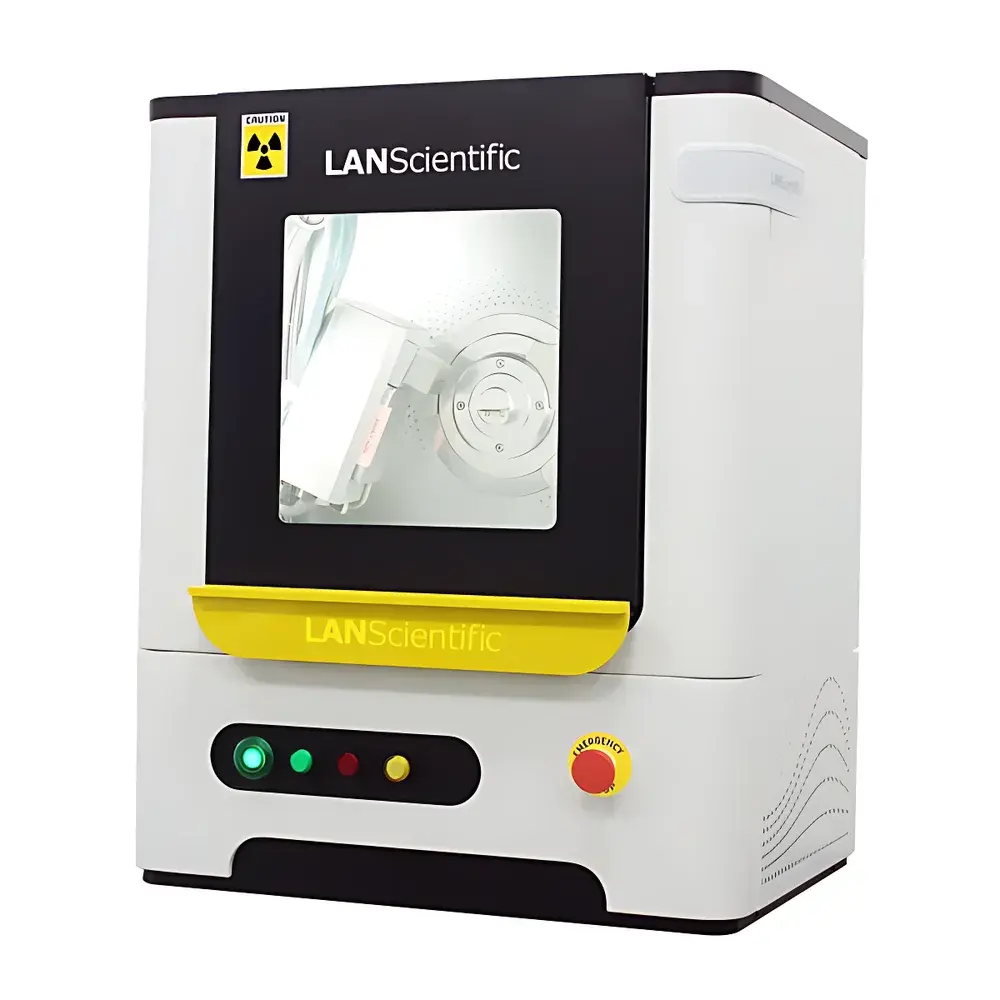
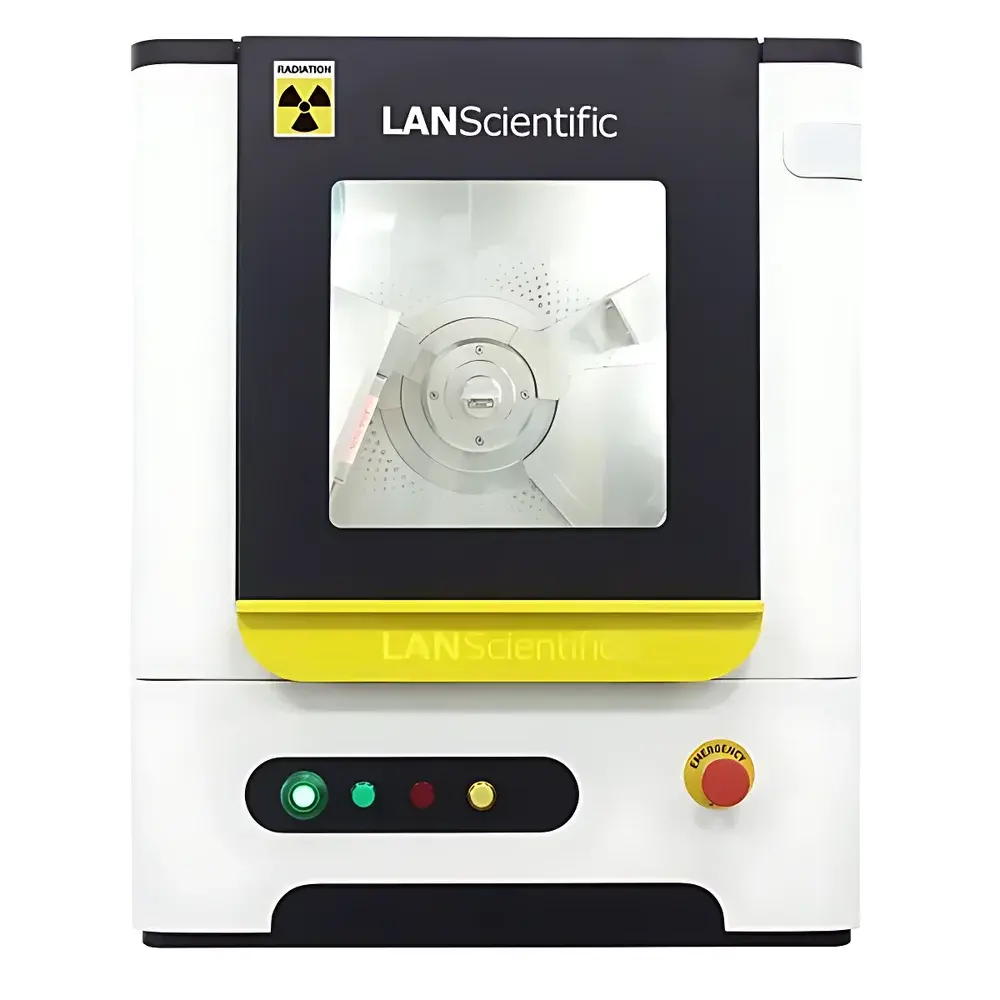
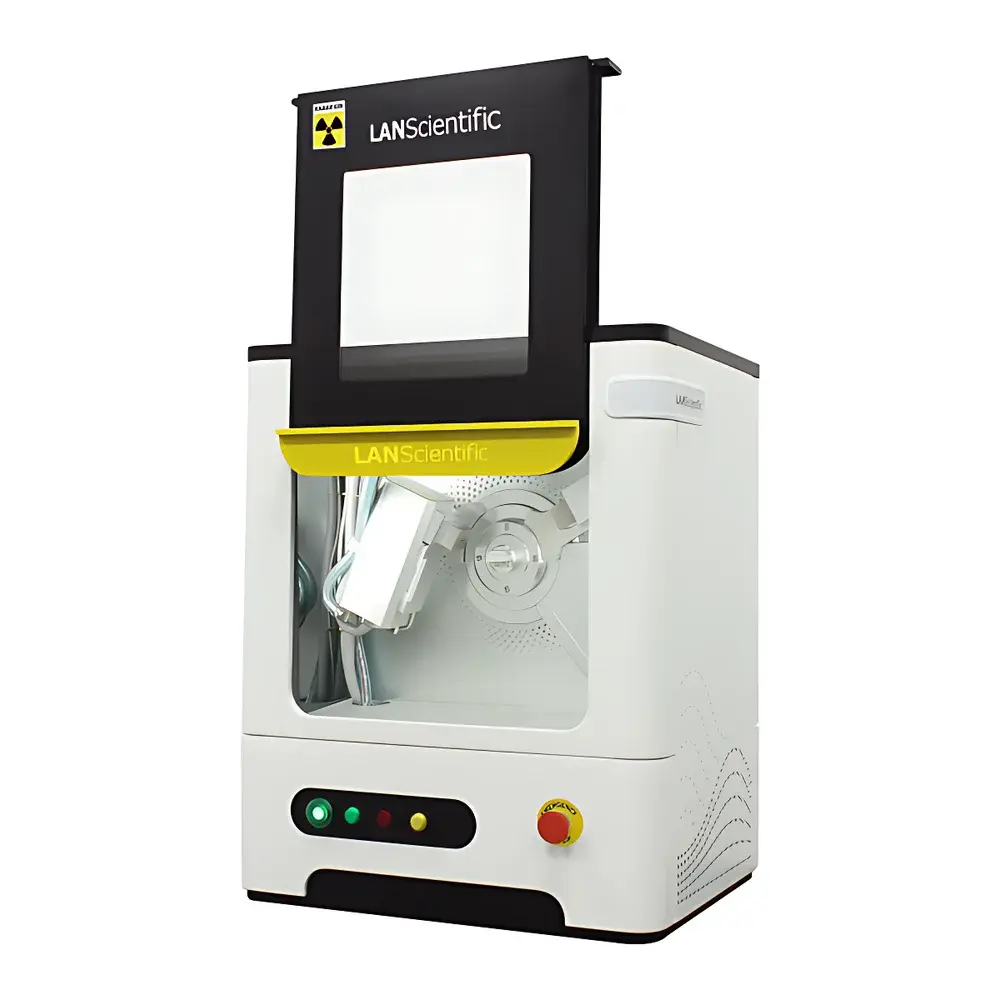
LANScientific FRINGE EV Desktop Powder X-ray Diffractometer
| Brand | LANScientific |
|---|---|
| Origin | Jiangsu, China |
| Manufacturer Type | Manufacturer |
| Product Category | Domestic |
| Model | FRINGE EV |
| Instrument Type | Powder X-ray Diffractometer |
| Power Rating | kW-class (integrated sealed X-ray tube) |
| Geometry | Bragg–Brentano reflection (θs–θd) |
| Detector | High-sensitivity scintillation or silicon-strip detector (configurable) |
| Sample Stage | Motorized goniometer with ±0.001° angular resolution |
| Software Platform | CrystalX v3.x (with ICDD PDF-4+ database integration) |
| Compliance | CE, RoHS, IEC 61000-6-3/6-4, EN 62471 (UV/soft X-ray safety) |
Overview
The LANScientific FRINGE EV is a compact, high-performance desktop powder X-ray diffractometer engineered for rigorous structural characterization of crystalline and semi-crystalline materials in pharmaceutical development, materials science, and quality control laboratories. Operating on the Bragg–Brentano reflection geometry (θs–θd), the system directs a monochromatic Cu Kα X-ray beam—generated by a sealed, air-cooled kW-class microfocus X-ray tube—onto the sample surface. Diffraction occurs when lattice planes satisfy Bragg’s law (nλ = 2d sinθ), producing intensity maxima at discrete 2θ angles. These signals are collected via a high-efficiency scintillation or silicon-strip detector, digitized with 0.01° step resolution, and processed in real time to generate high-fidelity diffraction patterns. Unlike conventional benchtop systems constrained by low-power tubes (<50 W), the FRINGE EV’s integrated kW-level source delivers superior photon flux, enabling rapid data acquisition (≤5 min per scan) without compromising peak signal-to-noise ratio or angular reproducibility—critical for polymorph identification, residual stress analysis, and lattice parameter refinement in active pharmaceutical ingredients (APIs).
Key Features
- Compact desktop footprint (W × D × H: 650 × 520 × 480 mm) with pneumatic lift-up panoramic viewing door—designed for ergonomic operation and space-constrained lab environments including GLP-compliant QC labs and university teaching facilities.
- KW-class sealed X-ray tube (Cu anode, 40–50 kV / 1–2 mA adjustable) delivering stable, long-lifetime output (>10,000 h typical tube life) with minimal thermal drift.
- Integrated Soller slits mounted directly on the goniometer arm—eliminating mechanical adjustment points, enhancing angular stability, and enabling vibration-tolerant deployment in mobile or field-deployable labs (e.g., vehicle-mounted analytical platforms).
- Dual safety architecture: interlocked sample chamber with automatic beam shutter cutoff upon door opening; real-time status feedback on touchscreen interface confirming full enclosure prior to exposure.
- Motorized precision goniometer with <0.001° minimum step size and closed-loop encoder feedback—ensuring repeatable positioning across extended scan ranges (5–120° 2θ).
Sample Compatibility & Compliance
The FRINGE EV accommodates diverse solid-state samples—including free-flowing powders, pressed pellets, thin films, and bulk metal or ceramic specimens—without requiring specialized holders or vacuum stages. Its open-beam path design supports ambient-air measurement for hygroscopic or oxygen-sensitive APIs, while optional He-purged or capillary configurations enable quantitative phase analysis under inert conditions. The instrument meets essential international regulatory requirements for analytical instrumentation used in pharmaceutical R&D and manufacturing: it supports audit-trail-enabled operation per FDA 21 CFR Part 11 (via CrystalX software), conforms to ISO 17025 calibration traceability frameworks, and provides raw data formats compliant with ASTM E1421 (Standard Practice for Describing and Measuring Performance of X-ray Diffractometers). All diffraction data files (.raw, .xy, .csv) retain metadata including voltage/current settings, slit configurations, and environmental timestamps—facilitating full traceability during GMP batch release testing.
Software & Data Management
CrystalX v3.x serves as the unified control, acquisition, and analysis environment. Upon completion of a scan, the software performs automated background subtraction, peak search (using modified Thompson–Cox–Hastings algorithm), and qualitative phase identification against the ICDD PDF-4+ database (2023 edition, >1.1 million entries). Quantitative Rietveld refinement is supported for multi-phase mixtures (e.g., API + excipient + hydrate forms), reporting weight fractions with uncertainty estimates derived from variance-covariance matrix propagation. All processing workflows are scriptable and exportable as SOP templates. Raw data and processed reports are stored in a hierarchical project structure with SHA-256 checksum validation; user roles (operator, reviewer, approver) are enforced through password-protected access tiers. Electronic signatures, change logs, and version-controlled method files comply with ALCOA+ data integrity principles.
Applications
- Pharmaceutical solid-state characterization: polymorph screening, hydrate/solvate identification, crystallinity index determination (e.g., amorphous content in spray-dried dispersions), and stability-indicating assay development per ICH Q5A and Q6A guidelines.
- Materials science: lattice parameter mapping of alloy systems, strain quantification in thin-film semiconductors, phase evolution during thermal cycling (in situ heating stage compatible), and nano-crystallite size analysis via Scherrer–Williamson deconvolution.
- Geological and metallurgical QC: rapid mineralogical fingerprinting of ores, slag composition verification, and corrosion product phase identification in pipeline integrity programs.
- Academic research: teaching crystallography fundamentals, validating DFT-predicted structures, and supporting synchrotron beamline proposal preparation through reference pattern generation.
FAQ
Does the FRINGE EV require external water cooling or high-voltage infrastructure?
No. The kW-class X-ray tube employs forced-air cooling and operates on standard 230 V AC / 16 A single-phase power—eliminating need for chillers, three-phase supply, or dedicated grounding rods.
Can CrystalX software perform Rietveld refinement for quantitative analysis?
Yes. Full-profile Rietveld analysis is embedded, supporting multiphase systems with user-defined constraints, preferred orientation correction, and microstrain broadening modeling.
Is the system compliant with FDA 21 CFR Part 11 for electronic records and signatures?
Yes—when deployed with CrystalX v3.x in audit-trail mode, including role-based access, immutable logs, and electronic signature capture validated per Annex 11 requirements.
What sample preparation protocols are recommended for API powders?
Standard protocols apply: gentle back-loading into zero-background silicon or quartz sample holders; minimal pressure to avoid preferred orientation; particle size distribution ideally <50 µm (D90) for optimal peak sharpness and statistical representativeness.
How is angular calibration maintained over time?
The goniometer includes an internal reference standard (NIST-traceable Si SRM 640e) for routine calibration checks; automated alignment routines verify zero-angle offset and 2θ linearity before each session.




