
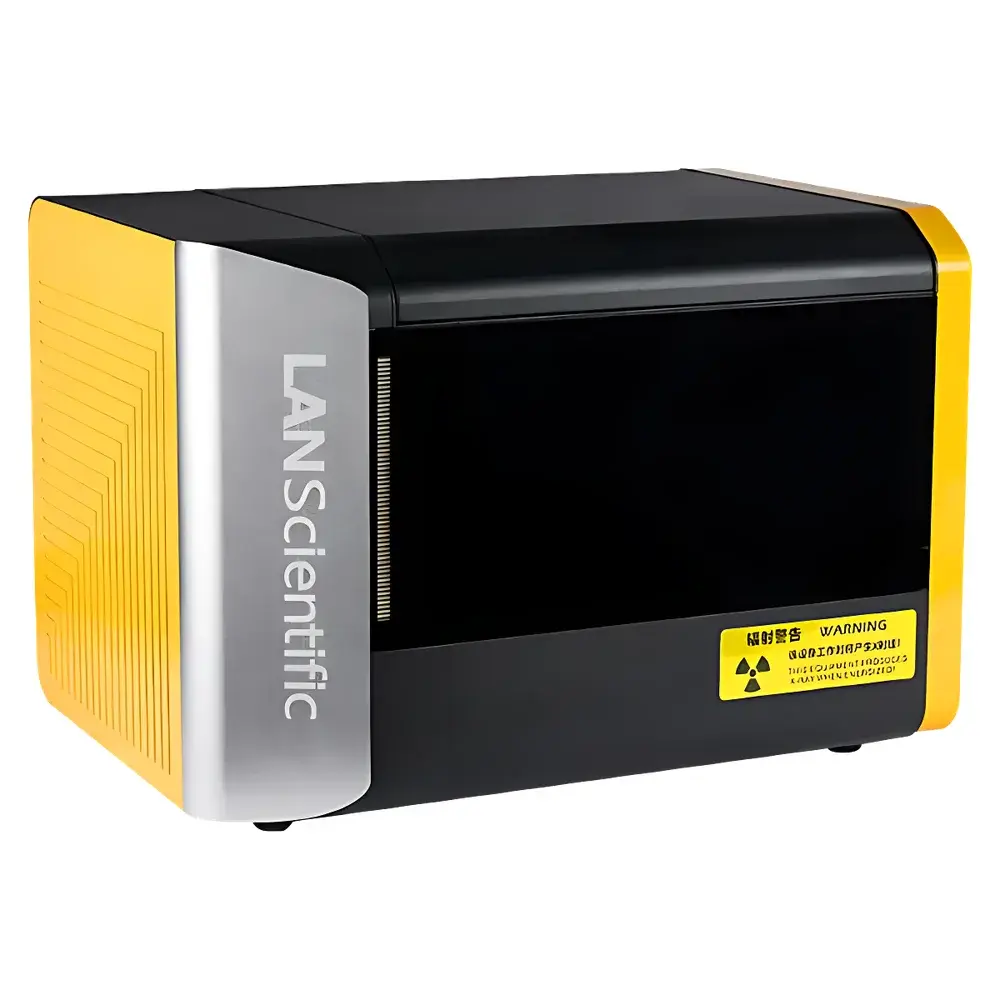
LANScientific ScopeX 980Quartz Quartz Sand-Specific Energy Dispersive X-Ray Fluorescence Spectrometer
| Brand | LANScientific |
|---|---|
| Origin | Jiangsu, China |
| Manufacturer Type | Manufacturer |
| Origin Category | Domestic |
| Model | ScopeX 980Quartz |
| Configuration | Benchtop/Floor-standing |
| Instrument Type | Conventional ED-XRF |
| Application Scope | General-purpose with Quartz Sand Optimization |
| Elemental Analysis Range | Na (11) to U (92) |
| Detection Limit | 1 ppm (for matrix-matched standards) |
| Energy Resolution | <125 eV at Mn Kα |
| Repeatability | ≤0.1% RSD (for major oxides at ≥1 wt%) |
| Detector | Peltier-cooled Silicon Drift Detector (SDD) |
Overview
The LANScientific ScopeX 980Quartz is a benchtop/floor-standing energy dispersive X-ray fluorescence (ED-XRF) spectrometer engineered specifically for high-precision quantitative and semi-quantitative analysis of quartz sand and silica-rich mineral matrices. Unlike general-purpose ED-XRF systems, the ScopeX 980Quartz integrates hardware and software optimizations tailored to the compositional challenges of quartz-based materials — notably low-Z element sensitivity (Na, Mg, Al, Si, P, S), high SiO2 dominance (>99% in high-purity grades), and trace-level transition metal contaminants (Fe, Ti, Mn, Cr, Ni, Mo). Its measurement principle relies on primary X-ray excitation of sample atoms, followed by detection of characteristic secondary (fluorescent) X-rays emitted during electron shell relaxation. The instrument employs a low-power, air-cooled X-ray tube optimized for light-element excitation, coupled with a high-count-rate Peltier-cooled silicon drift detector (SDD) to ensure excellent peak-to-background ratio and spectral fidelity across the full Na–U range.
Key Features
- Optimized vacuum path and automated vacuum control system: Minimizes atmospheric absorption of low-energy X-rays (<1 keV), enabling reliable quantification of Na, Mg, Al, Si, P, and S — critical for distinguishing quartz purity grades (e.g., 99.5% vs. 99.99% SiO2).
- Peltier-cooled SDD detector: Eliminates dependence on liquid nitrogen; maintains stable resolution (<125 eV at Mn Kα) and long-term spectral reproducibility without cryogenic infrastructure.
- Dedicated quartz sand calibration suite: Pre-loaded fundamental parameter (FP) and empirical calibrations for SiO2, Fe2O3, Al2O3, CaO, MgO, TiO2, MnO, P2O5, and K2O — validated against certified reference materials (CRMs) including NIST SRM 1633b (Coal Fly Ash) and GBW(E) 070082 (Silica Sand).
- Repeatability performance: ≤0.1% relative standard deviation (RSD) for major oxide concentrations ≥1 wt%, verified under GLP-aligned measurement protocols (n ≥ 10 replicates, pressed pellet preparation).
- Automated sample chamber sealing and pressure monitoring: Ensures consistent vacuum integrity across analytical sessions, reducing operator variability and supporting audit-ready operation.
Sample Compatibility & Compliance
The ScopeX 980Quartz accepts solid samples in powder, pressed pellet, or fused bead formats — with optimized workflows for quartz sand requiring minimal preparation (e.g., drying, homogenization, and 20-ton pressing). It complies with ISO 21043:2021 (XRF — General requirements for wavelength- and energy-dispersive instruments), ASTM E1621–22 (Standard Guide for XRF Analysis of Ceramic Whiteware Materials), and supports documentation traceability aligned with ISO/IEC 17025:2017 Clause 7.7 (Results reporting). While not FDA 21 CFR Part 11–certified out-of-the-box, its audit trail functionality (user login, method versioning, raw spectrum archiving) enables configuration for GMP/GLP environments upon customer-defined validation protocols.
Software & Data Management
The bundled QuantStudio™ XRF software provides intuitive method setup, spectrum visualization, peak deconvolution, and oxide-based quantification using matrix correction algorithms. All reports are exportable in user-customizable templates — supporting embedded company logos, spectral overlays, uncertainty estimates (k=2), and metadata fields (sample ID, operator, date/time, instrument conditions). Export formats include Excel (.xlsx), PDF/A-1b (archival compliant), and CSV for LIMS integration. Raw spectral data (.rtd) is stored in vendor-neutral format, ensuring long-term accessibility independent of software version.
Applications
- Quartz sand grading: Rapid discrimination between common quartz (98–99% SiO2), refined quartz (99.5–99.8%), and high-purity quartz (>99.99%) based on Fe, Al, Ti, and alkali metal content.
- Process control in silica mining and purification: On-site monitoring of flotation tailings, acid-leaching efficiency, and thermal treatment outcomes.
- Raw material certification for fused quartz crucibles, optical-grade silica, and semiconductor-grade quartz.
- Geochemical exploration: Field-deployable screening of quartz vein mineralization and associated pathfinder elements (e.g., As, Sb, W).
- Academic research: Teaching XRF fundamentals, method development for low-Z analysis, and inter-laboratory comparison studies.
FAQ
Does the ScopeX 980Quartz require liquid nitrogen cooling?
No. It utilizes a thermoelectrically cooled silicon drift detector (SDD), eliminating cryogen handling and associated operational overhead.
Can it quantify sulfur (S) and phosphorus (P) in quartz at sub-100 ppm levels?
Yes — when operated under vacuum and using optimized acquisition parameters (e.g., 50 kV, 1 mA, 100 s live time), typical detection limits for S and P are 5–10 ppm in SiO2-dominant matrices.
Is method transfer possible between different ScopeX 980Quartz units?
Yes. Calibration files, spectral libraries, and measurement protocols are fully portable via USB or network share, provided instrument configurations (tube anode, collimator, detector geometry) are identical.
What sample preparation is recommended for highest precision?
For routine quality control: dry, homogenize, and press into 32-mm pellets at ≥20 tons pressure using boric acid binder. For research-grade accuracy: lithium tetraborate fusion is supported with optional accessory kit.
Does the system support regulatory compliance for QC labs?
It provides foundational features for ISO/IEC 17025 and GMP alignment — including electronic signatures, audit trails, and calibration history logging — though formal validation must be performed per site-specific SOPs.



