
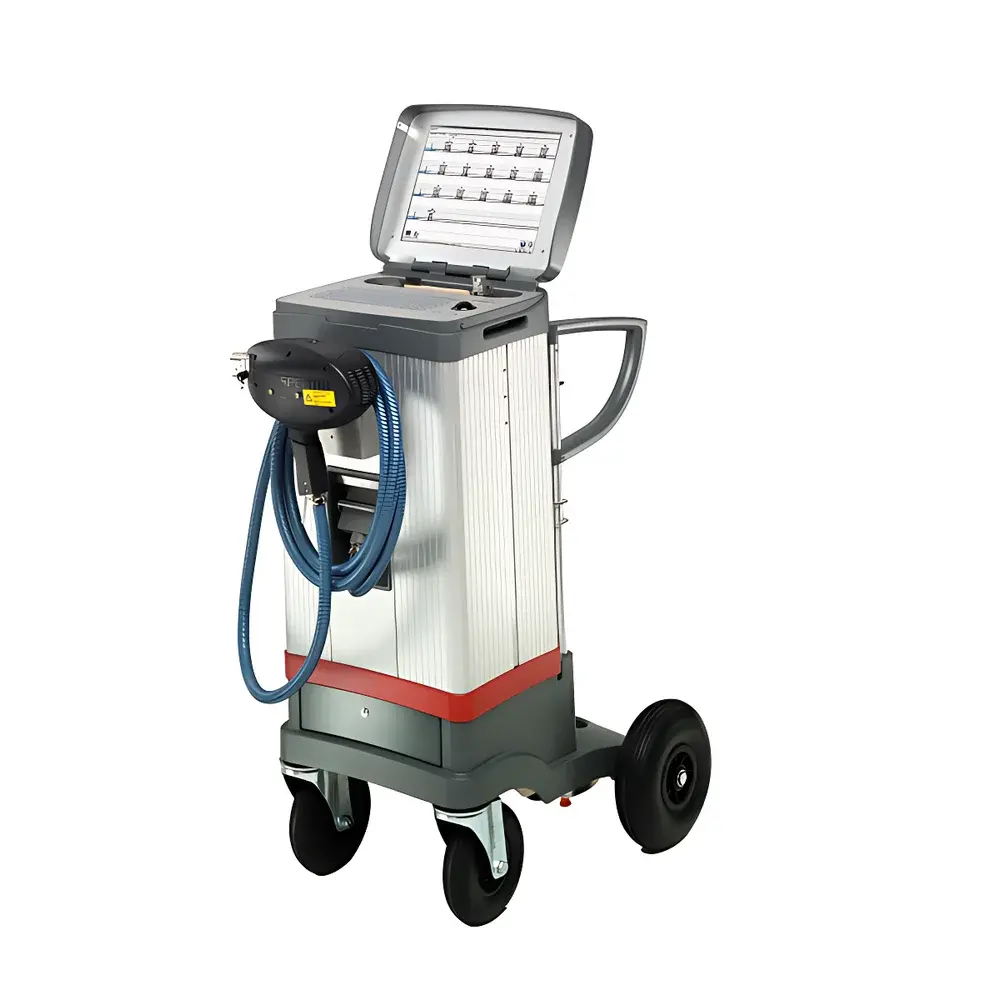
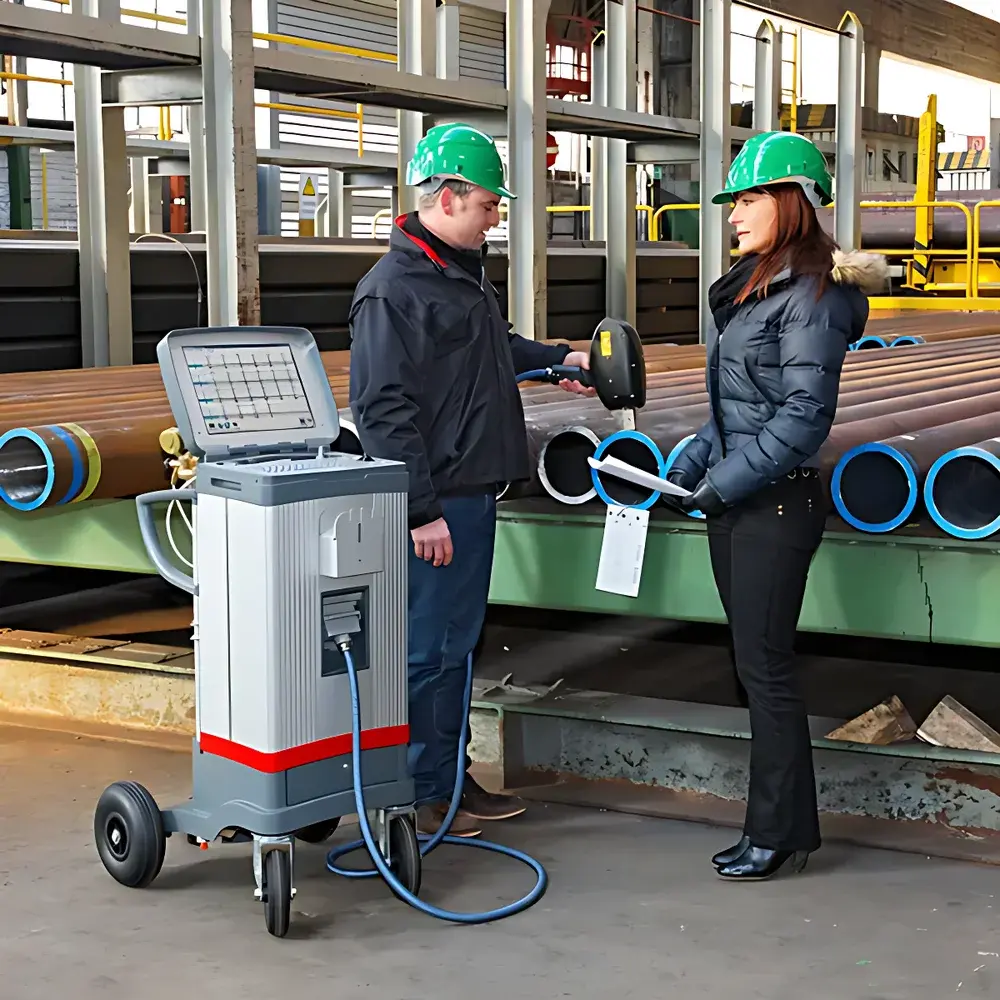
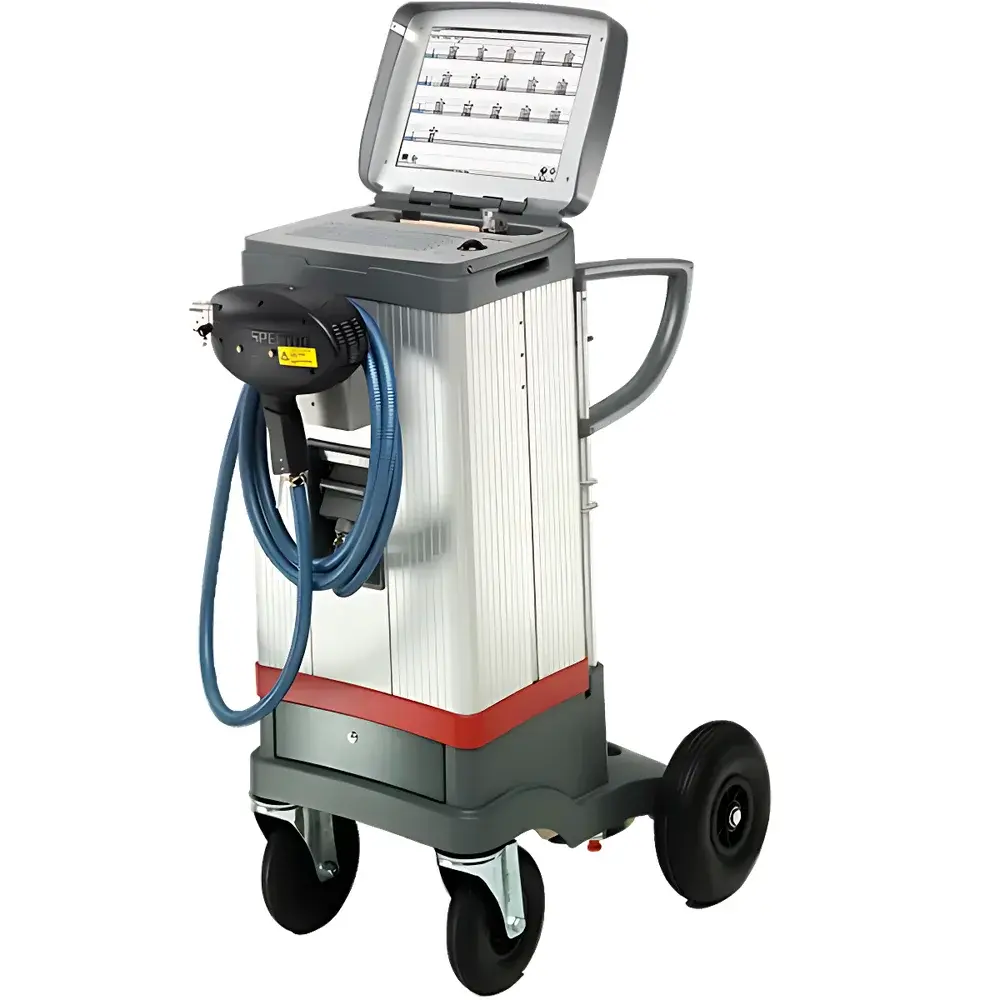
SPECTRO SPECTROTEST Portable Arc/Spark Optical Emission Spectrometer
| Brand | SPECTRO |
|---|---|
| Origin | Germany |
| Instrument Type | Portable/Mobile |
| Excitation Method | Spark & Arc |
| Detector Type | CCD (Charge-Coupled Device) |
| Focal Length | 400 mm |
| Grating Groove Density | 3600 lines/mm |
| Wavelength Range | 174–670 nm |
| Number of Channels | Unlimited |
| Power Supply | Rechargeable Battery (up to 800 measurements per charge) |
Overview
The SPECTRO SPECTROTEST is a field-deployable, battery-powered arc/spark optical emission spectrometer (OES) engineered for high-precision elemental analysis of metallic materials in production, fabrication, scrap sorting, and quality assurance environments. It operates on the fundamental principle of atomic emission spectroscopy: when a metal sample is subjected to controlled electrical discharge (spark or arc), atoms are excited and emit characteristic wavelengths of light. These emissions are dispersed via a high-resolution Czerny-Turner optical system with a 400 mm focal length and 3600 lines/mm holographic grating, then detected by a thermoelectrically cooled CCD array. The resulting spectral intensity profiles are quantitatively correlated to elemental concentrations using calibrated reference materials and advanced multivariate regression algorithms. Designed for rugged outdoor and shop-floor use, the SPECTROTEST delivers laboratory-grade accuracy without requiring fixed infrastructure—making it indispensable for rapid material identification, positive material identification (PMI), alloy grade verification, and compliance screening against ASTM E1086, ISO 11577, and EN 10052 standards.
Key Features
- Integrated arc/spark excitation capability with tool-free, ergonomic trigger gun—enabling seamless switching between modes for optimal performance across ferrous and non-ferrous matrices;
- iCAL2.0 intelligent calibration technology: single-reference standardization in under 5 minutes at startup, compensating for thermal drift and ambient temperature fluctuations (±0.5 °C stability maintained from 10–40 °C operating range);
- UV-enhanced excitation gun with integrated vacuum UV optics (down to 174 nm), enabling reliable detection of critical interstitial elements including C, P, S, N, Li, and Na—essential for low-alloy steels, stainless grades, and duplex alloys;
- Robust, IP54-rated portable chassis with shock-absorbing housing, drop-tested to MIL-STD-810G; total system weight < 15 kg (including battery and gun);
- Rechargeable lithium-ion battery supporting up to 800 spark/arc analyses per full charge, with hot-swap capability and real-time state-of-charge monitoring;
- Full-spectrum CCD detection (174–670 nm) with no physical channel limitations—enabling post-acquisition reprocessing, method expansion, and retrospective element re-quantification without hardware modification.
Sample Compatibility & Compliance
The SPECTROTEST accommodates flat, curved, and irregularly shaped conductive metallic samples—including castings, forgings, welds, pipes, plates, and scrap fragments—with minimal surface preparation (grinding or milling recommended per ASTM E407). It supports analysis of all major industrial metals: carbon steels, stainless steels (austenitic, ferritic, martensitic, duplex), aluminum alloys, copper alloys, nickel-based superalloys, titanium, and magnesium. All analytical methods comply with ISO/IEC 17025 requirements for testing laboratories and support audit-ready documentation per FDA 21 CFR Part 11 (with optional electronic signature and audit trail module). Routine operation meets GLP/GMP traceability standards through embedded instrument logs, user authentication, and secure data export (CSV, XML, SPC-compatible formats).
Software & Data Management
Controlled via the SPECTRO Analytical Software Suite (SAS v5.x), the SPECTROTEST provides intuitive touchscreen interface, customizable reporting templates, and automated pass/fail decision logic based on user-defined specification limits. Data management includes local storage (32 GB internal SSD), encrypted USB export, and optional network integration via TCP/IP Ethernet or Wi-Fi (IEEE 802.11ac). The automation interface supports remote command execution (SCPI-compliant), PLC synchronization, and integration into LIMS or MES platforms. All spectral raw data, calibration records, and measurement metadata are stored with immutable timestamps and operator ID—ensuring full chain-of-custody integrity for regulatory submissions.
Applications
- Rapid PMI verification in piping, pressure vessels, and structural components prior to welding or commissioning (per ASME B31.3, API RP 578);
- Scrap yard sorting and recycling stream optimization using real-time alloy classification (e.g., distinguishing 304 vs. 316 stainless, Al 6061 vs. 7075);
- In-process control during foundry operations—monitoring melt chemistry for C, Si, Mn, Cr, Ni, Mo, Cu, and trace elements;
- Failure analysis labs performing root cause investigation of corrosion, embrittlement, or fatigue-related defects;
- Third-party inspection agencies conducting field audits under ISO 17020 accreditation scope;
- Research facilities evaluating novel alloy development where portability enables in-situ testing across multiple pilot-scale furnaces or rolling mills.
FAQ
What is the minimum detectable concentration for carbon in low-alloy steel using spark mode?
Typical LOD is 15 ppm (3σ) under optimized conditions; certified reference materials (CRMs) such as NIST SRM 2152 and BAM CRM 182 are used for validation.
Can the SPECTROTEST analyze coated or painted metals?
Surface coatings must be mechanically removed prior to analysis; thin oxide layers (< 1 µm) may be ablated during initial spark pre-burn but are not recommended for quantitative work.
Is external argon gas required for operation?
No—integrated argon purge system with internal cylinder (20 L, 50 bar) enables > 200 measurements without refilling; optional external tank connection available.
How does iCAL2.0 differ from conventional multi-standard calibration?
iCAL2.0 uses a physics-based correction model trained on temperature-dependent spectral shifts, eliminating the need for daily recalibration with multiple standards while maintaining long-term accuracy within ±0.02% RSD over 8-hour shifts.
Does the system support regulatory audit trails for pharmaceutical or nuclear applications?
Yes—when configured with SAS Audit Trail Module, it complies with 21 CFR Part 11, EU Annex 11, and IEC 62304 requirements, including electronic signatures, role-based access control, and tamper-evident log archiving.




